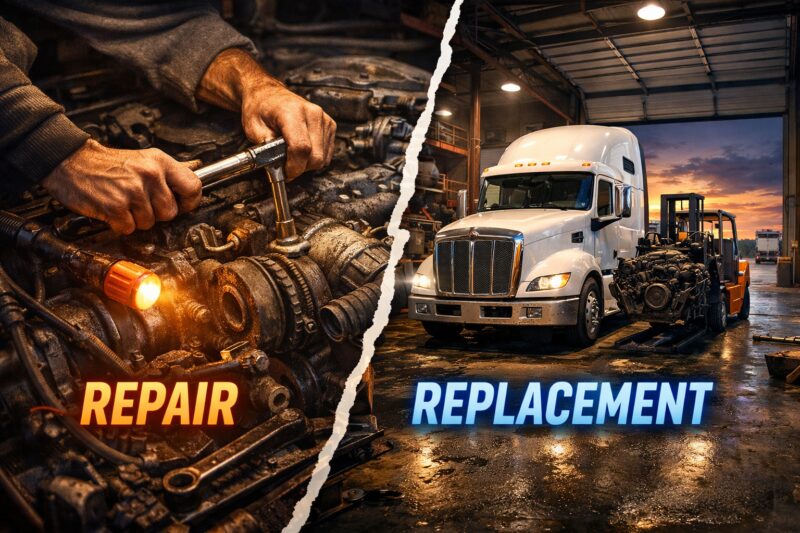
When diesel systems start failing, the safest money choice is not “repair versus replacement” by sticker price. It is matching the decision to a confirmed root cause, the risk of repeat failures, and the real downtime cost. Owners often ask diesel repair vs replacement when symptoms look similar but the underlying damage differs. Diagnostics, emissions-related parts, and parts availability can shift the math year to year in 2026. This article covers diesel engines in trucks, generators, and industrial equipment, focusing on decision-making, not just troubleshooting.
You will get a diagnostic-first checklist that turns symptoms into a decision-ready scope. Then you’ll see how to compare costs fairly using total ownership, including integration work and reliability risk. Finally, you’ll use a practical framework to choose repair or replacement with evidence in hand. You’ll also learn the most common mistakes that lead to repeat labor and avoidable downtime.
Use a diagnostic-first diesel decision to stop guessing before you price the fix
The right choice depends on confirmed failure mode, not on the loudest symptom. A low quote can still be wrong if it targets the visible part while the true cause lives upstream. That is why a diagnostic-first diesel decision is your first money-saving step.
Symptoms can mislead because diesel systems share pressures, sensors, and control logic. For example, a rail pressure fault can stem from a leaking line, a worn high-pressure component, or even contamination in the fuel supply. If the shop prices only the rail sensor because it codes, the underlying problem may return fast. Instead, ask for the evidence that ties the code to a physical cause.
How it works is simple in concept. The shop gathers codes and measured data, then connects them to components that likely failed. Visual checks for leaks and wear are also part of the chain. When relevant, additional tests like compression checks or leak-down testing can clarify whether internal damage happened. Oil analysis can also reveal fuel dilution or metal contamination after certain failure events.
Practical use means you request a decision-ready scope, not just a component list. The goal is to separate implicated parts from incidental ones. You want a short explanation of why each part is included. You also want clear boundaries on what remains excluded and why.
Tradeoffs still exist. Some faults are intermittent, especially those driven by heat, vibration, or load. A one-day test can understate risk. Therefore, ask for load-based confirmation or trend data when the complaint only shows under driving or operating load.
Edge case: a “simple” sensor replacement can hide contamination damage. If a previous failure allowed overheating or dirty fuel to circulate, later parts can fail even after the correct sensor swap. A common mistake is accepting a repair scope guidance that lists parts but not root cause. Instead, demand the causal story tied to test results.
In real shops, this decision quality depends on process. Good technicians document what they measured and what they ruled out. They then map those findings to the work they propose. If your shop avoids that conversation, it is harder to trust any repair or replacement quote.
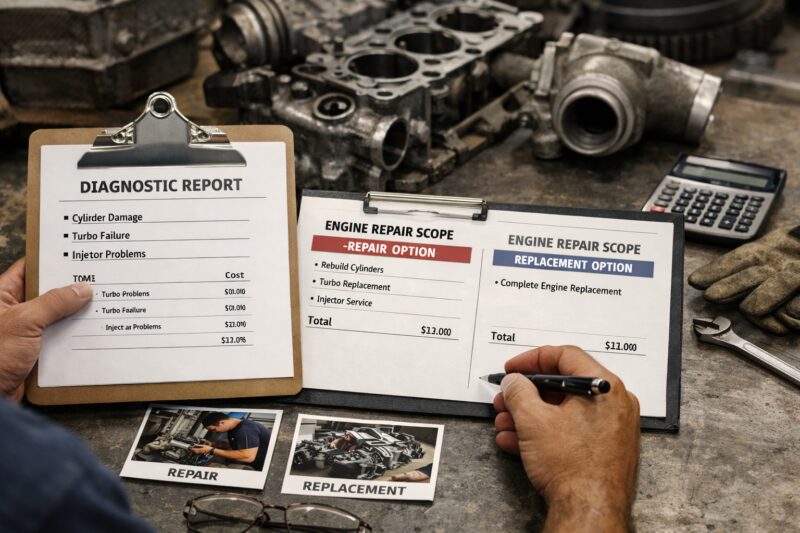
Translate diagnosis into a decision-ready engine repair scope that matches the real damage
Diagnosis only helps when it becomes a written engine repair scope you can compare. Without that, “repair” and “replacement” estimates can’t be fairly weighed. Therefore, you need engine repair scope guidance that ties each task to the confirmed failure.
How it works in practice is that every major system gets a status. Fuel supply, high-pressure generation, air induction, turbo control, sensors, and aftertreatment components each get a “confirmed” or “not supported” call. Then the scope lists what will be replaced, cleaned, calibrated, or inspected. When contamination is suspected, the scope should include cleaning actions and checks for the source.
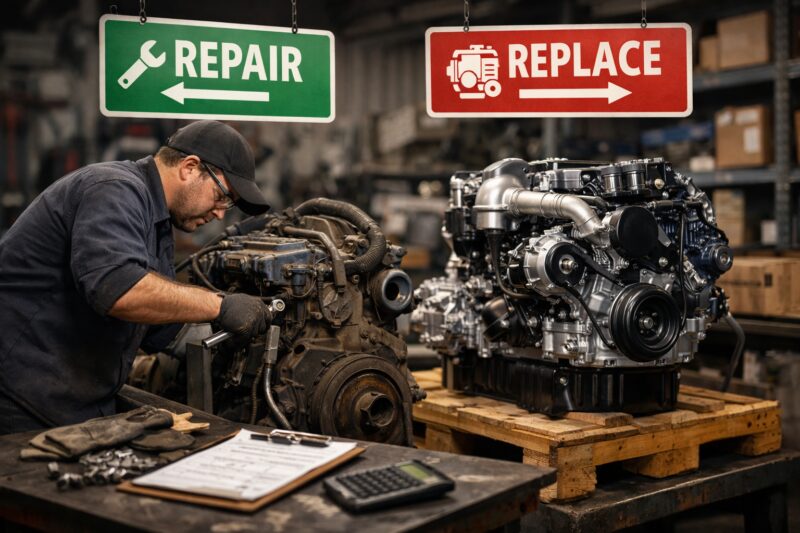
Why it matters is straightforward. Two shops can quote different totals, yet both can claim they’re fixing “the same problem.” In reality, one shop may correct root cause and prevent recurrence. The other may only swap failed parts and leave the upstream driver intact. Your decision hinges on which scope reflects physics, not just parts.
Practical application starts with your questions. What exact tests supported the diagnosis? What measurements confirm rail issues or air control problems? What will the shop recheck after work is complete? You also want clarity on whether the scope includes preventative actions or only component replacement.
Tradeoffs appear when evidence is incomplete. If the equipment has unknown maintenance history, you may need broader inspection to find hidden damage. For example, soot intrusion and overheating can damage more than one component family. A repair can still make sense, but the scope must expand to reduce recurrence risk.
A common misconception is that the cheapest scope is always the best value. However, a narrow scope can turn into a repeating-expense cycle. Another nuance: intermittent faults often need trend confirmation. If your symptoms only show under load, request test runs under representative operating conditions.
Real-world scenario: a generator shows shutdown after high load. Codes point to an actuator fault. A broader scope may reveal sticky contamination from fuel polishing neglect. If the shop only replaces the actuator, shutdown can return as soon as load repeats. With proper scope, the repair stops being a band-aid.
Compare total ownership repair planning costs, not just labor and parts
Repair is not automatically cheaper than replacement, even when the repair invoice is smaller. You need total ownership repair planning that includes downtime and reliability. In many cases, the “best” option is the one that returns the asset to reliable service with the fewest future surprises.
Direct repair costs usually include labor, parts, and fluids. However, total cost also includes downtime for diagnosis, parts delivery, and rework. If you tow equipment or rent a replacement unit, those costs matter too. After the repair, you may need monitoring steps, such as updated oil checks or confirmation test runs.
Replacement economics can look steep, but you must compare like with like. A replacement quote should include the engine cost or major component package, installation labor, and integration work. Integration can include controls compatibility, sensor setup, and exhaust or aftertreatment interfaces. It also can include commissioning and verification so the control system learns the configuration.
To compare across time, estimate expected remaining life or overhaul horizon. Do not compare only invoices from this week. Instead, discuss what the shop expects the asset to do after repair versus after replacement, given the confirmed cause. If the root cause is addressed, a repair can buy years. If the cause is unknown or systemic, replacement may prevent recurring interruptions.
Risk-adjusted thinking improves your accuracy. Ask what probability of repeat failures exists after repair. Also ask what risks come with replacement integration. For example, mismatched configuration or incomplete aftertreatment setup can trigger repeat faults, even if the new engine is healthy.
Warranty terms change the math too. If warranties exist, you need what’s covered and what’s excluded. If prior work voids coverage, factor that risk into your decision. A deeper insight is that warranty exclusions can mirror root-cause uncertainty. If the shop cannot guarantee root cause, the warranty may offer less real protection.
Repair diesel components when the failure is localized and the root cause is controllable
Repair is usually the stronger choice when damage is localized and diagnosis shows a controllable root cause. You should consider repair when the remaining useful life is likely and the corrected cause reduces recurrence. This is where many diesel repairs win, if the scope is evidence-based.
Localized failure scenarios often include fuel system problems with a clear source. For example, a leaking injector line, a faulty serviceable injector component, or a pressure control actuator with confirmed mechanical wear can fit a repair approach. Turbo-related issues can also be repairable when wear is limited and measured clearances remain within usable ranges. Sensor and actuator replacements can be reasonable too when diagnostics confirm the physical fault.
Aftertreatment-related repairs can be repair-friendly, but only when diagnosis supports it. For instance, EGR or DPF-related component service should follow tests that confirm the failing component, not assumptions from codes alone. Diesel exhaust systems can fail downstream after upstream faults, so you must confirm the causal chain.
Repair limits matter because repeated-expense cycles happen when root cause isn’t corrected. Therefore, a good shop includes preventative actions when needed. If contamination caused injector or high-pressure problems, you should address contamination pathways. That might include fuel filtration updates and checks of tanks, suction lines, and supply practices.
Workmanship and parts quality also affect outcomes. OEM parts can matter for fitment and calibration requirements, especially for sensors, actuators, and injectors. If equivalent parts are used, ask for confirmation of compatibility and verification steps. Calibration after service is also critical. For many diesel systems, “it starts” is not the same as “it’s correct.”
Common mistake: treating “repair” as a single action. Real-world repair might require cleaning, calibration, and verification, not only part replacement. Edge case: if the failure allowed overheating or metal debris to circulate, the “localized” part may not be the only damaged component. In that case, repair scope must expand or replacement becomes safer.
Replacement becomes the safer and more rational move when damage is widespread or likely to return. It also makes sense when evidence suggests hidden damage beyond the initially blamed component. When uncertainty is high, replacement can reduce the number of times you pay for the same failure story.
Replacement triggers often include multiple failed subsystems that share an underlying cause. For example, if fuel contamination shows up repeatedly across injectors, pressure components, and related valves, you might be chasing symptoms. Another trigger is evidence of widespread wear in rotating assemblies or structural issues. In those cases, repairing one part can leave other damaged areas to fail next.
Replacement “types” also influence the decision. Full engine replacement is a complete reset. Long block replacement can reduce some work while changing the heart of the assembly. A major rebuild option can be a middle ground, but only if core condition is known and tolerances are confirmed. Your choice should reflect the evidence from tear-down or inspection, not optimism.
Operational realities matter. Fleet uptime and mission-critical use raise the cost of repeated service interruptions. For standby power, one additional failure event can cost more than the initial replacement premium. In addition, parts availability and lead times can change in 2026, making replacement scheduling more predictable than repeated repair ordering.
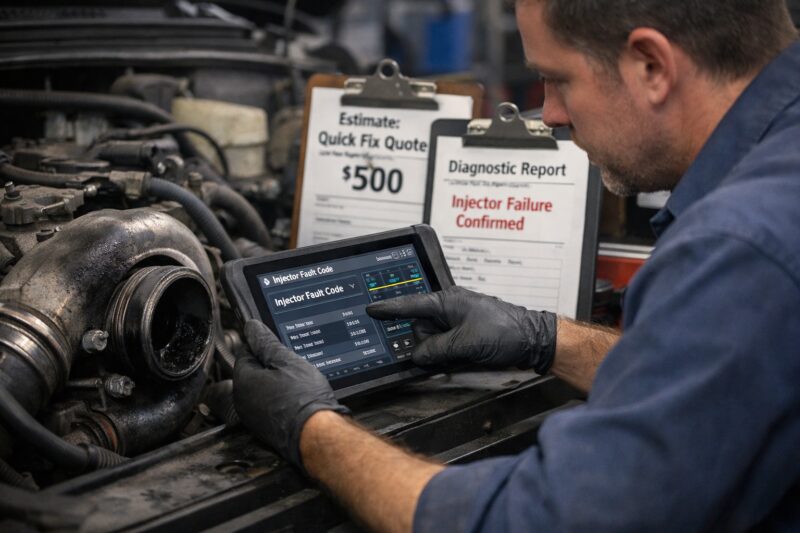
Integration risks can favor or oppose replacement. Even with a healthy engine, compatibility with existing controls and wiring must be addressed. Exhaust and aftertreatment interfaces need correct connections and configuration. Diagnostic tool relearning or setup steps may also be required so the system reads correct sensors and operates within intended strategy.
A deeper insight is how to judge replacement readiness when maintenance history is incomplete. Ask what documentation supports the replacement unit’s condition. Demand proof of tested compression or baseline measurements if available. Also ask how the shop will verify the full system after installation, not just the first start.
Apply a decision framework you can finish in one afternoon without getting upsold
You can make a solid choice using a short, repeatable decision framework. Start with evidence, then compare scope, expected life, and recurrence risk. This approach helps you avoid urgency pressure and reduces the chance of buying the wrong fix.
Step-by-step, first gather diagnostic evidence. Collect codes, test results, and any measured rail, air, or oil data used for the diagnosis. Next, estimate repair scope and replacement scope using the same “implicated parts” logic. Then compare life expectancy and reliability risk. Finally, decide and plan next steps with documentation in hand.
You should use stop points that force clarity. Stop when you do not have written scope, a parts list, and confirmation of root cause. Stop if the shop cannot explain why certain tasks are included. Stop if they only cite symptoms instead of measurements. A good shop can walk you through the chain from evidence to work.
To make tradeoffs easier, consider a scoring approach. Score each option by safety risk, likelihood of recurrence, downtime severity, and total cost to reliable operation. Use your best judgment where exact probability is unknown. The point is to create consistent comparisons across options.
Decision thresholds should be practical, not rigid. For example, replacement can be justified when multiple independent red flags appear. Those red flags might include confirmed systemic contamination plus evidence of internal wear. Or they might be repeated failures after prior “repairs” that did not correct root cause. In those cases, repair may keep paying the same tax.
A deeper insight is how to avoid confirmation bias. If estimates conflict, ask for alternative interpretations and the tests supporting each view. Then ask what additional test would confirm which view is correct. When the shop resists a second opinion, you risk inheriting their uncertainty as your cost.
Recognize common mistakes and misconceptions that create bad outcomes in diesel repair
Bad outcomes usually come from incomplete evidence, not from diesel mechanics being impossible to fix. One of the biggest misconceptions is that a lower repair estimate is automatically the best choice. That logic fails when the quote scope omits root-cause work.
Many bad repairs start with symptom-based quotes. If you see recurring smoke, limp mode, or pressure-related complaints, a proper diagnosis matters more than quick parts swaps. Therefore, ask whether the shop confirmed the physical cause. Also ask what they did to confirm the cause after replacement.
Downtime and logistics costs are often ignored. Parts lead times can affect when you can operate again. Delivery delays can also create scheduling problems for fleets and industrial shifts. That reality can make a cheaper repair feel expensive once you add transport, towing, and lost production.
Maintenance history changes the reliability outlook. Neglected oil change intervals can accelerate wear and damage lubrication delivery. Poor fuel quality can increase contamination risk. Cooling system neglect can contribute to overheating and hidden damage. When you ignore history, you can under-forecast recurrence risk after repair.
The “while-you’re-in-there” trap is another common mistake. Some shops recommend extra work without evidence tied to root cause. A better approach is to request repair checklist for fewer surprises. Ask which items are necessary because they are implicated, and which are optional because they are merely “possible.” Then review the evidence each item is based on.
Edge case: after one failure, debris may contaminate more components than expected. A shop that does not address contamination pathways can recreate failures. A common misconception is that replacing only the first-failing part ends the story. In reality, the system often needs a broader clean-and-verify approach.
Consider realistic alternatives to decide between repair and replacement with more accuracy
“Repair or replace” is not always the only comparison you should make. Several realistic alternatives can change cost structure and reliability. These options also help when you have partial evidence or uncertain core condition.
Common alternatives include partial repairs, partial overhaul, long-block replacement, and full engine replacement. Partial repair focuses on the confirmed implicated components. Partial overhaul can rebuild specific internal systems while still addressing root cause. Long-block replacement changes most of the engine’s internal core while keeping some external items, if compatibility works.
Each option affects cost, downtime, and risk. A long-block or major rebuild can reduce the risk of repeat failures when internal wear is likely. However, it can still depend on core condition. A full engine replacement can reduce uncertainty but increases integration and commissioning work.
How to choose among these alternatives is evidence-driven. Use diagnosis to decide what you know and what you do not. If you have confirmed localized wear with healthy adjacent parts, partial overhaul might be enough. If you have evidence of widespread damage or contamination migration, full replacement can be safer.
To avoid surprise costs, ask for quote details. Request labor lines tied to outcomes and test steps after work. Ask how the shop verifies success, not just installation completion. Ask what warranty or guarantee applies to each category of work, and what the exclusions are.
rebuild is not always a true middle ground. If core damage stems from contamination or scoring beyond salvage, rebuild can become risky. If tolerances are scarce or documentation is missing, rebuild may not reduce uncertainty enough. In those cases, replacement can be the more reliable plan.
Handle edge cases when signals conflict, parts are scarce, or documentation is incomplete
Conflicting signals are common in diesel repair decisions. You might get a low estimate that looks tempting, yet other evidence suggests systemic wear. Or you might get a high replacement quote when damage is clearly localized. You handle these edge cases by demanding test-backed scope boundaries.
When repair cost estimates look low but wear signals are strong, you need deeper confirmation. Ask which tests would rule out internal damage. Ask whether oil analysis shows metals that point to broader wear. Conversely, when replacement costs look high but damage appears localized, ask why the scope must be so broad. Look for gaps in the repair scope evidence.
Core availability and parts lead times can also drive outcomes. If supply constraints make replacement impractical, you may choose repair but sequence it strategically. That means prioritizing root-cause correction first, then planning the remaining work once parts arrive. In 2026, this supply reality can vary by region and component category.
Warranty overlap with previous work matters in edge cases. If the engine or components were already replaced, you need to understand what warranty covers and what it excludes. Also ask for documentation from earlier repairs. Prior work can make some steps unsafe to repeat without more inspection.
Engine life versus equipment life is another nuance. Replacing the engine may not solve system wear in mounts, alignment, cooling components, or lubrication delivery paths. If those supports are worn, the replacement can fail too. Therefore, your scope should consider the equipment-level contributors, not only engine internals.
avoid downgrade risks during replacement configuration. Choosing a less compatible configuration can trigger recurring diagnostic faults. That might happen if sensor types, calibration data, or aftertreatment interfacing does not match. When documentation is incomplete, ask the shop how they will confirm compatibility and how they will verify sensor readings after commissioning.
Frequently asked diesel repair vs replacement questions that affect real decisions
Is a diesel engine repair worth it compared to replacement?
Repair is often worth it when diagnostics confirm a localized failure and the root cause is addressed. The decision depends on recurrence risk, expected remaining life, and downtime cost. If a repair scope targets only the symptom, replacement may become the safer value.
How do I know if my issue is localized or widespread damage?
Look beyond codes and ask for evidence from tests that show what is implicated. Load-based testing, oil analysis, and checks for contamination pathways can reveal hidden damage. If failures involve multiple subsystems with shared causes, the damage often is not localized.
What questions should I ask a diesel shop before approving repair or replacement?
Ask for a written scope tied to confirmed test results and request the exact parts plan. Also ask how they confirm root cause before work starts and how they verify success afterward. Finally, review warranty terms and exclusions so you understand who bears risk if recurrence happens.
Should I replace injectors or the whole fuel system when problems keep coming back?
If injector problems repeat, the shop should prove whether contamination or supply-system faults cause the cycle. Replacing injectors without correcting fuel filtration and delivery issues can lead to the same failure again. Use evidence like contamination clues and supply pressure checks to decide scope.
What is the most important factor in diesel repair vs replacement for fleets?
For fleets, uptime risk often matters as much as the invoice total. You should compare total cost to reliable operation, including downtime severity and parts logistics. Maintenance history and warranty coverage also strongly affect expected reliability.
Does aftertreatment damage change the repair vs replacement decision?
Aftertreatment faults can change the decision because they may reflect upstream issues, not just a single failed part. A DPF or EGR-related repair should follow diagnosis that confirms the component and the causal chain. If aftertreatment damage repeats, replacement may reduce uncertainty.
How does my maintenance history affect whether I should repair or replace?
Maintenance history affects remaining life estimates and recurrence probability. Consistent oil quality and interval compliance support a repair path when wear is limited. Poor oil and fuel practices raise hidden-wear risk, which can tilt the math toward replacement.
What should be included in a replacement quote to avoid surprise costs?
A replacement quote should list integration items like sensor compatibility, wiring harness fit, and aftertreatment interfacing tasks. It should also include commissioning and calibration or diagnostic verification steps. Review exclusions so you know what is not covered.
Can I make the decision using only diagnostic trouble codes?
Codes alone are usually not enough. They point to a control symptom, but they do not always confirm physical damage or contamination sources. You need measured data and visual or mechanical checks to separate cause from effect.
If two estimates disagree, how should I evaluate which one is more credible?
Compare evidence quality, scope boundaries, and how each option ties work to confirmed tests. Ask both shops what additional test would change their view. If one option cannot explain root cause or lacks verification steps, it is usually less credible.
Finish with documented next steps that protect your budget and your uptime
The safest way to choose between diesel repair and replacement is to base the decision on confirmed cause, recurrence risk, and total cost to reliable operation. Do not choose based on urgency or the lowest invoice. Instead, use diagnostic-first thinking and demand a decision-ready scope.
Next, compare repair versus replacement using clear scope and verification steps. You should review warranties, integration work, and the expected overhaul horizon. This is also where total ownership repair planning helps you include downtime and logistics reality in 2026.
Before you approve work, ask for test results, a written parts list, and the post-repair or post-install verification plan. That creates repair checklist for fewer surprises instead of relying on promises. If estimates still conflict, request a second interpretation backed by additional tests.
Finally, consult a trusted diesel specialist for an outcome-based recommendation matched to the equipment’s service demands. Compare at least one written, test-backed estimate and plan the work with verification in mind for 2026 conditions. This approach keeps your decision evidence-based and helps protect both reliability and operating budgets.
Updated September 2026