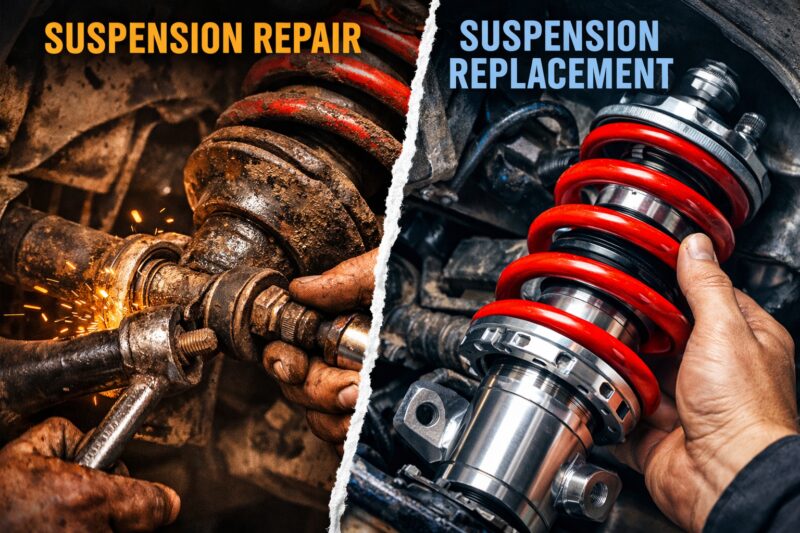
Deciding between suspension repair and replacement comes down to safety, geometry integrity, and whether the underlying cause is fixed. If the damage is localized and the rest of the suspension still controls movement correctly, repair is often the right call. If wear is widespread or a root cause will keep re-triggering failures, replacement usually wins for long-term peace of mind.
In this guide, we compare the idea behind suspension repair vs replacement so you can evaluate outcomes, not just costs. You will see how technicians inspect more than “what looks broken.” You will also learn what to ask for in estimates, and when alignment and related checks are non-negotiable. The best choice also depends on your use case, like a daily commute versus a performance or towing setup.
Finally, keep in mind that the right answer changes with vehicle type and wear pattern. A single failed component may still require broader work if nearby parts are degraded. Likewise, a suspension that “moves by hand” can still be unsafe if damping has faded.
How to judge whether repair is the right move for your suspension
Repair is usually the better choice when damage is localized and the suspension’s geometry and structural integrity are still sound. It also makes sense when the root cause is clear and fixable without replacing everything nearby. However, “repair” only stays safe when the technician verifies that the rest of the system still controls motion correctly.
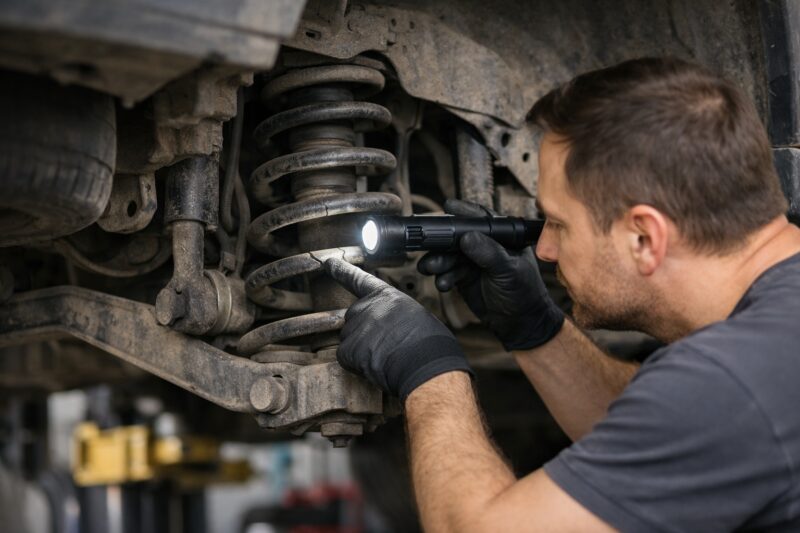
Start with practical inspection points. Look for torn boots, leaking shocks or struts, cracked or separated bushings, and play in control arm linkages. On many vehicles, you can see scuffed shafts on older dampers, or you can feel roughness in joints. You should also check top mounts and bearings where applicable, because worn mounts can cause noise and uneven ride height.
Next, use the nuance most guides skip. A component may move by hand and still be unsafe. That is because damping can fail internally without obvious external damage. A bad shock or strut can reduce rebound control and make tires lose contact sooner in corners or over bumps. Meanwhile, worn bushings can add compliance that feels like “roughness” even if damping leaks are not obvious.
Technicians should validate symptoms beyond eyeballing. They often compare left and right sides, then correlate noises and vibrations to specific corners. For example, a front clunk on braking may point to inner bushing wear or ball joint play, not just a tired strut. They may also check rebound feel, then confirm with measurements where required by the vehicle design.
Finally, keep one major caveat in mind. If the suspension was hit or bent, repairing individual parts may not restore safe geometry. In that scenario, the correct work can become a rebuild of the full corner or axle assembly. That is why shops should also check alignment changes and mounting surface condition before deciding on repair-only.
When replacement becomes the smarter long-term investment
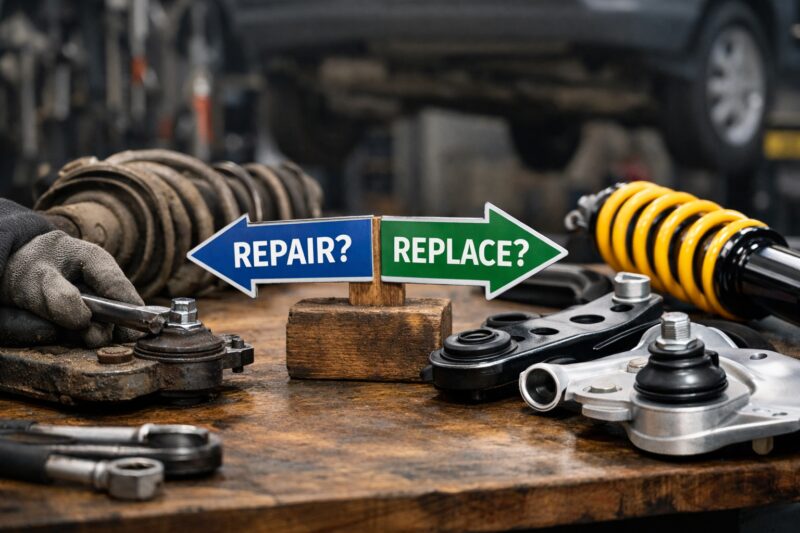
Replacement becomes the better long-term investment when multiple components are worn, safety-critical parts are degraded, or the underlying cause is likely to recur. Even if a single component failed first, adjacent wear can make quick repairs feel like temporary fixes. This is where many owners feel “stuck” between paying now or paying again soon.
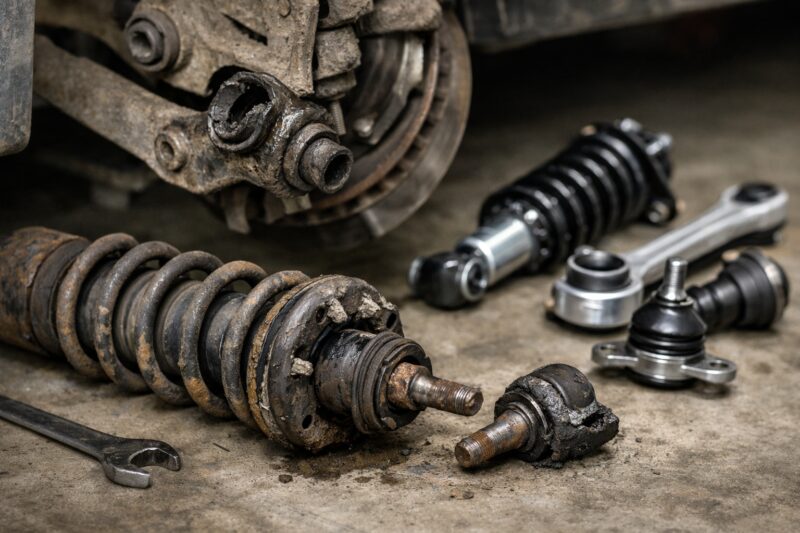
Common replacement triggers include severe corrosion on suspension hardware and mounting points. You should also expect replacement advice when bolts, studs, or threads are compromised. If shocks or struts are leaking on both sides, the system has likely lost consistent damping across the axle. Wide bushing deterioration can also justify replacing more than one component because the suspension will never feel “tight” again.
Replacement also helps when the shop repeatedly finds a pattern that suggests an underlying issue. For example, a short-lived failure after earlier repair often points to alignment problems or worn steering/suspension linkages. If the root cause is not corrected, new parts can fail again. Meanwhile, mismatched wear can create uneven handling, so “new on one side” may not restore predictable control.
Here is the deeper insight to consider. Replacing only the failed side can create a handling mismatch when the other side still has different spring rate behavior or damping strength. That mismatch can feel subtle at first, but it can change cornering balance and tire wear. Over time, it can also increase stress on mounts and linkages, raising the chance of comebacks.
Before committing, confirm the root cause is resolved. A shop should check alignment, inspect steering components, and consider any impact history. If the suspension geometry or attachment points are off, replacement may be wasted until those issues are corrected.
A decision path that leads to the right choice (repair vs replacement)
A solid decision path keeps you from guessing. First, identify the symptom and where it happens. Next, complete a full inspection, then confirm the root cause before you choose repair or replacement.
Then follow a practical step-by-step framework. Start with symptom identification, such as clunks, bounce, wandering, uneven tire wear, or steering vibration. Move to a full inspection of bushings, shocks or struts, mounts, and linkage play. After that, do a root-cause check, including any evidence of impact damage or persistent alignment drift. Only then should you compare estimate options.
To get a trustworthy recommendation, ask the estimator to be specific. They should provide itemized parts and labor. They should also list which components will be replaced versus reused. In addition, they should explain what measurements or checks supported the diagnosis, such as side-to-side differences or corner-specific wear. This is also where you can use your own questions to ask before service to push for evidence.
It helps to evaluate not only immediate symptoms, but expected life and comeback risk. Ask whether the problem tends to cluster on one axle or one corner. If it does, that often indicates a localized wear driver or a mounting issue. Also note whether your vehicle is a daily driver with steady mileage or a setup that sees heavy loads. Those factors change the risk of recurrence.
Borderline cases show why this framework matters. A single failed strut might still tip toward replacing both on the same axle if the other side is weak or leaking. A single torn bushing might justify a corner refresh if the control arm itself shows wear or if corrosion makes future service harder. In those cases, the right choice is the one that restores consistent control, not the one that replaces only the obvious part.
| Evidence you see | Repair-leaning trigger | Replacement-leaning trigger |
|---|---|---|
| Leaking shocks or struts | Localized failure with other side verified healthy | Leakage on both sides of an axle or uneven damping control |
| Bushing condition | One bushing degraded, surrounding components solid | Widespread bushing cracking or sloppy compliance across the corner |
| Joints and play | Play limited to a single joint that can be safely serviced | Wobble across multiple joints or joints with corrosion-driven failure risk |
| Impact or damage history | No evidence of bent arms, mounts, or knuckles | Compromised mounting points or geometry change suspected |
| Corrosion and hardware condition | Fasteners and threads serviceable | Corrosion severe enough to undermine future torque and fitment |
What to expect from a proper suspension repair process
A proper suspension repair process starts with diagnostic verification, then ends with checks that prevent “it feels worse after.” It should focus on what controls motion, not just what looks worn. If the shop skips evidence-based steps, your chances of repeat problems rise.
First comes diagnostic verification. The technician should confirm the symptom pattern and narrow it to a corner or axle. Then they should inspect components safely and remove parts in a way that avoids damage to threads, seals, and mating surfaces. After that, they should evaluate each component they touch, including what might be reusable and what should be replaced for safety.
For shocks and struts, the process includes checking for leaks, assessing shaft condition, and inspecting mounts. For bushings, the process includes evaluating cracking, separation, and deformation. For ball joints and control arm linkages, the process includes checking play and boot integrity. For sway bar end links, the process includes checking joint looseness that can cause clunks.
Next, expect “measure and verify” steps. The shop should seat components correctly and follow the vehicle’s torque specifications. This matters because suspension fasteners often clamp specific bushing angles. If torque is off, bushings can bind or move prematurely. Finally, the shop should do post-repair inspection priorities, like confirming no binding, no improper boot routing, and no leftover hardware issues.
Alignment plays a critical role in many repairs. If you replace specific joints, mounts, or steering-related parts, alignment should be checked. It also becomes important after impact, uneven wear, or any pattern that suggests geometry drift. Otherwise, you may get a “fixed clunk” but still have tire wear and pull.
One deeper insight relates to contamination. Damaged boots, old incorrect lubrication, reused worn fasteners, or compromised mating surfaces can undermine the repair fast. A strong shop treats the job as a system reset, not a single-part swap. If you want to find help, you can search for a trustworthy mechanic shop checklist to guide what “good” documentation looks like.
Options beyond “repair or replace” that still solve the problem
Not every suspension issue fits neatly into “repair” or “replacement.” Many jobs fall into targeted, partial, or refresh categories that better match the true condition of your vehicle. The goal is always to restore predictable control without replacing components that are still healthy.
One alternative is targeted component repair. For example, a single bushing or end link might be serviceable while the rest of the corner checks out within acceptable condition. Another alternative is partial axle or corner replacement when multiple parts at one corner have reached end-of-life. A third approach is a full-axle refresh when wear is widespread across the same axle, especially when damping inconsistency will affect handling.
In some cases, a guided rebuild or refresh approach may be feasible. Conceptually, this means the shop reuses components only after verifying they meet condition expectations. If springs are involved, the shop may reuse them when they are not sagging, corroded, or mismatched. If springs are fatigued or surface-corroded, they should be replaced for consistent ride height and spring behavior.
The deeper nuance is that the suspension might not be the root problem. Steering system wear can create similar symptoms, like knocking, pull, or vibration. If you fix suspension symptoms while the steering driver remains worn, you risk repeating the same comeback. Therefore, a good diagnosis should include adjacent checks for control, not only suspension components.
Also consider how your vehicle is used. A daily commuter tolerates different compromises than a towing or hauling truck. Off-road use and performance driving change loads and impact frequency. Those realities change how often “partial fixes” remain acceptable and how quickly borderline parts can fail again.
Common mistakes people make when choosing suspension repair vs replacement
Most costly suspension mistakes come from incomplete diagnosis and narrow scope. People tend to react to the loudest symptom, then ignore what else is deteriorating. As a result, they may pay for a repair that does not restore consistent control.
One common misconception is “If it’s quiet, it’s fine.” Noise can hide until wear progresses, especially with bushings that soften gradually. Another mistake is “I’ll just replace one side.” Uneven wear can create handling imbalance, and it can stress the remaining components. In addition, some owners assume any shop will diagnose the same way. But diagnosis quality varies with inspection rigor and measurement discipline.
Estimates can also mislead. If the estimate misses related parts, the job may become incomplete after disassembly. For example, corrosion can require additional replacement of mounts, bearings, or fasteners. If the shop skips corrosion severity assessment, you may face hidden costs and incomplete repairs.
Here is the deeper insight about mismatched components. Installing new dampers with old, soft bushings can distort feel and delay proper control restoration. It can also make steering response inconsistent. Meanwhile, reused worn fasteners can loosen over time if thread condition was not addressed. Those errors are easy to miss if you only focus on what is visibly broken.
Finally, avoid skipping documentation. Ask what warranty covers, what parts were replaced, and what return policies apply if symptoms persist. If a comeback happens, documentation helps prove whether a root cause was addressed or whether only a surface problem was treated. A good shop should be willing to show work and explain findings clearly.
Edge cases and safety factors that change the answer
Some situations automatically push the decision toward replacement or full corner/axle refresh. The most important factor is whether safe geometry is compromised. If geometry cannot be restored, “repairing individual parts” may be unsafe or ineffective.
Impact and bent-component scenarios are the clearest example. If a strut tower, control arm, knuckle, or mounting surface is compromised, replacement may be required to restore correct alignment under load. In that case, even a perfect bushing or new shock will not fix a bent attachment point. Your ride height and tire contact patch can also change, creating unpredictable handling.
Uneven wear and alignment-mystery cases also matter. If tires show unusual wear patterns, or you feel drift or pull after a correction, there may be a deeper steering or suspension cause. Steering vibration can overlap with suspension noise. Therefore, diagnosis should include both systems instead of making assumptions based on the first symptom.
Another deeper nuance involves brake and wheel-bearings issues. Worn wheel bearings can cause rumble and vibration that looks like suspension wear. Brake problems can create pull or steering feel changes that owners mislabel as suspension clunks. If the shop does not separate these sources, you might replace the wrong components and still have the same problem.
Corrosion and fastener realities also shift the plan. Seized bolts and compromised threads can force additional parts and procedures. That changes the risk profile and expected labor. It also affects whether repair-only is practical, because the job may need more component removal and reassembly than expected.
Choosing a shop and getting an evidence-based recommendation
The best suspension work comes from a shop that explains evidence, not just conclusions. You should be able to understand why they recommend repair or replacement. You should also see how they confirm the root cause.
Use a checklist to evaluate the shop’s process. Ask whether the tech measures instead of only looking. Ask how they identify the root cause and how they connect your symptoms to a corner. A trustworthy mechanic shop checklist can help you frame these questions to ask before service in a way that gets real answers.
Communication matters, too. Bring photos or short videos of the noise and show when it happens, like over speed bumps or during braking. Describe driving conditions that worsen it. Also share any recent impacts, curbs, potholes, or suspension-related service history. This helps the tech decide if the issue is wear-only or if geometry restoration is needed.
For evidence-based recommendations, look for alignment and torque-process discipline. Ask whether they plan alignment when appropriate, especially after replacing steering or suspension components. Good steering repair safety checks also include verifying related movement sources so they do not misdiagnose vibration as suspension wear.
When you compare estimates, interpret scope carefully. Confirm what is included, what will be reused, and what is uncertain due to corrosion. Ask how the shop will handle “surprises” ethically, such as when hidden wear is discovered during disassembly. In 2026, modern diagnostic tools and scans can complement physical inspection, but they should not replace it. The suspension still needs hands-on checks to confirm damping, play, and bushing condition.
Frequently asked questions about suspension repair vs replacement decisions
How do I know if my suspension problem is a repair or a replacement situation?
Look for localized damage signs like a single torn boot, one degraded bushing, or a shock leaking on one corner. Then confirm the rest of the suspension still controls motion through damping checks, joint play checks, and bushing inspection. If multiple parts on an axle are worn or if impact history suggests geometry issues, replacement or a corner refresh is often safer.
Should I replace both shocks or just the one that failed?
If one shock is leaking or has lost rebound control, you should still evaluate the opposite side. Shops often recommend replacing both on the same axle when the other side is weak, unevenly worn, or provides mismatched damping. Single-side replacement can be acceptable only when inspections verify the remaining shock meets condition expectations.
What should a professional check before recommending suspension repair?
A good inspection covers bushings, mounts, damping evidence like leaks, and linkage play at each affected corner. The tech should also check top mounts or bearings where applicable and inspect boots for tearing or contamination. Finally, they should verify whether alignment and steering components contribute to the symptom.
Can worn bushings make my car feel rough even if the shocks seem okay?
Yes. Bushings control compliance and isolation, so degraded bushings can create harshness, clunks, and vague steering feel even with shocks that look dry. Because damping and compliance both affect ride quality, the shop should verify both rather than assume only shocks cause roughness.
Is alignment necessary after suspension work, and what happens if it isn’t done?
Alignment is often necessary after replacing suspension or steering components that affect geometry. If alignment is skipped, you can get accelerated tire wear and a steering pull that returns or worsens. In some cases, you also feel renewed vibration because the tires chase a changed contact angle.
When suspension parts are rusted, does that automatically mean replacement?
Not always. The key is corrosion severity and how it affects function and attachment integrity. A shop should inspect mounting points, threads, and mating surfaces, because severe rust can make repair unreliable or unsafe even if the part appears intact.
What are the signs that the mounting points or chassis are damaged?
Signs include abnormal alignment results, repeated failures soon after repair, and visible deformation at mounting surfaces. If a strut tower area, control arm mounting, or knuckle area shows impact evidence, repair may not restore safe geometry. The shop should also look for uneven ride height and abnormal contact patterns.
How do I compare estimates when repair and replacement options look very different?
Compare itemized scope, including exactly which parts are new and which are reused. Also look for alignment plans, warranty terms, and whether the shop explains measurement results. If one estimate is vague about contingencies due to corrosion, it may hide future scope changes.
What questions should I ask about warranty coverage for suspension repair?
Ask what parts and labor are covered, what return conditions apply, and how comebacks are handled if symptoms persist. Request documentation showing what was replaced and what measurements or checks supported the diagnosis. This helps you confirm the warranty covers the right cause, not only the parts.
What’s the best way to prevent the problem from coming back after repairs?
Focus on root-cause correction, not just component replacement. Make sure alignment is completed when required, torque specs are followed, and related wear sources like steering linkages are checked. Then drive with realistic expectations for your use pattern, including load changes that affect wear.
Final guidance for making the right choice in 2026
Repair is the better choice when wear and damage are localized and geometry integrity remains trustworthy. Replacement is the better choice when multiple components are worn, safety-critical parts are compromised, or mismatched new and old parts would create inconsistent control. Either way, your decision should follow evidence, not shortcuts.
Use a clear process: get a full inspection, confirm the root cause, and review itemized estimates. Then plan for alignment verification when it is required by the work or the symptoms. Also avoid common traps like one-side quick fixes and skipping measurements.
If you want help finding qualified support, start with searching for a near you suspension repair provider and use a checklist to compare diagnostic quality. If a shop recommendation feels generic, ask for the evidence behind it. Then choose the option that maximizes safety and long-term value, not just the lowest upfront cost. If needed, get a second opinion and make sure the plan includes the checks that prevent comebacks.
Updated September 2026