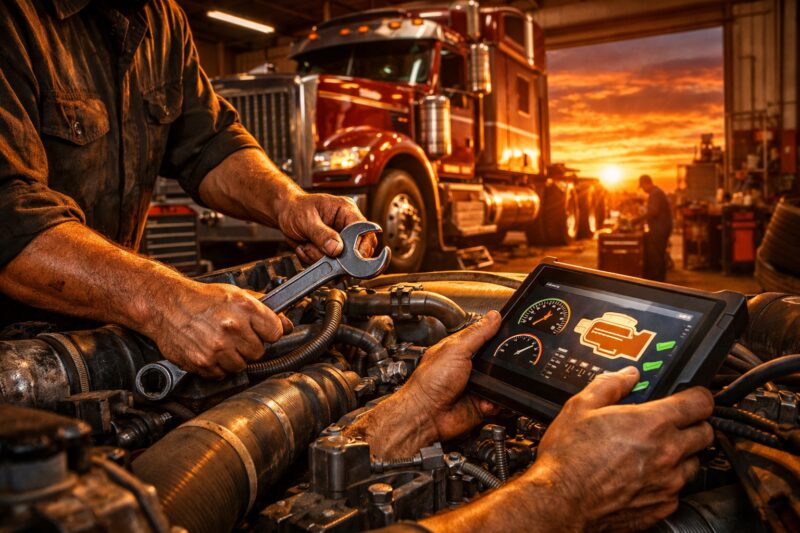
Choosing a diesel repair specialist is not just about who can quote the cheapest part. You should look for a shop that can prove the cause of the problem, then fix it in a way that holds up. If you know what to verify, you can avoid repeat repairs and pay for the right work the first time. That is the goal when you choose diesel repair specialist services with confidence.
Diesel systems are interconnected and unforgiving. Fuel delivery, air handling, turbo control, cooling, electrical starting, and aftertreatment all affect each other. A mismatch between diagnosis and repair often leads to “fixed” symptoms that return quickly. Therefore, your decision should reward diagnostic proof and repair quality controls.
This guide shows a practical framework you can use before you book. You will learn how to match a shop to your diesel system symptoms, what competence looks like, and which red flags to avoid. You will also find a comparison of dealership versus independent versus fleet-focused providers. The scope includes light, medium, and heavy-duty diesel, plus equipment and fleet use where downtime and records matter.
Match the right shop to your diesel problem before you book service
The right first step is matching the specialist to your specific diesel symptom type. When a shop understands where the fault usually lives, the diagnostic plan gets faster and more accurate. That is the fastest path to deciding whether you should authorize repairs.
Start by identifying your diesel’s use case and system category. Tell the shop if it is a passenger car, a light truck, a Class 6–8 truck, a generator, a skid steer, or a fleet vehicle. Next, group the symptom into a realistic category such as fuel system issues, air intake and turbo behavior, cooling and overheating, electrical starting, drivetrain concerns, or aftertreatment and emissions. Diesel engine repair expertise matters most when you can narrow down which subsystem is likely. However, the shop must still confirm it with tests.
Then balance two tracks in your mind. One track is diagnostic capability, which means the shop can find the root cause. The other track is repair capability, which means the shop can correct it properly with correct parts and verification. Many shops can replace parts. Fewer can prove what caused the failure and document the results.
In practice, you can shorten the decision process by using a “symptom-to-evidence” question. Ask the shop what they will measure during the , not just what they think the problem is. For example, if the check engine light is on, good shops treat it as a starting clue, not a conclusion. A common mistake is authorizing a part swap before the shop captures evidence. In an edge case like intermittent limp mode, proof often requires live data capture during the condition.
Internal checks you should expect include diagnostic process and live data, clear step order, and transparent estimates tied to findings. If you see that approach, you are closer to a safe decision when you choose diesel repair specialist services.
Shortlist shops using competence signals, not marketing claims
A strong shop shortlist comes from verifiable signals, not promises. You want proof of training, a structured diagnostic approach, and evidence that they communicate clearly. That is how you choose diesel repair specialist performance you can trust.
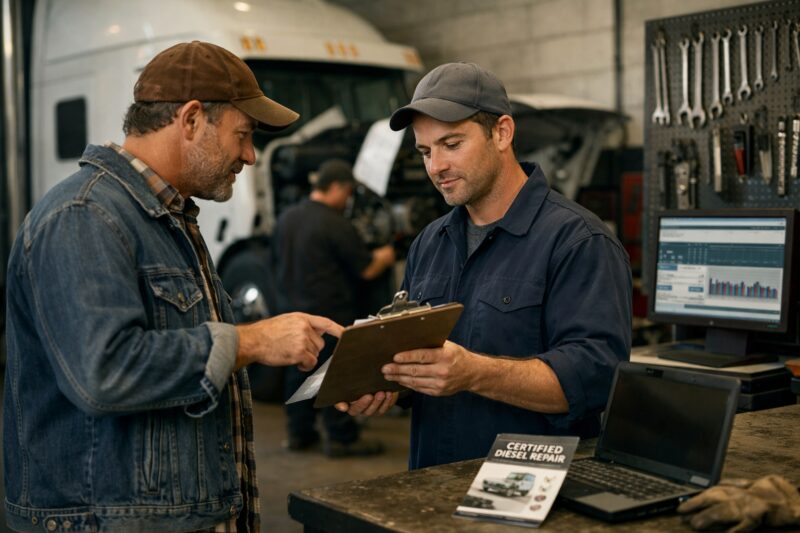
Begin with credentials that reflect diesel work. Many shops list certifications, but you should verify what is actually relevant to your engine family and system. When applicable, look for ASE-style credentials for automotive service technicians, plus manufacturer training records for specific diesel platforms. Also ask if the shop uses manufacturer test procedures or internal test plans. If they answer vaguely, that is a red flag.
Next, compare how they handle diagnostic uncertainty. A credible shop explains what they will do if fault codes point in multiple directions. They should also describe what tests they will run and in what sequence, so you understand the logic. In addition, they should explain how they will interpret results such as sensor readings and drivability behavior. For check engine light diagnosis, the best shops do more than pull codes. They connect codes to a diagnosis using tests and live readings.
Real-world scenario: a shop may claim “we fix these all the time.” However, it may not show any method for confirming root cause. A better approach is to ask for a sample diagnostic report format. It does not have to be long. It should show symptoms, tests performed, findings, and next steps. A common mistake is choosing based on speed alone. Speed without proof often increases the chance of repeat visits.
Finally, decide how the shop documents the work. A clean work order and a written estimate aligned to the diagnostic plan are good signs. The goal is to narrow your list to two or three shops you can confidently call for a next-step plan.
Good diagnostics answer two questions: what failed, and why. If a shop cannot explain both with evidence, you should delay authorization. That is the core way to choose a diesel repair specialist that prevents recurring failures.
In practice, diagnostic competence starts with intake and history review. The shop should ask about recent maintenance, fuel changes, warning light behavior, and whether the problem is repeatable. Then they interpret fault codes in context. Codes alone do not tell the full story. Therefore, the shop should verify with tests that confirm the actual condition.
A strong diagnostic flow includes inspection sequence, visual checks, and test results that narrow possibilities. It also uses diagnostic process and live data when codes or symptoms alone do not confirm a root cause. For example, a no-start complaint may involve fuel pressure, air intrusion, lift pump behavior, crank speed, battery and voltage drop checks, and wiring integrity. Aftertreatment complaints may require interpreting system status and sensor correlation, not just replacing a component.
Ask the shop what documentation it will provide. Request a written diagnostic report, or at least a documented checklist in the work order. It should include what tests were performed and what results led to the conclusion. For transparency, ask how they will confirm findings before recommending costly components. In an edge case like intermittent regen-related behavior, they should propose a method to capture data during the next event, or they should explain why they cannot reliably reproduce it and how they will proceed safely.
Common mistake: approving a large repair line item based on “likely” diagnoses. Instead, ask them to show how their conclusion matches the symptoms. When the shop communicates tradeoffs, you gain control of the decision.
When you find that style, you are building confidence in your choice diesel repair specialist decision. You are also improving the odds that your repair plan matches the real issue.
Assess repair quality using parts strategy, warranty terms, and documentation
Repair quality is how the shop prevents the problem from coming back. To judge it, you must look past the estimate and evaluate parts choices, warranty structure, and documentation habits. This is where many customers unknowingly decide on repeat-failure risk.
First, ask how the shop decides between OEM and quality aftermarket parts. OEM parts often help with fit, calibration alignment, and compatibility for emissions-related components. Quality aftermarket parts can work well in many cases, but the shop must verify cross-compatibility for your engine family and component design. When aftertreatment is involved, parts selection needs extra care because wrong components or incomplete verification can create recurring issues.
Second, review warranty terms like a contract, not a courtesy line. Confirm what the warranty covers, including parts and labor. Also ask if it includes diagnostic work if the issue repeats. Then ask how the shop handles claims when repeat failures suggest a missed root cause. If exclusions are broad, that changes your risk profile.
Third, look for the paper trail. A reputable shop updates work orders with what it found, what it replaced, and what tests confirmed the repair. It should also keep consistent inspection notes. If parts were returned, or if old components need to be shown, the shop should explain how they handle that. A common failure mode is “fixing symptoms” without correcting root cause, such as replacing a component while contamination or air leaks remain.
For practical acceptance, ask for a verification step. After the repair, what evidence will show the issue is gone? That may include test drive notes, live data confirmation, or reset and adaptation verification. Ask how they will confirm that the problem stays resolved after initial operation.
When a shop can answer these points clearly, your decision becomes more than a price comparison. It becomes a quality-based plan to reduce future visits. That is an essential part of choosing a diesel repair specialist you can rely on.
Compare dealership, independent specialty, fleet providers, and mobile service
Different providers excel in different parts of diesel repair. Dealerships often specialize in manufacturer-specific systems. Independent shops may provide deeper diagnostic depth and flexible process. Fleet-focused providers can plan for downtime and records. Mobile service can triage on-site issues to prevent long delays.
Dealership service can be strong when you need OEM parts, manufacturer tooling, or platform-specific calibrations. It is also useful when warranty history and dealer documentation matter. However, dealership estimates can be higher, and diagnosis may move through a more formal approval process. Independent specialty shops may spend more time on root cause. They may also be more willing to stage repairs based on test results.
Fleet-focused providers often understand downtime constraints and parts logistics. They may stock common diesel components for your fleet category. They can also provide recurring reporting that helps managers track repeat failures. Mobile service can be a fit for equipment or rigs that cannot easily leave the yard. The tradeoff is that mobile work may have limitations for complex emissions repairs or calibration work, depending on tooling and parts availability.
A deeper nuance is staged service. Sometimes the best option is a diagnostic-only appointment first. Then you authorize repair only after the shop confirms the findings. That approach reduces the chance of paying twice when the first guess is wrong. It is also helpful in edge cases like intermittent faults that only appear under specific driving or load conditions.
Choose based on your profile. An individual owner may prioritize clear communication and manageable costs. A contractor may prioritize minimizing equipment downtime and accurate documentation. A large fleet may prioritize repeatability, service history consistency, and escalation handling. A rental equipment company may prioritize documentation that supports future claims.
To compare options, ask each provider the same evidence questions. Request their diagnostic process and live data approach, their parts strategy for your system, and their verification step after repair. If their answers stay consistent across visits, that is a sign of process maturity.
Avoid mistakes that cause repeat repairs and unnecessary expense
Most repeat diesel repair failures come from skipped steps and unclear authorizations. You should avoid approving work that is not tied to confirmed findings. You should also avoid estimates that do not explain assumptions clearly.
One common mistake is trusting the first quoted part. A symptom can point to multiple causes in diesel systems. For example, low power can result from fuel delivery issues, air leaks, turbo control problems, or aftertreatment derating. If the shop does not confirm which one applies, you risk replacing parts that were never the real cause.
Another mistake is skipping diagnostic steps to “save time.” In reality, diagnostics are how you prevent wasted labor. If the shop bypasses testing, you may pay for replacement labor now and diagnosis later. Also watch for vague “up to” estimates. Those often expand after the shop finds additional work, leaving you surprised and less able to compare options.
Warranty misunderstandings also drive expense. Ask what the warranty covers and what it excludes. Confirm whether repeat failures trigger additional diagnostics at no extra cost. If the shop only covers parts but not labor, your risk increases. In emissions or aftertreatment cases, improper work can create recurring issues. Therefore, you should expect symptom confirmation before replacing catalyst, DPF, SCR, or related sensors. A misconception is that bypassing safety steps is harmless. It can be more costly in repeat failures and compliance concerns.
Finally, fix miscommunication early. Symptoms often describe the effect, not the cause. The shop should bridge that gap with tests and clear explanations. Ask how they connect your symptoms to their conclusion. If they cannot, consider another diesel-focused service specialties provider that will document the reasoning.
Your “safe decision” outcome should include a structured first . Bring a symptom log, share maintenance history, and ask for a written diagnostic plan before approving parts. Then only authorize work that matches the confirmed findings.
Match competency to your diesel system: fuel, air, cooling, electrical, drivetrain, aftertreatment
Diesel repair covers multiple systems, so you should match the specialist to your symptom category. A shop that can diagnose fuel issues may not be as strong with aftertreatment verification. You choose diesel repair specialist fit when you confirm system-specific competence.
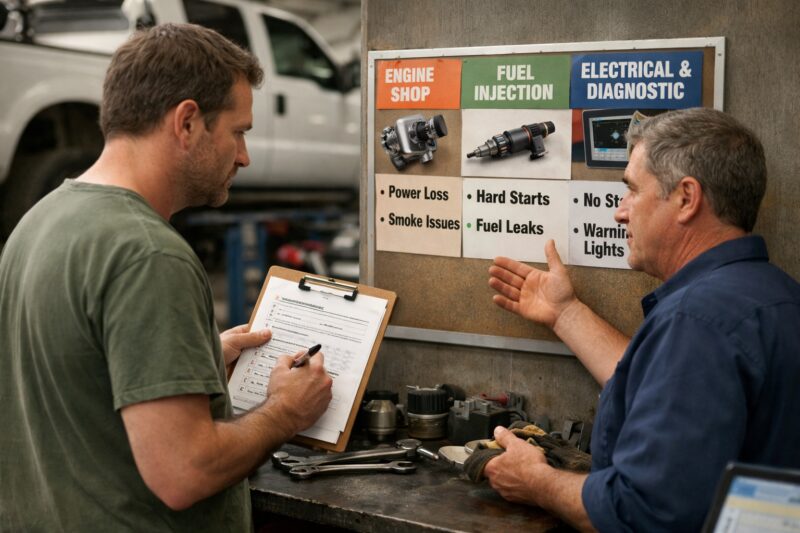
Start with the major categories. Fuel injection and delivery issues can cause hard starts, misfire-like behavior, smoke, and power loss. Air intake and turbo control issues can create boost problems, noise, and drivability symptoms. Cooling and overheating concerns can involve hoses, pumps, thermostats, and control logic. Electrical starting issues may involve battery condition, voltage drop, wiring grounds, relays, and sensors. Drivetrain symptoms can involve clutch, transfer case behavior, driveline vibration, and related controls.
Then include aftertreatment and emissions. Diesel aftertreatment issues often relate to regen behavior, DPF loading, SCR and DEF-related performance, or catalyst efficiency. However, the best shops do not jump to parts. They verify which system status and sensor signals correlate with your symptoms. They also confirm whether the issue is rooted in operating conditions, maintenance history, or a fault that blocks the system from clearing.
Deeper insight is that repair success often depends on preconditions. Fuel quality, filter maintenance, oil condition, and driving patterns can affect aftertreatment outcomes. A specialist should ask about these before recommending work. They should also explain how they will verify the repair actually restores normal operation. For example, if the check engine light is on, they should explain how fault code behavior changes after repair. Then they should explain what “normal” looks like based on the system’s logic.
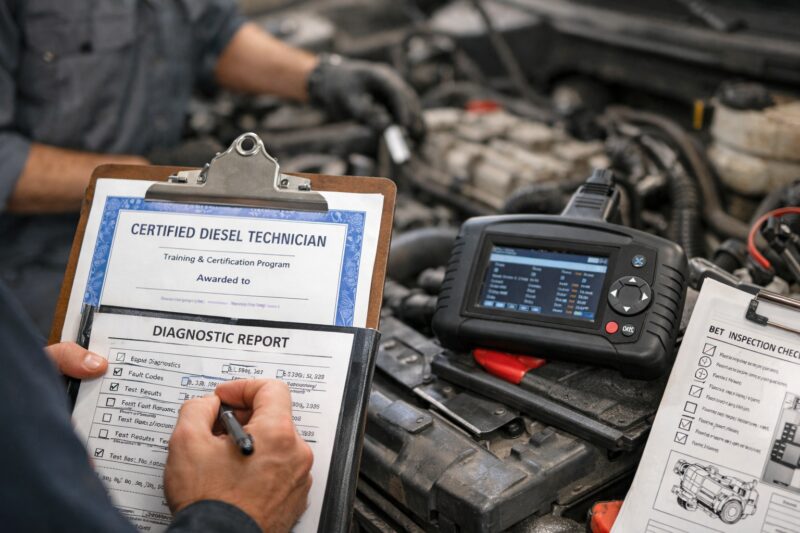
Ask the shop how they handle evidence-based acceptance. Do they verify with a test drive and data checks? Can they demonstrate they have handled similar cases in the same system category? If the answer is only “we’ve done it before” without describing method, you may want to keep searching.
This is the point where choosing diesel repair specialist services becomes practical. You are not buying a generic repair. You are buying system competence for your specific problem.
Confirm fit through communication, scheduling, escalation, and re-diagnosis
A diesel repair specialist should run the service like a controlled process. Clear intake, realistic timelines, and a defined escalation path reduce confusion. Most importantly, the shop should re-diagnose when the first repair does not fix the root cause.
Good process starts with communication. The shop should ask detailed intake questions and then explain what it will do. It should provide progress updates at predictable points. It should also clarify who makes decisions if findings change. If a diagnostic step produces new information, the shop should document it and ask before expanding scope.
Scheduling also matters. Ask when they can start the diagnosis and when they expect to call with findings. For parts lead times, ask what happens if a part is delayed. A capable shop will offer options, such as alternative sourcing or staged work that still keeps you moving toward a confirmed repair plan. If your vehicle is essential for work, confirm how they handle prioritization.
Escalation is a major deciding factor in hard-to-fix cases. Intermittent issues can be difficult to reproduce. A good shop explains what data it will gather and what triggers the next step. It also tells you when to stop and when to continue. That prevents endless labor that still never finds the root cause.
Re-diagnosis should be handled professionally if the first repair fails. They should not shift blame to “the parts” without testing. Instead, they should return to evidence and compare the result to the diagnostic plan. Ask how they handle repeat failures and how they document the new findings.
To make it simple, use a first appointment script. Ask what tests they will run, what documentation you will receive, and how you authorize additional work if findings change. Also ask who will explain the diagnostic conclusion. When their answers are crisp, you gain confidence in your diesel-focused service specialties fit and you reduce future friction.
Frequently Asked Questions About How to Choose a Diesel Repair Specialist
What qualifications should a diesel repair specialist have?
Look for diesel-relevant training and credentials, not just general auto experience. Ask whether technicians have manufacturer training for your engine family, plus documented competency in fuel, aftertreatment, and electrical diagnosis. Also ask what diagnostic tools they use and whether they provide a written diagnostic report. A qualified shop can explain their competence in plain terms and connect it to your symptom category.
How do I know if a shop is actually diagnosing the problem or just replacing parts?
Ask for evidence of testing, such as a written summary of fault code interpretation, visual inspections, and diagnostic process and live data results. A diagnosing shop should explain which measurements confirm or rule out likely causes. Watch for vague explanations like “we’ll try a part and .” If they cannot show what they tested and why, that is a warning sign.
What questions should I ask before approving diesel engine repair work?
Request a clear scope tied to the diagnostic findings. Ask which parts they plan to replace and what verification step will confirm the fix. Also ask about warranty coverage for parts and labor, and whether repeat failures trigger additional diagnostics. Finally, ask how they communicate changes if new issues appear mid-repair.
How can I compare two repair estimates when the symptoms are similar but the work scope differs?
Compare line items and assumptions, not just the total price. Ask each shop what diagnostic work they completed and what evidence supports their conclusion. Also confirm whether either estimate includes a verification step, especially for aftertreatment repairs. If one estimate skips diagnostic proof, you should treat it as a higher risk option.
Do I need OEM parts, or can I use quality aftermarket parts for diesel repairs?
You may not always need OEM parts, but compatibility and verification matter. A competent shop can explain how it verifies fit and emissions-related behavior when using aftermarket parts. For emissions and aftertreatment components, OEM is often preferred because calibration and system logic can be sensitive. Either way, ask how the shop protects warranty coverage and confirms correct installation.
What should I expect during a diagnostic appointment for a hard-to-start diesel?
You should expect detailed intake questions about when the problem happens and what changed recently. The shop should check fuel delivery, air and contamination indicators, and electrical starting conditions such as battery voltage and voltage drop. They should also interpret relevant codes and use live measurements when needed. Good check engine light diagnosis work connects the symptoms to test results instead of guessing.
A strong shop can help, but it should show system understanding and verification steps. Ask how it confirms whether the issue is related to sensor correlation, system status, or operating conditions that affect regen and clearing. It should also explain what it will measure after repair to confirm normal behavior. Avoid shops that promise fixes without confirming the underlying fault.
What are warning signs of a poor diesel repair job?
Repeat failures, unclear documentation, and shifting blame are common signs. Another warning is missing test verification, such as no explanation of how check results changed after the repair. If the shop cannot provide a diagnostic summary or warranty terms are unclear, you may face higher risk. Also be cautious if the shop only replaces parts without addressing likely root causes such as contamination or leaks.
How do I choose a diesel repair specialist for fleet vehicles with downtime constraints?
Ask how the shop schedules diagnosis, communicates progress, and plans parts to reduce downtime. You should also confirm that it maintains detailed records for repeatability and accountability. A fleet-focused provider should explain how it handles warranty disputes and repeat failures with a process-based response. Finally, ask whether it offers staged diagnostics before committing to major repairs.
How long should diesel repairs take, and what’s a reasonable explanation if it takes longer?
Timelines depend on diagnostic complexity, parts availability, and whether an intermittent fault can be reproduced. A reasonable explanation includes what tests are in progress and what is waiting on parts or access. The shop should also provide update intervals and a plan for what happens if the diagnosis changes. If communication is absent, that is a sign you may need to re-evaluate the fit.
Conclusion: choose a diesel repair specialist based on proof, quality controls, and system fit
The best way to choose a diesel repair specialist is to focus on diagnostic proof and repair quality controls. You should expect the shop to match its method to your diesel system symptoms. Then it should confirm findings with tests before it recommends expensive components.
Use a simple action path. Build a shortlist of two or three shops, request diagnostic documentation expectations, and compare estimates using line items and assumptions. Confirm warranty terms and the verification step that proves the repair fixed the root cause. If you need help deciding which questions matter, ask each shop how it handles diagnostic process and live data, especially for your symptom category.
A practical next step is to contact multiple specialists with the same symptom summary. Ask them to explain their diagnostic approach and what documentation they provide. Then pick the one that communicates clearly, documents work, and offers a plan to prevent repeat failures. When a diesel-focused service specialties provider delivers reasoning and verification, you can schedule repairs with confidence and reduce the odds of coming back for the same issue.
For additional background on technician testing and quality expectations, you can review guidance from the National Institute for Automotive Service Excellence at ASE and general diagnostic and repair expectations from the Federal Trade Commission at Federal Trade Commission. For emissions-related context and how monitoring systems work, use the EPA’s overview resources like U.S. EPA. These references can help you frame your questions during your visit and evaluate whether the shop’s process aligns with industry best practices.
Updated September 2026