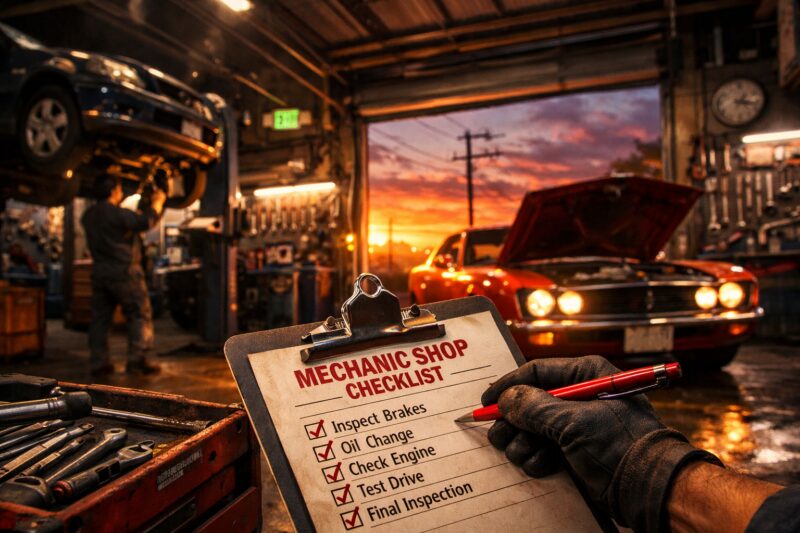
A Mechanic Shop checklist is a structured set of intake, estimation, approval, and verification steps that keeps repairs faster and clearer by reducing scope confusion and missed diagnostics. Used correctly, it helps you get timing you can plan around and workmanship you can verify—based on evidence, documentation, and explicit authorization, not vague promises or “we’ll see what it needs.” In 2026, a well-run Mechanic Shop relies more on digital scheduling, text/email estimates, and layered diagnostics, so having a checklist now prevents delays and protects you from unclear costs. If you want the right shop for your vehicle, the outcome you’re really after is simple: you evaluate options, communicate effectively, approve only what you understand, and verify what was done before you pay.
This guide is practical and navigational by design. You are not here to memorize car theory—you are here to find a shop, ask the right questions, and walk out with documentation that makes the next decision easy. We’ll walk through what to prepare before you arrive, how to request a complete estimate (including what “may require” should mean), how to set communication expectations for faster turnaround, and how to choose credentials and warranty terms that actually support trust. You’ll also learn the mistakes people make when they skip documentation, misread “free inspection,” or assume the cheapest quote is the fastest repair path.
For writer tone: keep it grounded, action-oriented, and focused on outcomes. Each section below is written so you can take notes or copy questions into your call script.
Mechanic Shop intake checklist (before work starts): what to have ready and what to ask
A Mechanic Shop intake checklist is the fastest way to prevent diagnostic mistakes, rework, and “surprise” add-ons because it forces you (and the shop) to start with shared facts. Before any wrench turns, you want the shop to understand your symptoms, your driving conditions, and your vehicle history well enough to build an accurate diagnostic plan and written scope.
Why it matters: many repair delays start before diagnosis. A vague intake like “it shakes when I brake” can lead to a tech checking only rotors and brake pads, when the real cause might involve suspension play, tire issues, or ABS sensor readings. In 2026, shops often receive cars after you’ve scheduled via text/email and described symptoms from memory, sometimes days after the event. If the intake is thin, the shop may compensate by running broad tests, which costs time and increases the chance you’ll be asked to approve multiple “may be” items.
How it works: the intake checklist turns your experience into diagnostic signals. Have vehicle details ready: year/make/model/trim, VIN (if you’re comfortable sharing), mileage, key warning lights (exact wording if it appears), and the timing of symptoms (first noticed date, frequency, and whether it worsens). If you’ve had recent work, bring the receipt or at least the part names and approximate date. Also include driving conditions: short trips vs highway, weather exposure, recent tire rotation, pothole impacts, towing, or aftermarket parts (especially sensors, lights, or wheels). Those facts help the technician choose the correct test path instead of starting with assumptions.
Practical application: when you call or arrive, request a clear scope using a “problem statement” and suspected cause(s) that you and the advisor can align on. Ask how they will diagnose first when the driver is uncertain. A good shop will explain what they will check first, what they expect to find, and what would change their plan. Capture the agreement immediately in writing: the estimate, check-in notes, and a copy of your authorization. If visible issues matter, ask to document them with photos or short videos—especially for leaks, underbody damage, or “looks fine” complaints.
Tradeoffs and limitations: some shops will try to keep intake conversation short by calling it “a quick look.” That approach can work for simple maintenance, but it’s risky for intermittent drivability, sensor-related issues, and no-start conditions. Common mistake: assuming the service advisor will automatically get every detail from you—without you providing a structured symptom timeline. Use your checklist to ensure you get technician-level clarity from the start. This is also why “Mechanic Shop checklist steps” should begin before you even discuss pricing; clarity on the problem determines how fast the diagnosis can converge.
Related navigation: if you are trying to compare how other repair workflows protect customers, review the “Trusted mechanic approval process” approach and how it handles authorizations and scope changes for vehicle work orders. It pairs well with intake documentation from your check-in notes.

Sources that explain expectations and transparency practices in auto repair can be useful when you want backup for what “authorization” and documentation should look like: FTC Auto Repair Rule — the FTC provides guidance on consumer rights, estimates, and disclosures. For repair authorization and recordkeeping principles in regulated environments, see NHTSA Vehicle Recalls when your symptoms may intersect with recalls or safety-related parts.
Writer note for accuracy: do not claim specific diagnostic timing guarantees. Instead, focus on what you can request—diagnostic approach, expected check order, update cadence, and written approvals.
Requesting an estimate: what “clear, complete” should include at a Mechanic Shop
A clear, complete estimate at a Mechanic Shop spells out what work is included, how much diagnosis is being charged, and what approvals are required for additional steps. It should help you make a confident go/no-go decision without guessing whether the shop is bundling costs or hiding assumptions.
Why it matters: incomplete estimates are one of the most common reasons repairs feel “slow” even when parts are available. If the shop gives a single number with vague language, they may later ask you to approve additional labor hours after discovering the original assumption was wrong. That creates approval fatigue and delays because you are not aligned on decision criteria. In 2026, digital communication makes this worse: an estimate sent by text can look “official” while still lacking the line-item clarity you need to compare apples-to-apples between shops.
How it works: a strong estimate breaks down components you can verify. Ask for line items that include diagnostic fee (and what it covers), labor hours by category, parts pricing (OEM vs aftermarket), and taxes/fees. Include disposal fees when they apply. Confirm the estimate format: written vs verbal, and whether the estimate is “good for X days” or subject to change with a specific trigger. A complete estimate also includes approval checkpoints—what requires re-authorization before extra work is performed, and what is part of the initial authorized scope.
Practical application: use the phrasing “What exactly triggers the next approval?” If they say “we’ll see what it needs,” request decision criteria. Example: for a warning light, ask whether they will diagnose using scan tool data and test results first, then decide on component replacement based on specific findings (such as verifying a sensor reading under load, checking harness integrity, or confirming a circuit fault). Deeper than obvious: how to spot hidden assumptions is to listen for phrases like “may require replacement” without listing what conditions would make replacement necessary. Ask them to describe the evidence they will look for and what alternatives they will consider before replacement.
Tradeoffs and limitations: some diagnosis cannot be fully scoped until tests are complete, especially for intermittent electrical faults. A trustworthy shop handles this by giving you a “diagnose first” agreement and then presenting findings with an updated estimate. If they refuse to provide written documentation of what is included, that’s a signal you should pause. When you request clarity, you’re also reinforcing “What to ask before paying,” so you do not end up paying for work you cannot confirm.
Real-world scenario: your check engine light is on and the code points to an oxygen sensor. A vague estimate might say “replace oxygen sensor and clear codes.” A complete estimate describes diagnostic steps: verify fuel trims, check live data response, inspect wiring/connectors, confirm exhaust leaks, and then propose sensor replacement only if test results support it. That prevents “parts swapping” that wastes time and money.
For consumer framing, this guidance aligns with how regulators describe disclosures around service and estimates: FTC Auto Repair Rule.
Communication & scheduling: how to get fast repairs from the right Mechanic Shop
Fast repairs come from consistent communication that matches the diagnostic reality: you need a shop that updates you on what’s happening, why it’s happening, and what changed since the last message. The Mechanic Shop should set a timeline you can trust—starting with a diagnostic goal and then transitioning to repair milestones.
Why it matters: turnaround time is not just “how quickly they can work.” It’s how quickly they can remove uncertainty. If they do not communicate diagnostic progress, you may approve the wrong next step, or you may wait too long to authorize a necessary safety repair. In 2026, many shops run multi-queue schedules and update customers by text/email. If updates are vague (“we’re working on it”), the shop may spend time redoing diagnostics or waiting on approvals you thought were already granted.
How it works: ask for a “fast but correct” workflow. Ideally they do same-day or next-appointment diagnostic triage, then stage repairs based on safety priority and parts availability. Safety issues—brakes, steering, overheating, no-start, major oil leaks—should be handled with priority. Then ask how they set a timeline: what the initial estimate is for (diagnostic window vs repair completion), and whether they can give a “hard ETA” for completion after the diagnostic pass is complete. Confirm what triggers timeline changes: parts lead times, additional findings, authorization delays, or waiting for you to confirm approval.
Practical application: agree on your preferred communication channel (call/text/email) and define what counts as an “update.” For example: “One diagnostic update before 3 pm” or “Update when parts arrive.” Also ask about diagnostic rework. A smart question is: if the first diagnostic pass is inconclusive, do they repeat tests, re-check connectors/harnesses, and document what was already ruled out—without charging you again for the same steps? If they do charge again, they should explain why (for example, new symptoms occurred, or initial conditions could not be replicated).
Tradeoffs and limitations: some shops cannot commit to tight ETAs if they rely on same-day decisions or if parts sourcing is unpredictable. That doesn’t mean they’re untrustworthy, but you should request transparency: a parts sourcing policy for substitutions, an update cadence for delays, and a clear rule about how often they will contact you when waiting. Common mistake: confusing “diagnostic started” with “diagnostic complete.” Your checklist should include a milestone definition: completion means they have scan data/test results and a proposed next scope.
For related planning around approval mechanics and scope control, use the “Trusted mechanic approval process” page as your parallel reference while you talk to the shop. Then bring those principles into your communication cadence so you know what authorizations happen when.
External consumer guidance can help frame what “authorization” and estimate disclosure should look like: FTC Auto Repair Rule. When safety components or recall-adjacent parts are involved, cross-check through NHTSA Vehicle Recalls.
Choosing the right Mechanic Shop: criteria for trust, credentials, and accountability
The right Mechanic Shop is not the one with the lowest price—it’s the one that can explain diagnosis, document decisions, and stand behind the work with warranty terms you can understand. Trust is measurable through credentials, documentation, and accountability mechanisms that tie actions to evidence.
Why it matters: accountability prevents scope creep and protects you when repairs do not go as expected. A shop can be friendly and still be unreliable if they do not provide written authorization boundaries, do not maintain repair notes, or cannot explain why the repair plan changed. In 2026, with more digital scheduling and customer expectations shaped by reviews, it’s easy to be drawn to “fast replies.” But the trust indicators you want are operational: clarity, documentation, and a consistent warranty claim process.

How it works: start with practical trust signals. Ask about licensing and insurance as applicable in your region, and confirm how they handle warranty coverage (both parts/material warranty and labor warranty). Then focus on diagnostic transparency: will they show scan tool data snapshots, test results, or at least written findings that map to the proposed repair? Ask about technician competence for your vehicle type/system, and whether they use diagnostic tools appropriate to the problem (scan tools, live data, lab scopes for certain electrical issues). You are evaluating whether they can do correct diagnosis the first time, not whether they can “try a part.”
Practical application: verify the warranty in writing—duration, claim process, exclusions, and whether substitutions are covered. Then ask for accountability mechanisms: “If you find something different than expected, what do you do before proceeding?” A good shop will explain how they update the plan, request re-authorization for additional work, and document the reason for changes. For safety and compliance checks, ask how they handle test-drive documentation and post-repair verification. If applicable, ask whether they follow manufacturer procedures for torque specs, resets, calibrations, and system re-learns.
Tradeoffs and limitations: some specialty shops (brakes/tires/electrical) may not be best for broad diagnostic work, while a general shop may not be equipped for all advanced electrical diagnostics. The point is to match shop capability to the repair type. Common mistake: relying on generic “we’ve been in business for years” while skipping the warranty and documentation questions. Another common mistake: assuming a dealership is automatically best for cost. Dealership pricing can be higher, but the value may be in procedure fidelity and access to OEM parts documentation.
As a next step, you can use this evaluation checklist to support “Choose the right service shop” decisions when comparing multiple providers. It will also help you build a shortlist that you can call with consistent intake questions.
When you want authoritative consumer expectations on repair disclosures and estimates, use FTC Auto Repair Rule. For safety-related verification around certain components, cross-check with NHTSA Vehicle Recalls.
Common mistakes & misconceptions when using a Mechanic Shop checklist
A Mechanic Shop checklist works only if you use it to prevent bad assumptions. The most common failures happen when people treat the checklist as paperwork instead of decision control—especially around “free inspection,” vague estimates, and authorization boundaries.
Why it matters: checklists are meant to reduce uncertainty, but mistakes can increase it. For example, choosing the cheapest estimate often increases overall time because the diagnosis may be thinner or deferred, leading to multiple approval cycles. In practice, a low initial quote can be fast to generate but slow to finish because the shop discovers additional issues after you authorize a partial scope.
How it works: use the checklist to correct misconceptions. “Free inspection” is not always free diagnosis. Ask whether the inspection includes scan tool reading, road testing, or labor time spent on diagnosis—and whether the diagnostic cost is waived only if you authorize repairs. Another misconception is that “we’ll look at it” means they will definitively diagnose. In reality, some shops may perform a visual check and then propose a maintenance bundle rather than running targeted tests. Your checklist should require clarity: what testing is included, and what the outputs will be (codes, measurements, test results, or documented findings).
Practical application: avoid overlooking documentation. If you do not keep copies of estimates, authorizations, and prior work orders, you cannot compare what changed or verify whether the shop followed the plan. Your intake checklist should include a written estimate and check-in notes immediately. Also ask about authorization boundaries: if the shop can add work without your explicit sign-off, you can end up with scope creep and fees that take time to dispute or resolve.
Deeper insight: symptoms are not diagnosis. A noise, vibration, or warning light can share multiple causes. Common mistake: authorizing a guess based on the symptom description alone. Example: “It jerks on acceleration” could be engine misfire, fuel delivery, transmission adaptive behavior, or throttle body issues. A checklist forces the shop to present evidence-based next steps, not only plausible guesses.
To keep the focus on decision clarity, your checklist should also align with “What to ask before paying” so you confirm what is included in each billable category before you approve final payment.
Options & alternatives: what to compare beyond the first Mechanic Shop you find
The best approach is to compare multiple repair pathways before committing, because different types of providers excel at different tasks. When you compare options beyond the first Mechanic Shop you find, you can trade speed, predictability, warranty fit, and diagnostic depth in a controlled way.
Why it matters: not all repairs benefit from the same shop model. A chain or general service provider might be great for routine maintenance, but not ideal for complex driveability diagnostics, advanced electrical systems, or intermittent faults. Meanwhile, dealerships may be best for manufacturer procedure compliance and OEM parts guidance, but they may have higher labor rates. Specialty shops might deliver fast turnaround for specific issues—brakes, tires, alignment, or electrical—because they see those problems frequently and keep the right tooling on hand.
How it works: compare by repair type and by operational outcomes. For routine maintenance, focus on appointment availability, clear labor time expectations, and warranty coverage. For complex diagnostics, focus on how they handle diagnostic rework, whether they document findings, and whether they will diagnose first when the cause is uncertain. For body or after-collision work, focus on parts sourcing policies, calibration procedures, and documentation of paint and structural repair methods.
Practical application: create a shortlist of two to three providers and call each with the same intake checklist questions so you can compare apples-to-apples. Ask about their diagnostic capability and tool access. If your issue is electrical/driveability, you want confirmation they use modern scan tools and can capture live data. Then request similar written estimates with the same scope language. If one shop provides a single vague number while others offer diagnostic approach and approval checkpoints, you’ll know which one is likely to cause delays.
Tradeoffs and limitations: mobile mechanics can be convenient for certain tasks, but they may be less appropriate for diagnosis requiring lifts, specialized equipment, emissions testing environments, or extensive road testing. Common mistake: assuming “closest provider” equals “fastest.” In practice, a more capable shop with better diagnostic clarity can be faster because they converge on the correct repair sooner.
Optional comparison table (for your notes or future internal linking): you can compare providers by speed, transparency, warranty clarity, diagnostic capability, and best-fit repair types. This pairs with “Choose the right service shop” when you want a structured selection process.

Also remember regulatory consumer framing for disclosures around estimates and repairs: FTC Auto Repair Rule.
Advanced considerations (what most guides miss) for Mechanic Shop repairs in 2026
In 2026, the hardest Mechanic Shop repairs aren’t always the most expensive—they are often the most uncertain: intermittent issues, no-start problems, sensor-driven drivability, and cases where the light went off and came back. Your checklist should evolve to force decision trees, verification steps, and clearer handling of diagnostics that can’t be fully scoped at drop-off.
Why it matters: many guides stop at “get a written estimate.” But modern vehicles produce intermittent faults through complex sensor and network behavior, and scheduling systems often push shops to “move to the next car.” If you do not request a structured diagnostic approach—especially for intermittent faults—you may end up paying for repeated tests that don’t actually reduce uncertainty. This is also where parts lead-time realities matter: if a shop orders a part without a clear verification plan, you can lose weeks waiting for replacements that still do not solve the root cause.
How it works: ask for a decision tree. If multiple causes are plausible, request that they explain what they will check first and what result would lead them to the next step. For example, if a no-start is suspected to be fuel or spark, ask how they will confirm fuel pressure and spark status (or relevant outputs) before replacing expensive components. If the “light went off,” ask what they will use to confirm whether the system stored historical data and whether they will perform a verification procedure that replicates the fault conditions.
Practical application: request pre- and post-repair verification. That can mean capturing codes and freeze-frame data before repair, checking and recording live data baselines, and then clearing codes with documented follow-up checks after the repair. For example, for a transmission-related fault, ask whether they will record shift behavior parameters or relevant adaptive reset steps where applicable. Deeper than obvious: common failure is codes cleared without verification that the underlying condition has been resolved—leading the light to return quickly. Your checklist should require that “verification” includes what they measured and what changed.
Tradeoffs and limitations: parts sourcing may require substitutions. Ask what their substitute policy is and whether the warranty applies to substituted parts the same way it applies to OEM parts. Also ask how they communicate delays: in 2026, lead times are real, and trust depends on operational transparency. If a shop refuses written documentation or won’t provide warranty details, you should treat that as a risk factor, not a bargaining opportunity.
For decision-making support around how repairs get authorized and documented, revisit “Mechanic Shop checklist steps” and keep your verification requests aligned with the approval workflow. Then, before paying, use “What to ask before paying” to ensure you receive the evidence you asked for.
Authoritative guidance on diagnostic and safety-related obligations should also guide your process when recalls or safety systems are involved: NHTSA Vehicle Recalls. For repair disclosure practices and consumer rights around estimates and authorization, use FTC Auto Repair Rule.
Frequently anchored by location: finding a Mechanic Shop near you (without losing standards)
Finding a Mechanic Shop near you should improve convenience and timing, not lower standards. Your location-based plan must still require written estimates, clear diagnostic steps, and authorization boundaries so that “near me” does not become “lower accountability.”
Why it matters: geographic convenience can reduce pickup/drop-off friction, but shops that are closer may still have longer queues, limited diagnostic capacity, or inconsistent documentation habits. In many regions in 2026, same-day availability is influenced by parts delivery networks and appointment load. A checklist ensures you confirm operational fit early rather than discovering it after you’ve left your car.
How it works: clarify what “near you” means for turnaround. If you need the car by a specific date, your definition of “near” should include parts delivery distance, appointment lead time, and pickup window policies. Ask the shop directly about diagnostic capacity: do they handle your type of problem quickly, and do they have the tooling for it? Also ask how they handle communication across time zones and schedules—especially if you prefer text/email updates.
Practical application: add local-search checklist additions. When reviewing online reviews, look for evidence of diagnostic transparency and warranty claim handling, not just friendliness. Ask for a call-back or written estimate confirmation and verify whether they provide written authorization forms. Deeper than obvious: avoid location bias. Newer shops may have fewer published warranty claim stories, but older shops may be busier and less responsive. The answer is not “new vs old,” it’s “documentation, warranty clarity, and diagnostic evidence.”
Tradeoffs and limitations: if you expand your search beyond “near you,” you might find better diagnostic transparency and faster convergence. But that could increase logistics effort. Your checklist helps balance those tradeoffs by making the comparison objective: each shop gets the same questions and documentation expectations.
To support regional decision-making, document your experience. Keep your communication logs, photos/video submitted, and copies of written approvals so you can compare across shops fairly. This is how you prevent one-off experiences from misleading your future choices.
Consumer expectations around disclosures and authorization remain consistent regardless of location: FTC Auto Repair Rule.
Frequently Asked Questions About finding a reliable Mechanic Shop
Ask for the exact diagnostic steps they will run first, the scope of the work included in the estimate, and what additional findings require your re-authorization. Require a written estimate with line items for diagnostic fee, labor hours, and parts type (OEM vs aftermarket). Also ask how they communicate delays and what counts as an “update,” so you are not waiting in uncertainty.
How do I know if a Mechanic Shop estimate is complete or vague?
A complete estimate lists diagnostic coverage, labor categories, parts pricing assumptions, and approval checkpoints for any additional work. Be cautious when you see broad language like “may require replacement” without decision criteria or evidence of how they’ll determine necessity. If the estimate does not state whether it’s written and what terms apply (like validity duration), request clarification before approving.
How long should a Mechanic Shop take to diagnose a car problem?
Diagnosis time varies by complexity and whether the problem is intermittent, but you should still request a diagnostic timeline range and a definition of what “first diagnostic pass” means. Ask whether they will re-check or repeat tests if conditions change, and whether rework is charged again. A reliable shop explains timing drivers such as parts availability for test replacements and queue position.
Do I have to pay the diagnostic fee if I don’t approve repairs?
Often you do pay the diagnostic fee because diagnostic labor is performed even if you decline repair work. However, policies vary by shop, so confirm upfront what is included in the diagnostic fee and whether it can be credited toward repairs. Request this information before authorizing any testing.
What’s the difference between an estimate and a quote at a Mechanic Shop?
In many contexts, an estimate is a projection that can change if new findings appear, while a quote implies tighter commitment to pricing for a defined scope. The important part is the approval contract language: what triggers changes and what requires re-authorization. Ask how the shop documents estimate changes and whether you receive updated written scope before work expands.
How can I verify the warranty on parts and labor from a Mechanic Shop?
Request the warranty details in writing: duration for parts and labor, what is covered, and any exclusions or limits. Ask for the claim process, including how you should present proof of prior approval and documentation if a part fails. Confirm whether warranty coverage changes when substitute parts are used.
Can a Mechanic Shop charge more after I approve the initial estimate?
They typically can charge more only when the work scope changes or additional authorized repairs are performed. Ask what specific changes require your re-authorization and ensure those triggers are written in your paperwork. If they pressure you to approve without criteria, that is a red flag.
What should I bring to a Mechanic Shop the day I drop off my car?
Bring your vehicle information, a short symptom timeline (when it started, how often it happens, and conditions like speed/temp/weather), and a list or photos of warning lights. Also bring receipts or notes about recent work, including parts replaced and dates. If you can, provide photos or video of visible issues like leaks, damage, or abnormal engine bay signs.
How do I choose between an independent shop and a dealership for repairs?
Choose based on the repair type and your priorities. Dealerships can be strong for manufacturer procedure compliance and OEM parts guidance, while independent shops may offer quicker scheduling and often competitive diagnostic approach. Ask both to describe diagnostic transparency, warranty terms, and whether they follow manufacturer procedures for your specific system.
How do I handle an intermittent issue when dealing with a Mechanic Shop?
Request that the shop uses a structured diagnostic approach, documents what conditions are required to reproduce the fault, and defines re-inspection rules. Provide detailed notes about when the symptom occurs and what changed right before it appeared. Ask whether they will verify pre- and post-repair baselines so the problem is checked beyond just clearing codes.
Should I expect a road test and post-repair verification from a Mechanic Shop?
Yes, especially for drivability, vibration, brake, and steering concerns. Ask what verification steps they will perform after repair, including what they check during a test drive and what they document. A strong shop records results and ties them back to the diagnostic findings rather than relying on code clearing alone.
Consumer rights and disclosure expectations around estimates and repair authorization are discussed in the FTC Auto Repair Rule. If your complaint relates to safety systems or recalls, confirm status with NHTSA Vehicle Recalls.
Conclusion: use a Mechanic Shop checklist to control scope, confirm expectations, and verify repairs
A Mechanic Shop checklist helps you navigate repairs by controlling scope, confirming expectations, and documenting decisions so you are not forced into unclear approvals. When you structure intake, request complete written estimates, define communication timelines, and verify post-repair outcomes, you reduce the two biggest causes of slow repairs: uncertainty and authorization confusion.
Across the sections above, the trust levers stay consistent. Written authorization boundaries prevent scope creep. Transparent estimate components (diagnostic fee, labor hours, parts type, and approval triggers) make costs predictable. Warranty clarity helps you plan for what happens if a repair does not hold. And pre- and post-repair verification ensures the work is more than “codes cleared.”
Next step: shortlist 2–3 nearby options and call with your intake and estimate checklist questions. During the first interaction, pay close attention to whether they document diagnostics, describe verification steps, and provide warranty details without pressure. Your best CTA is to consult the shop’s documentation process during the first interaction and proceed only when the checklist items are met.
If you want a second framework to compare with your checklist approach, use “Trusted mechanic approval process” as your parallel reading for authorization and scope discipline. That, combined with “Mechanic Shop checklist steps,” gives you a practical script for choosing and verifying repairs in 2026.
Finally, keep an eye on consumer disclosure guidance as a baseline when you compare shops: FTC Auto Repair Rule.
Updated May 2026