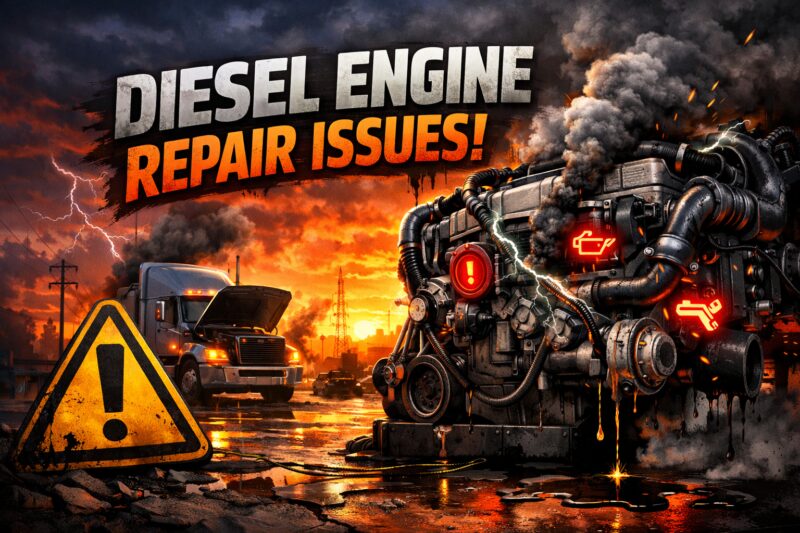
If your diesel won’t start, loses power, or won’t clear warning lights, you’re probably facing one of the common diesel engine repair issues that cluster around fuel delivery, air control, combustion, glow/starting support, and exhaust aftertreatment. When people search for diesel engine issues, they usually want to know what is most likely causing the symptoms and what to check before paying for parts. This matters in 2026 because modern diesel systems depend heavily on sensors and emissions aftertreatment logic. As a result, a “simple” fix may not work if stored trouble codes and service history are ignored.
This guide helps you identify the most likely repair issues, understand why symptoms overlap, and choose a smarter diagnostic path. You’ll also learn how to separate fuel faults from air faults, and why a single code can mislead. Finally, you’ll get a workflow for deciding what’s safe to inspect yourself and when to escalate to a diesel specialist.
Keep one more point in mind: light-duty diesels and heavy-duty diesels often fail in different ways. A daily commuter sees more cold starts and short trips. A towing or long-haul operator sees longer high-load operation and different wear patterns. Both can show similar symptoms, but the root causes often differ.
Fuel delivery failures that cause hard starts, stalling, and power loss
Hard starts and stalling on a diesel usually point to fuel delivery problems, not just “bad injectors.” Fuel issues often create the same drivability symptoms that combustion faults can, so good evidence matters. In many cases, diesel engine issues start with something as basic as supply pressure, air in the system, or clogged filters.
Fuel systems have a tight chain of tasks: lift pump or supply pressure, filtration, pressure control, and injector metering. If any link fails, the engine may crank but not build the right pressure in the rail. Low rail pressure can also mimic injector leakage because the result feels like weak or inconsistent injection. Meanwhile, air introduced anywhere can act like a clog, causing unstable fueling.
For practical checks, start with fuel filter condition and water contamination. If the filter is overdue on engine oil change intervals and filter discipline is poor, fuel quality problems rise quickly. Look for sediment and water in the filter housing. Then note cranking behavior: does the engine crank longer when cold, or fail only after heat-soak? Those patterns help separate supply problems from temperature-related sensor or control faults.
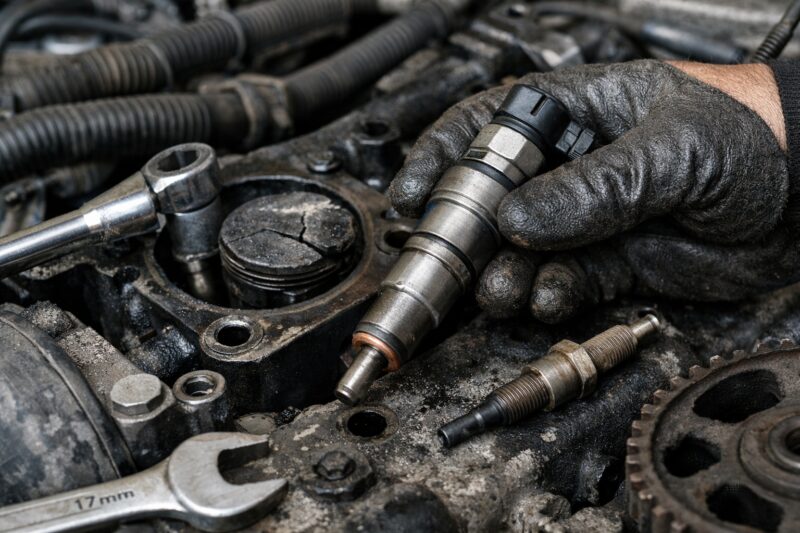
Here is deeper nuance that avoids wasted labor. Injector internal wear can create intermittent faults that do not show up during a one-time test. Some injectors develop dribbling or altered leak-off behavior that changes rail pressure stability under certain conditions. A shop that only reads codes may miss this, while diesel trouble code diagnostics paired with rail data or injector balance information can catch it.
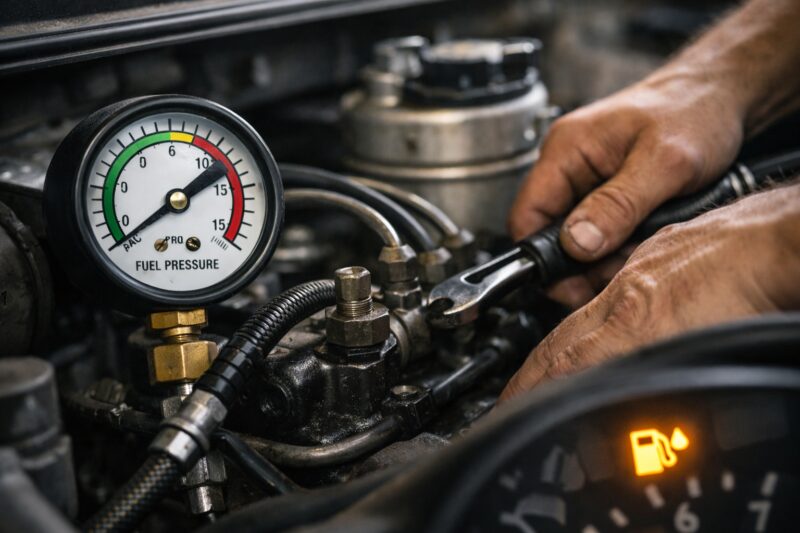
Fuel-system diagnosis also has tool limits. A pressure gauge and proper scan tool functions often matter. Flow and return checks can require specific adapters and safe procedures. If you plan diesel fuel system repair yourself, follow the right steps for depressurization and capture. Cutting corners can lead to leaks, inaccurate readings, or repeat repairs.
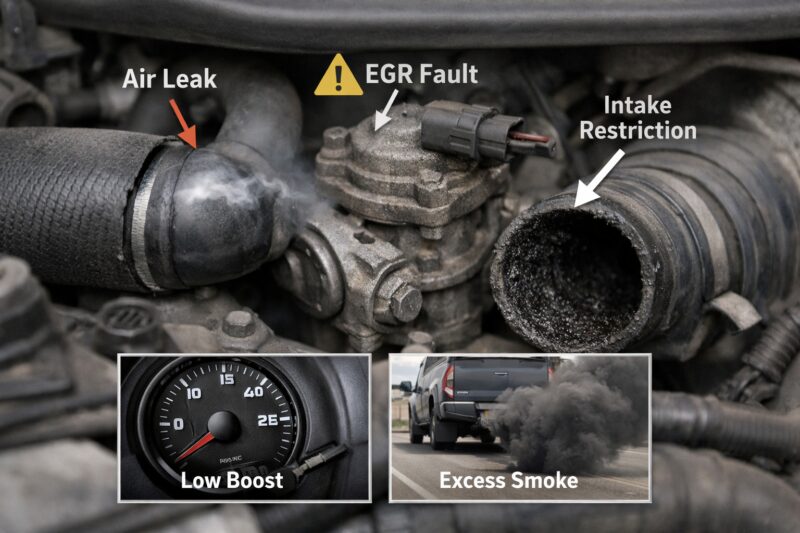
Air leaks, EGR faults, and intake restrictions that reduce boost and create smoke
Boost loss, reduced power, and odd smoke patterns often come from airflow control problems in the intake and emissions paths. These issues can also overlap with fuel symptoms because poor airflow leads to poor combustion. Therefore, the fix depends on where the airflow is actually going wrong, not on what code appears first.
On many modern diesels, the airflow path includes the turbo, charge pipes, air filter housing, intake tract, EGR valve or control system, and sometimes intake throttle or related actuators. A vacuum leak can affect control strategy even when the turbo itself is healthy. Charge-air leaks after the turbo reduce the effective boost the engine receives. EGR flow problems can also upset combustion stability and soot management.
Watch for observable outcomes. Do you get turbo whistle noise, lag, or a “lazy” response under load? Do you see different soot patterns after hard acceleration versus steady driving? Some drivers also notice that the check engine light diesel comes on with boost or EGR plausibility codes. That combination often points to an air-path or control mismatch rather than a single failed injector.
A deeper insight involves soot buildup and drive cycles. Short trips can prevent complete soot burn-off strategies, which then overload sensors and aftertreatment logic. As soot increases, airflow and temperature sensing can become less reliable. That can create a cascade where the aftertreatment system flags issues that trace back to boost leaks, EGR imbalance, or restricted intake. A common mistake is replacing fuel parts while the real root is an air leak that starves the engine.
To choose inspection priorities, start with hoses, clamps, and visible charge pipes. Check the air filter, then inspect intake connections for cracks or loose fit. Next, verify whether vacuum-controlled components hold pressure. If you have scan data, compare commanded versus actual boost and check EGR commanded versus modeled results. Actuator testing and smoke testing are often needed when the intake looks “fine” at rest.
Injector wear and combustion problems that create rough idle and “misfire” behavior
Rough idle, vibration, and misfire-like drivability often involve injector and combustion issues. However, on diesels, “misfire” symptoms are not always electrical or injector-only. You need to consider spray quality, compression health, and readiness for combustion.
Injector faults can come from clogged internal passages or degraded spray patterns. In addition, incorrect injector quantity or compensation values can cause each cylinder to contribute differently. Carbon deposits can also affect spray quality, but carbon alone is rarely the full story. Meanwhile, glow and combustion readiness issues can look like injector problems, especially during cold start.
How do you interpret roughness correctly? Look at whether it changes after warm-up. Does the engine shake more on cold mornings and smooth out once hot? Does vibration appear only under load? Also check whether the idle speed control hunts or stays steady. Those clues help separate fueling imbalance from mechanical issues like low compression.
Combustion-related issues matter too. Low compression from mechanical wear can create uneven combustion that mimics injection problems. Overheating from weak cooling can also degrade combustion performance and accelerate fuel-related deposits. A nuance many people miss is that diesel “misfire” can be caused by a combination of spray problems and cylinder conditions, not just injector spray.
Real-world scenarios show why one-time checks fail. In fleets with infrequent oil changes and overdue filters, injector deposits can build and affect injector response. Owners who use off-spec fuel or have unknown filtration discipline can also see accelerated wear. If you only replace the component named by a single code, you might still have poor rail pressure stability or a related air control problem.
Glow plugs, cold-start aids, and charging weakness that cause extended cranking
Extended cranking, late starts, and heavy smoke during start-up often involve glow plugs, glow control, or weak charging support. Even when the injector system is healthy, slow combustion readiness makes the engine struggle. As a result, diesel engine issues can look like fuel problems when the real cause is heat management for starting.
Glow systems typically include glow plugs, a controller, and sensors used to decide when and how long to preheat. When glow controller logic fails, the engine may not reach the combustion conditions it needs. Charging weakness adds another layer. Low battery voltage can slow the starter and reduce cranking speed, which then affects injection timing and combustion stability.
Symptom patterns are useful. Does the engine crank longer when cold but start normally once warmed? Does smoke appear gray or sooty, and does it clear after a few seconds? Do you see codes right away, or only after the engine meets certain thresholds? If you can measure battery voltage during cranking, you can separate voltage drop from true combustion readiness failures.
A deeper nuance is comparing voltage under load versus voltage at rest. A battery can “test okay” when static, yet still sag heavily during cranking. In addition, intermittent wiring or connector issues can cause glow operation to fail only when components heat up. A common mistake is assuming “glow system” means replacing parts without checking measured voltage and scan data.
There are tradeoffs in repair choices. Replacing all glow plugs can be reasonable on high-mileage engines, but targeted diagnostics can save money when only one side fails. Safety matters as well. Glow plugs use high-current circuits, so avoid shortcuts that can damage wiring or create false test results.
Exhaust aftertreatment faults that trigger limp mode and repeated warning lamps
Limp mode and persistent aftertreatment warning lamps often come from problems in the DPF and SCR/DEF emissions control systems. On modern diesels, the engine’s power may be limited if the aftertreatment system cannot manage soot or NOx emissions. Therefore, aftertreatment faults are not “separate” from fuel and air problems.
DPF systems manage soot by regenerating it. SCR/DEF systems use diesel exhaust fluid dosing to reduce NOx. Both systems depend on accurate inputs from sensors like NOx, temperature, and pressure sensors. If sensors drift or wiring is damaged, the control unit may behave conservatively and enter reduced-power states.
Driver-facing symptoms often include warning lamps, reduced power, and regen attempts that do not complete. Some operators notice frequent soot loading on the dash or in service information. However, a nuance many people miss is indirect causes. If fuel atomization is poor due to air leaks or injector issues, soot can rise faster. Then the DPF can overload sooner, and SCR dosing can become less effective because exhaust conditions shift.
Use a structured inspection sequence. First, confirm the vehicle’s operating pattern. Short trips often prevent full regeneration cycles. Next, read stored codes and capture freeze-frame context. Then check DEF fluid level and quality, and review prior service history. If the vehicle has a documented diesel fuel system repair history, that context can matter when aftertreatment faults appear soon after.
Real-world scenarios show why aftertreatment-only repairs fail sometimes. Replacing a sensor may clear warnings briefly, while the underlying cause keeps generating soot or skewing exhaust conditions. In fleets that run mixed duty cycles, aftertreatment logic can also flag cascades from boost control issues or EGR imbalance. The fix should confirm the root cause, not only the symptom lamp.
A diagnosis workflow that stops guessing on common diesel engine repair issues
The fastest way to reduce repair bills is to follow a symptom-to-cause workflow, not a parts list. A good process maps the symptom to likely systems, then uses evidence to confirm the next step. This is how you avoid repeating the same repair and still not fixing the problem.
Start with the basics. Check battery health, fuel filter condition, and air filter integrity. Then inspect for obvious air leaks like cracked hoses or loose clamps. Also check for charging and ground issues that can create random sensor behavior. These checks often prevent wasted labor before you even scan.
Next, connect symptoms to operating conditions. Note whether issues happen at cold start, during acceleration, or at steady cruise. Also record whether the symptom appears in park, at idle, or under load. Then retrieve codes and freeze-frame data. This is where diesel trouble code diagnostics becomes more than reading a number. The stored conditions help you narrow down which subsystem is likely failing.
When you interpret scan data, avoid confirmation bias. Do not assume injector failure because an injector-related code appears. Instead, request measurements that show rail pressure stability, injector balance where available, or return flow trends. Similarly, do not assume boost leaks just because power drops. Compare commanded and actual boost values and verify actuator responses.
Finally, know when to stop and escalate. If internal mechanical tests suggest low compression or if aftertreatment faults require coordinated fuel and air verification, involve a diesel specialist. If you see repeated limp events after the first fix, it often means the root cause was never confirmed. A professional diagnosis package with measured data reduces guesswork. It can also protect warranty coverage if repairs repeat.
Common mistakes and misconceptions during diesel engine repairs
Most repair mistakes come from skipping evidence, clearing codes too quickly, or replacing parts “by symptom” alone. On diesels, the same symptom can come from different systems. Therefore, a correct fix depends on what data supports the diagnosis.
One major mistake is clearing codes without documenting them. You lose freeze-frame context that can show the operating conditions during failure. Another mistake is ignoring maintenance history, including filter discipline and DEF service practices on aftertreatment-equipped vehicles. If engine oil change intervals and fuel filter intervals have been extended, multiple systems can degrade at once.
Misconceptions about smoke lead to bad decisions. Smoke does not always mean injectors. For example, airflow control issues can cause poor combustion and visible soot. Also, some light smoke can be normal during certain load changes or cold conditions. The key is condition-specific diagnosis, not generic assumptions.
A deeper nuance is air leaks versus injector failure confusion. Air leaks can cause low-quality combustion that looks like a weak injector. Injector wear can also cause uneven cylinder contribution that resembles an air control issue. If you only interpret “low power” and replace one suspected part, you may chase the wrong system repeatedly.
To improve accuracy, document symptoms carefully. Note cold versus hot behavior, idle versus drive conditions, and whether problems happen after long periods of parked time. Photograph warning lamps and inspect filter condition before removing any components. Also record what the scan tool shows, including code timing and freeze-frame data. This data hygiene is often the difference between a one-visit diagnosis and weeks of repeats.
Comparing repair options and what evidence to request
Choosing a repair should be about the plan and evidence, not only the part name. The best outcomes usually come from aligning the repair type with the confirmed root cause. When people compare quotes using the right criteria, they reduce the chance of paying for symptom fixes that do not last.
There are four realistic categories. First is maintenance or service refresh, like filters and fluid verification. Second is component repair or replacement, such as injectors, sensors, or actuators. Third is calibration or learning where required, especially after certain component replacements. Fourth is professional diagnostics with measured data and clear test results.
For injectors and aftertreatment-related repairs, ask what type of parts and documentation you receive. Replacement, remanufactured, or rebuild options can differ in how they are tested and what adaptation steps are needed. Request paperwork that shows the parts were tested and what specifications they meet. For aftertreatment repairs, ask how the shop verifies soot management and dosing logic after the fix.
A deeper insight involves calibration and learning. Some repairs can clear codes temporarily but then trigger repeats if software adaptation steps are skipped. Ask which procedures are mandatory for the specific repair you are authorizing. Also ask whether the shop will verify that sensor readings return to expected ranges under real driving conditions.
When evaluating quotes, look for accountability. Does the quote include diagnosis billed separately, or does it bundle tests into the repair price? Are the tests written clearly, and do they confirm root cause rather than symptom? Also check warranty terms on both parts and labor. Finally, consider your usage type. Short-trip commuters may need aftertreatment expectations and a maintenance cadence plan that fits regeneration limits.
Edge cases that complicate diesel fault repairs on modern engines
Some diesel engine failures do not behave like simple textbook problems. Intermittent faults, sensor drift, or multi-system cascades can hide the real cause. As a result, a repeat warning cycle may persist even after you replace the “obvious” part.
Intermittent wiring and connector issues are a common edge case. Heat-soak can loosen connections or change resistance only after driving. Then the scan tool captures faults that seem unrelated. Ground points matter too, because poor grounding can create sensor data errors that trigger odd control actions. A common mistake is blaming injectors or emissions hardware before inspecting harness routing and pin tension.
Cascades are another complication. One system can overload another. For example, a boost leak can upset EGR or exhaust conditions, then trigger aftertreatment limits. Injector-related issues can increase soot production and then cause DPF regeneration problems. This chain is why aftertreatment-only fixes sometimes fail if fuel and air verification did not happen first.
Aftermarket modifications can also create misleading patterns. Non-OE sensors, tune changes, or nonstandard DEF systems can shift control behavior and fault definitions. If you have any nonstandard components, be sure the diagnosis process accounts for them. Otherwise, scan codes may appear “wrong” to a technician who assumes stock configuration.
Mechanical edge cases exist as well. Compression variability can show up only under load, not during idle. That is why test conditions matter. If you only assess symptoms at a standstill, you might miss cylinder wear that appears when the engine demands full power.
Frequently asked questions about common diesel engine repair issues
What are the most common diesel engine repair issues by symptom like hard starting or stalling?
Hard starting and stalling often trace back to fuel delivery problems, air path faults, or cold-start support. For example, a weak supply can mimic injector failure during cranking. Because symptoms overlap, scan data plus operating conditions matter.
How can I tell whether the problem is fuel pressure versus an injector fault?
Cranking behavior gives clues, but it is not enough. A better approach is to request rail pressure stability data and injector balance or return trends when available. One test can mislead, especially if the fault is intermittent.
Why does my diesel go into limp mode even after replacing a sensor?
Limp mode can persist when the aftertreatment system still sees the root cause, such as soot overload or exhaust condition mismatch. Replacing a sensor clears a symptom, but it does not fix fuel, air, or wiring issues that keep triggering logic. Also check freeze-frame context to see what was happening when the fault set.
Yes. Contaminated or incorrect DEF quality can lead to dosing faults and regeneration problems. Verify DEF quality and level before replacing dosing-related parts, and confirm the exact code definition with stored context.
What should I check first before bringing my diesel in for repair?
Start with maintenance items and basic inspections: fuel filter condition, battery and charging support, and intake or boost leaks. Then document symptoms with cold versus hot behavior and warning lamp timing. Finally, pull codes and save freeze-frame data if your scan tool supports it.
Is it safe to clear diesel fault codes to see if the issue returns?
It is usually better to document codes first, because clearing can hide freeze-frame data. Intermittent faults may also appear differently after clearing, which complicates root cause confirmation. If you clear codes, be ready to capture new codes and conditions quickly.
How do short trips affect the frequency of diesel exhaust aftertreatment repairs?
Short trips often limit complete DPF regeneration cycles, so soot loads rise over time. That can lead to more frequent warnings and reduced power events. If your driving includes mostly short starts and city errands, plan maintenance and driving strategies around aftertreatment needs.
What long-tail signs suggest the injectors are worn versus the glow system failing?
Glow problems tend to show up most during cold starts and may improve after warm-up. Injector wear can affect idle quality and drivability across a wider temperature range. Smoke differences and injector-related diagnostic data can help separate the causes.
When should I suspect a charge-air leak or turbo control problem instead of fuel issues?
Suspect air or turbo control when power loss links to boost plausibility codes, abnormal smoke under load, or charge pipe symptoms. A common clue is delayed turbo response or repeated boost-related faults. Then confirm with inspection plus commanded versus actual boost checks.
Could wiring or sensor connector problems mimic major diesel engine problems?
Yes. Heat-related connector faults can create sensor dropouts and false readings that trigger major controls. Look for corrosion, poor pin tension, and damaged harness areas, especially after warning lamps recur intermittently.
Conclusion: choose root-cause evidence to end recurring diesel engine issues
When you face common diesel engine repair issues, remember the symptoms usually cluster into fuel delivery, air and boost/EGR control, combustion and injector health, glow or starting support, and exhaust aftertreatment logic. Therefore, the best first step is system mapping with real context, not a guess based on a single code or one visible symptom.
Use a clear decision path: document what happens and when it happens, check basic maintenance items like filters, and review trouble codes with freeze-frame context before replacing parts. Diesel trouble code diagnostics can guide the next measurements, but it should not replace basic inspections. Also, keep an eye on engine oil change intervals and DEF service habits because they can affect multiple systems at once.
If you need diesel fuel system repair, air-path verification, or aftertreatment root-cause confirmation, ask what tests were performed and what data was reviewed. When the repair plan includes measured evidence and a clear warranty, you avoid repeating the same work. When symptoms persist or aftertreatment warnings keep returning, consult a qualified diesel technician who can validate root cause rather than chasing the symptom lamp.
When you’re ready to move forward, focus on a plan that ties tests to outcomes and asks for accountability. That’s the fastest way to stop recurring diesel engine issues and get your diesel running reliably again in 2026.
Updated September 2026