
If you’re searching “ATV Repair Near Me,” the fastest way to avoid surprise costs and long downtime is to book only after a shop answers specific questions about fitment, diagnostics, parts/warranty, and turnaround. Your choice affects not just what you pay, but whether the underlying cause is fixed safely the first time—especially with no-start issues, slipping drive, or brake and electrical problems. This is a transactional guide for people who need a repair booked now (or must choose the right option before dropping the ATV off), not a general maintenance article. If you’re planning preventive service, you can still use the same checklist to confirm transparency and reduce comebacks.
How to choose ATV repair near you (a 7-question decision path)
If you want the right results from “ATV Repair Near Me,” use a decision path that starts with the problem, then validates fitment and diagnostic approach before you hand over the keys. The goal is simple: make sure the shop can correctly diagnose your exact ATV and communicate costs and timelines before work begins.
Choosing the wrong shop often shows up later as misdiagnosis, incomplete troubleshooting, or parts sourced incorrectly. For example, a common no-start case might look like “bad spark” when the real issue is a charging problem, a clogged fuel delivery path, or a safety switch fault. When the shop skips a structured diagnostic process, you can end up paying for parts that do not address the root cause.
Here is a practical decision path you can follow: identify the symptoms and likely system (starting, fuel, ignition, charging, brakes, driveline). Next, shortlist nearby shops and call with the same information each time. Confirm who actually performs the work (especially if the shop uses partner facilities). Finally, book only after they meet your criteria for diagnostic scope, written estimates, parts and warranty rules, and realistic turnaround.
The deeper nuance with “near me” is that it can hide operational complexity. Some listings represent an intake location, while the actual work is performed at a different facility with different parts inventory and lead times. That matters for downtime and return-visit frequency; insist on confirmation of where diagnostics and repairs will happen.
Set success criteria up front: diagnosis clarity (what they checked and what they found), written estimate approach (line items and approval workflow), and a timeline that reflects parts availability rather than hopeful promises. This also ties into the ATV repair shop checklist you can reference to align expectations before your appointment.
Ask these 7 questions before booking ATV repair near you
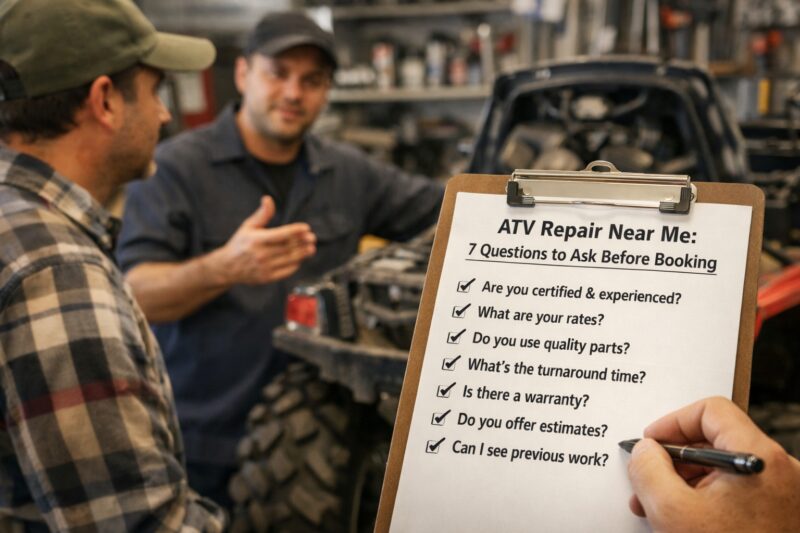
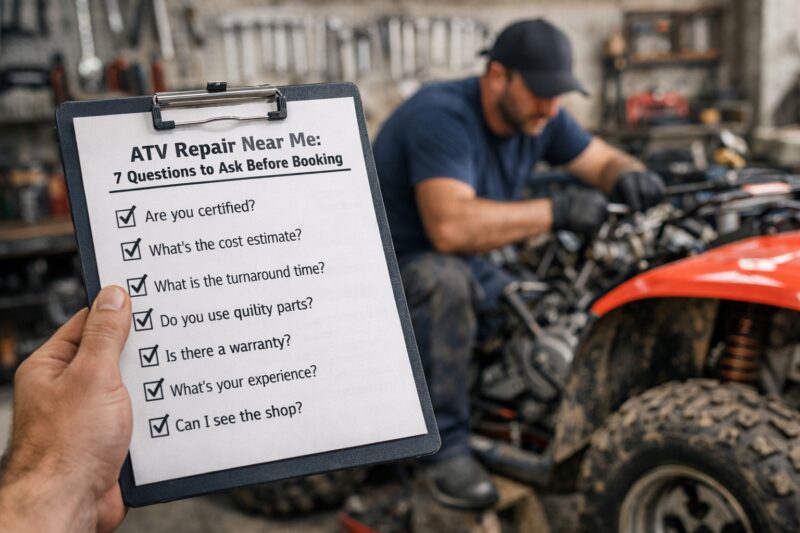
Before booking “ATV Repair Near Me,” ask seven targeted questions that force the shop to explain fitment, diagnosis, parts, warranty, and approval steps. If they cannot answer clearly, you’re taking a risk that will usually cost more later.
These seven questions reduce risk in four main ways: they limit misdiagnosis, prevent surprise costs, improve parts compatibility, and reduce the chance of extended downtime due to backorders or incomplete testing. Most importantly, they ensure the shop’s process matches your urgency—no-spark repairs and slipping drive issues often need a tight diagnostic loop, while planned preventive work still benefits from documentation and parts sourcing clarity.
Before you call, gather the “what to bring/know” basics: ATV make, model, year, engine size, VIN if available, and the exact symptom timeline (sudden after riding in rain, gradual loss of power, intermittent cut-out). Bring photos or short video showing what the ATV does (or does not do). If any error codes exist (on models with diagnostics), note them exactly and share any recent changes (battery replacement, aftermarket exhaust, new clutch/drive parts, or fuel changes).
Question 1 should confirm fitment and scope: “Can you confirm you service my ATV make/model and the specific system involved?” Ask what evidence the shop uses—service logs, technician training, or their history with your exact configuration. If the shop replies with vague confidence but cannot specify the system (for example, whether they troubleshoot starter circuits vs. ignition coils vs. fuel delivery), you should treat it as a red flag.
Question 2: “What’s your diagnostic process and how do you charge for it?” Confirm whether diagnostics are free with repair, a flat fee, or billed hourly. Good answers include the testing order, what they will communicate during the process, and whether they provide a written summary. If you rely on the wrong diagnostic path, you may pay for repeated “try this” steps rather than a root-cause fix.
Question 3: “What parts will you use—OEM, aftermarket, or remanufactured—and what warranty do they include?” Ask what the warranty covers (parts only vs. labor too), the duration, and how claims are handled. Deeper insight matters here: the shop should explain why they recommend a repair, not just what they plan to replace. Require a cause-versus-symptom explanation—avoid vague upsells like “it probably needs a carb cleaning” when the actual problem may be fuel delivery or an air leak.
To keep your questions consistent across calls, use the same internal framework from the honest repair estimate checklist so each shop answers apples-to-apples.
What to verify about diagnosis, estimates, and timelines (avoid booking surprises)
To avoid booking surprises, verify diagnosis scope, how estimates are written, and how timelines account for parts shipping and backorders. A transparent shop will explain how they confirm findings and what triggers an update or change in price.
Start with how to interpret an estimate. A strong estimate breaks labor and parts into line items and clarifies whether the price is “not-to-exceed,” subject to inspection, or contingent on additional testing. Ask what triggers a re-quote. For example, diagnosing electrical faults often requires follow-up tests once the battery health and charging output are verified; a good shop explains what new information could change the plan.
Turnaround realism is the next test. Parts lead times can vary widely in 2026 due to manufacturer inventory cycles, shipping delays, and supplier consolidation. Ask how they handle backorders: do they notify you immediately, request approval before waiting on parts, or propose a time-saving alternative when OEM is delayed? You should also ask about scheduling constraints—how soon they can intake your ATV and whether your appointment date is “diagnostic drop-off” or “repair start.”
Confirm diagnostic scope tailored to symptoms. If your problem is no-start, a quality check typically includes battery and charging verification, spark testing, fuel delivery checks, and inspection of common failure points like safety switches and air/fuel intake obstructions. If you have slipping drive, confirm driveline inspection steps (clutch/variator condition, belt condition, alignment, and related wear). If brakes feel inconsistent, insist on a real brake inspection rather than a quick “it might just be dirty.”
Edge case to ask about: what if they see multiple possible causes during inspection? For example, they might discover both a charging issue and a fuel system fault. Ask how likely each cause is, what additional testing they will perform to narrow it down, and where the “stop conditions” are—when do they stop digging and present your decision?
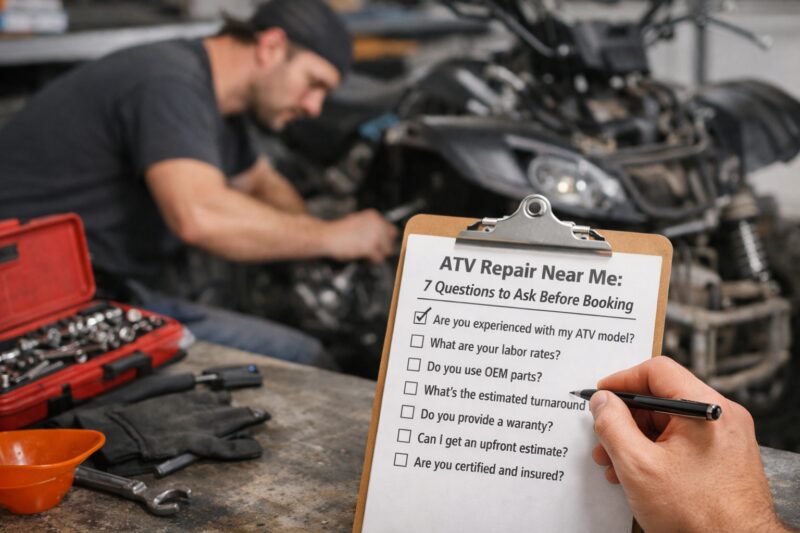
Finally, set an outcome the reader can aim for: a written plan to proceed, not just “bring it in and we’ll see.” That’s where the ATV tune-up safety checklist can be useful as a parallel reference for safety-critical inspections and documentation expectations before you commit.
Common mistakes when searching for ATV repair near me (pitfalls to avoid)
When searching for ATV Repair Near Me, the biggest pitfalls are choosing based only on proximity or price, then skipping diagnostic and warranty questions. Those mistakes lead to wasted trips, incomplete fixes, and repeat failures.
One common transactional error is “quote-first” booking without diagnostics. A shop might quote based on your description—like “bad stator” for a no-start that also includes a weak battery or fuel delivery issue. Without structured testing, you risk paying for parts that do not address the true root cause. Another mistake is ignoring warranty terms: a shop may offer a part warranty but not include labor, or they may use vague language that makes claims difficult.
A third pitfall is assuming any mechanic can handle ATVs. Some general shops can do quality mechanical work, but powersports competency matters for fitment, fastener/torque conventions, safety checks, and part sourcing compatibility. Ask what experience they have with your exact system and whether they understand the ATV’s model-specific wiring and safety interlocks.
Red flags to spot early: refusal to discuss process, no documentation of work performed, and pressure to approve without a written estimate. Another deeper-than-obvious problem is symptom-masking repairs—like cleaning a carb when the real issue is contaminated fuel, a damaged fuel pump, an air leak, or an intake sealing failure. In that scenario, the ATV might run briefly, then fail again, turning your initial repair into a “comeback” expense.
If you want immediate prompts you can use on the phone, try this approach: if they say “we’ll know once we take it apart,” ask “what tests can you run first, and what would change the plan?” If they say “all ATV parts interchange,” ask for part numbers and compatibility verification by VIN or model year. If they say “warranty is standard,” ask “what exactly is covered, for how long, and how are claims handled?”
Compare your options: shop types, service models, and realistic tradeoffs
To choose the best ATV repair booking option, compare shop types by how they handle diagnostics, parts sourcing speed, warranty clarity, and safety-critical inspections. The cheapest quote is not always the lowest total cost if it increases rework or repeat visits.
Here are realistic options you’ll encounter when searching for ATV Repair Near Me: a full-service powersports ATV/motorcycle repair shop, a general automotive shop that explicitly claims powersports competency, a mobile repair/on-site diagnostic option (useful for non-start or no-drive situations), and a dealership or authorized service center (often strongest for OEM compliance). Each comes with tradeoffs in transparency and logistics.
A full-service powersports shop typically excels at diagnosis because they’re familiar with ATV-specific systems and common failure patterns. They may also communicate better around parts compatibility and warranty processes. A general automotive shop might be cost-effective for basic mechanical concerns, but you should verify that they can source and fit powersports-specific components and perform safety checks correctly.
Mobile diagnostic services can be a smart first step when your ATV cannot be driven safely to a shop or when you need fast triage. However, parts replacement may still require a trip to source components, and you should confirm whether the mobile provider coordinates with a repair facility for the actual work.
Dealership or authorized service centers can be a strong choice when OEM parts and warranty compliance are priorities. The tradeoff is often cost and lead times, especially if OEM parts are backordered. The most important apples-to-apples method is to ask the same seven checklist questions to each option before you book.
Deeper insight: parts availability vs. quality can change your outcome. If OEM is delayed, a shop might propose aftermarket or remanufactured replacements. Ask them to explain compatibility verification (and how they handle revisions) and what the warranty covers for that part type. If the shop cannot state warranty terms clearly, you’re taking risk in exchange for speed.
This is also a good place to think about your constraint: budget, urgency, and whether you must keep OEM compliance. If your issue hints at major internal work, consider checking additional context using engine rebuild warning signs so you know what “big repair” conversations should sound like before you commit.
Advanced considerations most guides miss (edge cases that change the decision)
Some ATV repairs are decided by edge cases—especially electrical intermittents, safety-critical brake/steering issues, and jobs that require tear-down authorization. If you handle these correctly up front, you avoid rework and reduce the chance you approve unnecessary work.
Electrical gremlins and intermittent failures are a classic challenge because the fault may not appear during a short inspection window. When calling for ATV Repair Near Me, ask how they will document tests over time: do they perform systematic tracing (battery health, charging output, stator/regulator tests, ground verification, connector checks) and provide results you can understand? A good shop doesn’t rely on “it probably needs a new part.” They test, record, and explain.
Another advanced scenario is engine work that requires tear-down authorization. Ask what portion of disassembly they can perform under the initial approval and what they need from you before deeper teardown. You should expect a clear plan for “if we find X, we recommend Y,” along with pricing boundaries for each step.
Safety-critical systems deserve special attention. For brakes, steering, and throttle return, ask what inspections they perform and whether they verify operation after replacement (not just “parts installed”). In many cases, riding the ATV to a shop with failing brakes can be unsafe; your booking decision should include tow/transport options and shop intake precautions.
Common mistake most guides miss: treating multi-cause problems as a single “guess.” If the shop finds both clogged fuel components and a low-charge condition, they should explain the probability and propose next-step testing to narrow causes. Your best outcome is a controlled diagnostic loop with “stop conditions,” meaning the shop knows when they have enough information to propose a repair direction.
Repeat-failure prevention is another edge case. Contamination risks (clutch contamination from wrong fluids, contaminated fuel, oil degradation, or charging-system damage) can cause the repaired part to fail again. Ask how the shop prevents comebacks: do they clean relevant channels, replace associated consumables, verify charging output after parts installation, and document what they tested?
Finally, what good communication looks like during the job: photo/video updates when parts are removed or components measured, a call-before-change policy if work scope shifts, and a final inspection confirmation that ties results back to the original symptoms.
Geographic anchor: what “near me” should mean for ATV Repair Near Me (local constraints that matter)
When you search for ATV Repair Near Me, “near” should translate into practical factors that affect your repair timeline: drive time, intake process, and whether the shop can receive your ATV from your area efficiently. If those details are vague, your turnaround can slip even if the address looks close.
Start with drive time tolerance and transport options. If your ATV won’t start, has brake issues, or has driveline problems, you may need towing or trailer transport instead of riding it. Ask whether the shop offers drop-off instructions, has an intake ramp or proper tie-down space, and can safely receive a non-running or partially disabled machine.
Then clarify the operational “near me” nuance: some shops have multiple intake locations or partner garages. Confirm the exact facility where diagnostics and repairs will happen and whether they share parts inventory. This affects parts lead times, because an intake site may not have the same supplier relationship as the repair facility.
You can also ask about local operational considerations without needing a city name: typical parts delivery route speed (how fast OEM/aftermarket suppliers respond), shop hours for intake, and the procedure for emergency appointments. In some regions, high-demand weekends or seasonal riding spikes can change appointment availability rapidly—so ask what their fastest diagnostic appointment date looks like.
Deeper insight: “near me” can also hide jurisdiction or insurance/approval rules. If you’re using a warranty claim or insurance process, confirm they can provide documentation compatible with your provider and whether transport or mileage changes the claim workflow.
Use a short local verification checklist: confirm the shop address and whether the bay supports your ATV’s size and configuration, ask how intake works (check-in steps and paperwork), confirm whether they can provide documentation for insurance or warranty purposes, and verify who contacts you for approval updates during the job.
Frequently Asked Questions About ATV Repair Near Me
What questions should I ask an ATV repair shop before booking?
Ask whether they confirm your ATV make/model and the specific system involved before diagnosing. Then ask their diagnostic process and how diagnostics are charged (free with repair, flat fee, or billed hourly), and require a written estimate with line items. Finally, confirm parts sourcing (OEM vs. aftermarket vs. remanufactured) and the warranty coverage for both parts and labor.
How much does ATV repair near me typically cost for diagnostics?
Diagnostic fees vary by shop, but many use a flat diagnostic fee or hourly rate for troubleshooting. The key detail is what that fee includes, such as electrical testing, fuel delivery checks, or brake inspection steps. To avoid paying twice, ask whether the diagnostic fee is credited toward the repair if you approve the work.
Can I get an estimate before bringing my ATV in?
Sometimes you can get a preliminary estimate based on photos, symptoms, and error codes, but most shops will clarify that a true quote requires inspection. Expect “estimate vs. quote” differences: a rough range based on common failures versus a written estimate after at least basic diagnostic checks. If the shop refuses to explain what information they need, you may be booking blind.
Do you use OEM parts or aftermarket parts for ATV repairs?
Most shops can source either OEM, aftermarket, or remanufactured components, but you should confirm compatibility verification by model year or part number. Ask what warranty each option carries and whether labor is included in coverage. If OEM is backordered, request the substitution policy and how they handle quality and warranty implications.
What should I do if the problem returns after repair?
Contact the shop promptly and request a warranty recheck tied to the original work. Provide any documentation you have, including what parts were installed and what symptoms returned. A strong shop will retest systematically rather than repeating the same fix without addressing possible root-cause contamination or additional underlying faults.
How long should ATV repairs take in 2026?
Timelines depend on the repair type and parts availability, but you should ask for a realistic schedule that includes shipping and backorder handling. Minor issues with in-stock parts may be quicker, while electrical troubleshooting or engine work often takes longer due to testing and tear-down authorization. The best indicator is how they describe their process for parts delays and when they update you.
What if my ATV won’t start—what diagnostics should be performed?
Ask for a structured no-start diagnostic sequence such as battery/charging checks, spark testing, fuel delivery evaluation, and inspection of safety interlocks and related switches. The shop should confirm what they tested and what results led to each next step. If they jump straight to replacing components without testing, that’s a higher-risk approach.
Is it safe to ride my ATV to the repair shop if the brakes are acting up?
If brakes are inconsistent or feel unsafe, do not ride it and risk a crash—use towing or transport instead. Ask the shop how they accept safety-critical machines and what intake steps protect technicians and your ATV. A safe shop will prioritize inspections and will not treat brake issues like a routine “maybe it’s fine” problem.
Can a general mechanic handle ATV repair near me?
A general mechanic may be able to help if they explicitly confirm powersports competency and can source compatible parts for your specific ATV. Ask what experience they have with your system and how they verify fitment rather than relying on “similar parts.” You should also require the same checklist expectations for diagnostics, written estimates, and warranty documentation.
How do you prevent repeat failures? ATV repair near me
Prevent repeat failures by insisting on documented root-cause testing, not symptom-only fixes. Ask how the shop verifies the repair after installation—such as charging output after electrical work or brake function after brake service. Also confirm what they do to address contamination risks (fluids, fuel quality, and clogged passages) that can cause the same problem to return.
Sometimes the most “transactional” part of ATV Repair Near Me is not the work itself—it’s the call you make before you book. If you shortlist 2–3 shops, ask the seven questions consistently, and require confirmation on fitment, diagnostic scope, written estimate/approval workflow, parts and warranty coverage, and a realistic timeline, you dramatically reduce booking risk. When you drop off your ATV, make sure the shop has your symptom details, photos/video, and documentation expectations so they can confirm what they will test and what could change your estimate. Then book only after you have a clear plan for what happens next and what happens if findings change—so you’re not paying twice for the same problem in 2026.
Updated May 2026