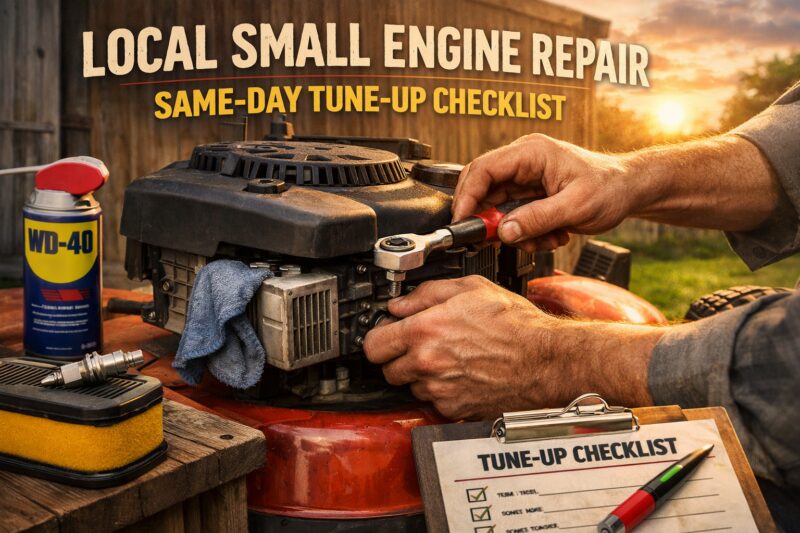
If your small engine needs service today, the fastest path to reliability is a same-day tune-up checklist that aligns what the shop can test immediately with what it may need to order. This Local Small Engine Repair guide walks you through exactly what to bring, what a competent tech should inspect, and what “complete tune-up vs diagnostics + repair” looks like so you can get predictable timing and pricing.
In 2026, same-day service matters commercially because downtime costs add up: a mower that won’t start delays cleanup schedules, a generator that struggles to load extends outage risk, and repeated failures waste fuel, labor, and emergency calls. A good shop can often perform preventive maintenance components and quick diagnostic checks immediately, but the timeline depends on whether the problem is consumable-level (spark plug, air filter, fresh fuel, oil) or requires parts and deeper measurements (carb rebuild, ignition module replacement, compression recovery). This checklist covers common residential and light-commercial equipment such as lawn mowers, trimmers, leaf blowers, generators, pressure washers, and small yard tools.
To keep expectations realistic, the steps below include “what to ask,” “what should be inspected/confirmed,” and clear boundaries for when same-day is likely versus when the shop should re-scope the work. If you follow the pre-visit guidance, you reduce diagnostic time and avoid the most common turn-around killers.
Same-Day Tune-Up Readiness: What to Bring Before You Call (Local Small Engine Repair)
To get same-day tune-up results, prepare the details a technician needs to triage quickly—then ask for a clear “what we can test today” plan. Your goal is to shorten diagnostic time by giving the shop model-specific and symptom-specific information up front.
Local Small Engine Repair becomes faster when the first phone call already contains data that affects fuel/air/spark behavior: the exact model and serial number, whether the issue is hard starting, smoke color, surging at idle, poor cutting performance, or bogging under load. Same-day timing is also commercially driven by predictability: shops that can run basic checks immediately can give you a firm pickup window and a controlled estimate, rather than an open-ended “we’ll see.”
Before contacting a professional, it's helpful to follow a few smart strategies for small engine repair. Start by gathering essential information, such as photos of the engine tag or the mower's deck sticker, along with a video showing your attempts to start the engine. Note any recent changes that could affect performance, including the type of fuel used (like 2-stroke mixture or unleaded), whether you added stabilizer during storage, and details about the storage conditions, such as exposure to heat and humidity. This preparation can make it easier to provide accurate information when you refer to the quick troubleshooting checklist on small engine repair. By being well-prepared, you can streamline the repair process and potentially avoid unnecessary service calls.
Same-day is realistic when parts aren’t required, when failure is consistent with common consumables on hand, or when the tech can validate the root cause with quick tests. If your engine has edge-case symptoms like a seized recoil starter, a broken flywheel key, visible fuel line cracking, or signs of low compression, the shop may need additional time to confirm and quote next steps. In those cases, a quality shop should communicate a revised scope quickly, not keep you waiting without a decision point.
One documentation pack that helps most customers move faster includes: (1) model/serial photo, (2) purchase year or age estimate, (3) current symptoms and when they began, (4) last service receipt or a written list of what was replaced, (5) fuel type and mixture ratio (if 2-stroke), (6) storage method and whether stabilizer was used, and (7) whether the engine is smoking (blue/black/white) and when. This also supports “faster, safer repairs” because the tech can confirm the risk level before tools and parts are pulled.
The Same-Day Tune-Up Checklist: Step-by-Step Shop Workflow
A competent same-day tune-up follows a shop workflow that prevents rework: safety steps, visual inspection, air/fuel/spark checks, then verified operating tests. If the tech skips verification, the tune-up may look complete while the underlying failure causes repeat breakdown.

How it works in practice is less about “turning knobs” and more about confirming each system can deliver the correct mixture and ignition timing under real operating conditions. A quality Local Small Engine Repair tune-up starts with safety and baseline checks because many “simple tune-up” symptoms are actually fuel contamination, vacuum leaks, clogged cooling fins, or ignition faults. When those are ignored, customers pay twice: once for the initial service and again when the engine fails shortly afterward.
First, the tech should complete a safety and baseline sequence (cleaning access points, removing covers safely, and noting any physical damage). Next comes visual inspection: air filter condition, intake and carb area integrity, fuel lines for cracks, throttle linkage movement, exhaust restrictions, and loose fasteners that can affect vibration and timing. Cooling system inspection is critical on mowers and generators; clogged cooling fins can cause overheating that mimics “fuel problems” or causes shutdowns.
Then the workflow should move through air/fuel/spark verification. That typically includes spark plug condition and gap, checking for consistent ignition, inspecting fuel delivery (including any filters), verifying correct fuel/air flow paths, and confirming the choke function where applicable. After consumables, the tech should calibrate and test for stable idle and correct throttle response. A real same-day tune-up should include at least a basic starting test and a controlled run to confirm the engine achieves operating condition reliably.
Important nuance: “cleaning” without diagnosing is one of the most expensive traps. For example, a carb surface cleaning might improve external cleanliness but still leave worn jets, stuck float behavior, or internal leaks that cause intermittent stalling. A good shop prevents repeat failure by confirming symptoms against checks: smoke pattern, starting behavior, idle stability, and whether the engine bogs only under load.
Same-day typically includes common consumables the shop can stock or already has access to: spark plug(s), air filter(s), and fresh/treated fuel where appropriate, and oil where applicable. However, if the diagnosis points to a spark module, carb rebuild kit, recoil assembly, or compression recovery needs, the shop should move from tune-up to repair planning with authorization before it becomes a waiting game.
Finally, the shop should be able to show that the tune-up was completed, not just performed. Practical verification includes a start-under-load or load-equivalent test when possible (for mowers: engagement and cutting behavior; for pressure washers: stable pressure with minimal pulsation; for generators: start and stable output behavior). The goal is operational validation, not just “it runs.”
How to Choose a Local Small Engine Repair Provider for Fast Turnaround (Decision Path)
Fast turnaround starts with choosing a shop that can explain what they will test today and how they decide next steps. Use a decision path: call scripts → intake quality → diagnosis fee clarity → timeline commitment → estimate structure.
Begin with the call itself. A shop that can handle same-day should ask targeted questions that narrow the problem quickly, such as starting behavior, smoke color, whether the engine stalls when you move the throttle, and whether the issue is consistent or intermittent. If they only ask “what’s wrong” without model context, they are likely to waste time re-triaging once the unit is on the bench.
Next, confirm how pricing is structured. Ask whether there is a diagnosis fee, what it covers, and whether it is credited toward repair if you approve work. Then request a timeline commitment tied to scope: for example, “What can you complete today if parts are not required?” A quality provider should offer a realistic window (intake-to-ready time or first test by end of day), and it should tie that to the shop’s bay capacity and stocked consumables.
Look for criteria that indicate same-day capability: service bay scheduling that can absorb walk-in or same-day drop-off, availability of common parts for popular brands, and a workflow that includes verification tests instead of “replace and hope.” Tradeoffs matter commercially. The lowest price may mean deferred testing or delayed authorization waiting for parts; the fastest schedule may trade depth unless the shop still performs verification steps. Warranty coverage also affects risk: ask what is guaranteed (parts, labor, or diagnostic work) and whether records are provided.
Nuance you should request explicitly is the difference between “tune-up” and “diagnostic + repair.” If the symptoms suggest fuel contamination or ignition misfire, the more commercially accurate path may be diagnostics-first with a short plan and authorization threshold. Ask whether they can provide a “diagnosis plan before approval,” such as checking spark and basic fuel delivery before ordering components—this keeps the same-day promise credible.
Examples help gauge what “fast diagnosis” looks like. Hard start with no smoke often points toward spark or air restriction; repeated brief starts followed by stalling can indicate fuel delivery issues or choke problems; intermittent power loss during cutting can reflect governor linkage or carb float problems. A shop that communicates these fast diagnostic indicators clearly is more likely to deliver a reliable same-day outcome.
When evaluating different providers, it’s essential to find the right repair service by prioritizing evidence-based workflows, which include documented tests, clear authorizations, and a transparent process from identifying the symptoms to the repair recommendations. Additionally, if your equipment is specialized, consider reaching out to experts in specific categories, such as an ATV-focused mechanic, especially when facing unique storage and access challenges.
If you are deciding between different service types, you may find it helpful to review a nearby-shop approach with on-site constraints, including influencer marketing for SEO style outreach and other local visibility tactics—but the key decision remains operational: communication and test verification.
Common Mistakes & Misconceptions in Local Small Engine Repair (That Cause Repeat Breakdowns)
The biggest misconception is “a tune-up fixes everything,” which leads customers to approve incomplete work and then experience repeat breakdown. A same-day tune-up should correct preventable issues and verify operation, not mask deeper faults.
Why this matters commercially is straightforward: every repeat failure burns time and money. A mower that stalls after a “tune-up” can force another day of downtime, while a generator that can’t reliably start under load creates outage risk. Repeat breakdowns often happen because the shop focused on consumables or cleaning without confirming root causes like compression condition, ignition module integrity, or internal carb behavior.
One common customer pitfall is customer-provided fuel or oil. Wrong mixture ratios for 2-stroke equipment, stale fuel from old containers, contaminated fuel stored with water, or incorrect oil grade/level (and missing oil where required) all undermine same-day outcomes. Even a perfect tune-up cannot compensate for inconsistent fuel delivery. If your fuel history is uncertain, tell the shop directly; that transparency helps them adjust their test plan quickly.

Another mistake is booking/expectation misalignment. Customers show up with minimal information or refuse authorization for needed parts under the assumption the shop will “make it run today anyway.” In reality, a good shop should explain what can be done immediately and what must be scoped after tests. Expecting load testing without the right equipment or assuming that a carb clean equals a carb repair often produces disappointment and a second visit.
Deeper insight: recurring issues can point to an underlying system problem that simple maintenance cannot resolve. For example, repeated surging can indicate a vacuum leak, float failure, or governor linkage problems rather than a bad air filter. If a pressure washer repeatedly loses pressure or cycles strangely, it may involve pump components, unloader behavior, or clogged inlet screens—not just a tune-up.
Red flags readers should watch for include vague inspections (“we’ll just adjust it”), unrealistic timelines without stating whether parts are required, and unclear warranty or no record of what was replaced and what tests were run. Also watch for shops that cannot explain why a symptom maps to an action. If the tech can’t connect your reported hard-start behavior to specific checks, ask for a diagnostic plan first.
If you need specialized coverage for equipment categories with access and storage complexities, look for faster, safer repairs workflows by asking about how they handle hard-to-access systems—similar to how an ATV mechanic often manages diagnostic constraints.
Options & Alternatives: What You Can Choose Besides “Just a Tune-Up”
Instead of choosing “just a tune-up,” choose the service option that matches your symptom severity and your downtime constraints. The commercially smarter approach is usually diagnostics-first when failures suggest ignition, compression, or internal fuel system issues.
There are several realistic categories of service. A preventive maintenance package is best when the engine runs but performance is declining (weak cutting, slow starts during the season’s first use, or minor surging). Diagnostics-first service is better when the engine fails to start, starts then dies immediately, or exhibits smoke patterns that point to an ignition or internal fuel delivery fault. A full overhaul/repair makes sense when testing indicates worn internal components or repeated consumable failure. In severe cases, replacement or engine swap can be the most economical option when labor plus parts approaches the cost of a refurbished unit.
What is often missed is when a “tune-up” should be bundled with related work. If fuel lines are cracked or the filter is compromised, replacing those during the same visit prevents repeat failures. If the air intake path is leaking or a carb rebuild is necessary, treating that as part of the same job beats separate “clean and adjust” attempts that reopen the same labor expense. Conversely, over-servicing occurs when shops replace multiple parts without connecting them to test findings—this can raise cost without improving reliability.
Here is a simple comparison table you can use to keep total cost and time-to-ready under control.
| Service category | Typical timeline | Cost drivers | Best when |
|---|---|---|---|
| Preventive tune-up | Same day or 1 day | Consumables + labor | Runs but underperforming |
| Diagnostics-first | Often same day for basics | Diagnosis + test time | No-start, stalling, intermittent faults |
| Diagnostics + repair | 1–3+ days depending on parts | Parts + labor | Ignition module, carb rebuild, compression issues |
| Overhaul / deeper repair | Multi-day | Labor-intensive work | Repeated failures, internal wear |
| Replacement / engine swap | Variable | Unit cost + labor | Cost-to-repair approaches replacement value |
Commercially, ask each shop to quote by workflow stage: diagnosis step, then parts-only order stage, then labor stage. This keeps you from paying for repeated bench time. When you “get it fixed fast,” you want a provider that can explain why the selected option fits your symptoms and how it affects your readiness timeline.
If you are considering DIY baseline checks, treat them as verification, not a substitute for troubleshooting. You can inspect air filter condition, confirm fuel freshness, and check visible fuel line cracking, but avoid guessing ignition timing or disassembling carb components without understanding what will be verified afterward. For many customers, renting temporary equipment or borrowing tools for one day while the shop confirms deeper faults can be a lower-cost alternative than repeated “try-a-tune-up” cycles.
To compare service options consistently across shops, ask the same set of “what will you test today” questions and confirm authorization thresholds. This is the practical way to align downtime and cost instead of chasing vague promises.
What Most Guides Miss: Advanced Tune-Up Verification & Edge Cases (Deeper Than Obvious)
Most “tune-up” guides stop at spark plugs and air filters, but a reliable same-day outcome depends on advanced verification tests and clear edge-case communication. The tech should validate system behavior in a way that predicts continued operation, not just immediate starting.
Deeper insight starts with understanding what tune-ups can and cannot fix. Consumables address predictable wear and minor restriction, but they do not resolve compression loss, broken ignition components, damaged crankcase seals, or internal governor failures. Advanced verification helps you avoid paying for work that does not match the failure mode. That includes verification steps like checking for air leaks in the intake path, validating throttle linkage movement and governor response, and confirming that the engine transitions through idle and throttle without surging or bogging.
Edge cases matter because they define whether same-day can be preserved. For example, sometimes a clogged jet or accessible passage can be cleaned and flow restored quickly if the carb design allows safe bench cleaning. Likewise, if the symptom indicates an easy ignition component replacement and the shop stocks the correct module or coil, same-day recovery can still happen. But cases like compression loss, a cracked crankcase, broken rewind starter requiring disassembly, or internal governor wear typically force re-scoping. A quality shop should flag these possibilities during the first inspection and communicate the impact on timing.
Another advanced concept is leak checks and what they mean without turning the job into full teardown. A tech can often identify vacuum leaks through symptom mapping and targeted inspection rather than complete disassembly. Similarly, basic compression implications can be inferred from starting resistance and test results, prompting recommendations for deeper evaluation if needed. The key is to connect observations to a decision tree, so the customer isn’t surprised after paying for consumables.
Hidden problems commonly appear during operational testing: a mower may start fine but bog unevenly at cutting height, a generator may run without load but behave unpredictably under real load conditions, and a pressure washer may show pulsation that indicates pump unloader issues or inlet restriction. A proper checklist accounts for these verification points and should record what the engine did during testing so repeat customers can see the history.

Documentation also improves outcomes for repeat breakdown prevention. The shop should record parts used, settings performed, test results, and any adjustments that affect operation. This matters because if the engine fails again, the tech can compare results rather than guess. If you are trying to select a provider consistently, use that recordkeeping as a deciding factor in addition to timeline.
When you ask questions across different local equipment categories, consider where an influencer marketing for SEO type of approach matters less than operational workflow—i.e., you want the shop’s “verification narrative,” not just a promise. For specialized vehicle-adjacent equipment, you can apply similar diagnostic discipline—faster, safer repairs—when selecting an ATV mechanic for units with complex storage and access concerns.
Local Service in Your Area: How to Anchor the Checklist for Nearby Shops (National-to-Local Strategy)
To make Local Small Engine Repair same-day possible in your area, tailor the checklist to local storage habits, seasonal demand, and common equipment types—then use it to drive clear communication with nearby shops. The same process works nationally; only the assumptions change.
Start by anchoring your questions in what your region tends to see. In humid or hot climates, fuel varnish and moisture-related fuel degradation may be more common during storage, so you should ask what fresh-fuel verification looks like and whether they treat fuel as part of the tune-up. In colder climates, starting problems around the first thaw may relate more to fuel stability and choke function; in high-dust areas, air restriction and clogged cooling fins can dominate performance issues. These differences don’t require guessing if you bring a clear symptom timeline and confirm local practices when you call.
Verify local parts availability by asking what they commonly keep stocked for your equipment brands and engine families. If your area has many residential mowers and seasonal landscaping gear, those shops often stock common consumables. If you’re dealing with less common equipment—commercial-grade generators, specialized pressure washer models, or less-popular brands—same-day may depend more on diagnostics accuracy and pre-authorization for parts ordering.
Seasonal demand in 2026 can also break the same-day promise if you wait too long. Call early, request a diagnostic window, and ask how the shop prioritizes units with urgent downtime. Commercially, “urgency” means describing your operational need: for a mower, your target schedule and cutting height requirements; for a generator, whether you need it to start reliably under load and during power-transfer conditions. The more specific your readiness criteria, the more the shop can plan a “tested and runnable” pickup instead of a “we adjusted something” handoff.
Finally, define what same-day should mean operationally. In a reliable setup, it means pickup time plus a tested/runnable standard that matches your use case: stable idle, correct throttle response, no abnormal smoke pattern, and a functional engagement behavior where applicable. When you confirm those outcomes, you can compare shops fairly.
If you need help structuring questions and ensuring comparable quotes across providers, use choose the right repair service as your internal decision lens: workflow clarity, test documentation, and next-step authorization. That same decision discipline supports faster, safer repairs regardless of shop location.
Frequently Asked Questions About Local Small Engine Repair Tune-Ups (Same-Day)
What should be included in a same-day tune-up for a small engine?
A same-day tune-up should include a structured inspection of air intake and filtration, fuel delivery basics (including checking for obvious blockages or line issues), and spark plug/ignition checks appropriate to the engine type. It should also include confirmation steps such as a stable idle test and a practical run to verify throttle response. Many shops will replace common consumables like a spark plug and air filter if they’re worn or degraded.
How do I know if my small engine needs a tune-up or repair?
If the engine starts but performs poorly, a tune-up is often commercially appropriate. If it won’t start, repeatedly stalls, or shows clear smoke/color patterns (such as persistent black smoke or abnormal white smoke), diagnostics-first is usually the smarter path. Compression loss, ignition module problems, and internal fuel system failures typically require repair rather than “adjust and hope.”
What questions should I ask a local shop for Local Small Engine Repair pricing?
Ask whether there is a diagnosis fee, what it covers, and whether it is credited toward repair if you authorize work. Also request a scope-based estimate structure: what parts are likely, what labor steps they will perform, and what authorizations are needed before ordering special components. Clear pricing should distinguish a preventive tune-up from diagnostic + repair work.
Can a shop complete a tune-up the same day without waiting on parts?
Often yes for common consumables and adjustments if the shop has typical parts in stock and your diagnosis points to wear items. Same-day delays happen when the fix requires non-stock parts like specific ignition modules, carb rebuild kits, or major assemblies. A good shop communicates this early after quick tests rather than after hours of bench time.
Do spark plugs, air filters, and fuel treatment always fix hard starting?
They can resolve hard starting when the issue is contamination, a worn plug, air restriction, or degraded fuel. But they do not reliably fix ignition module failure, broken recoil or related starting components, or compression problems. If the engine has severe “no start” symptoms, the shop should verify spark and fuel delivery behavior before assuming consumables will solve it.
What’s the fastest way to speed up the diagnosis for a small engine?
The fastest customers provide model/serial information, a symptom timeline (when it started and whether it worsens), and details about fuel type and storage conditions. A video of starting attempts and smoke behavior can also reduce diagnostic guesswork. This preparation supports quick triage and makes same-day scheduling more realistic.
How long should a tune-up take for a mower vs a generator?
Many mower tune-ups can complete same-day because the workflow typically includes straightforward checks, consumable replacement, and a practical cutting engagement test. Generators may require longer verification because “runs” is not enough; technicians often need checks related to stable operation and load behavior. Turnaround also depends on whether special parts are needed and the shop’s testing equipment availability.
Is it worth paying for diagnostics if I’m already requesting a tune-up?
Diagnostics is often worth it when symptoms suggest more than routine wear, such as persistent stalling, repeated no-start events, or unusual smoke patterns. Paying for diagnostics can prevent repeat breakdown by identifying whether the correct fix is a repair rather than additional cleaning. If the shop applies the diagnosis fee toward approved work, the cost risk is usually lower.
What are red flags that a Local Small Engine Repair shop is overpromising?
Red flags include vague explanations of what will be tested, unrealistic same-day claims without asking for model/symptom information, and no clarity on parts availability. Another red flag is failing to document what was replaced or what tests were performed after service. If warranty terms and records are unclear, treat the promise as less reliable.
Can I bring my own parts to a local small engine repair shop?
Some shops accept customer-supplied parts, but they may limit installation or reduce warranty coverage because fitment and compatibility risks become yours. If you bring your own parts, document the part numbers, provide receipts if available, and ask the shop to confirm compatibility before installing. For speed, it is often better to let the shop source correct parts once diagnostics confirm what is needed.
Conclusion
Same-day Local Small Engine Repair is achievable when you bring the right readiness information, confirm the service scope early, and align expectations with what the shop can test immediately. A practical tune-up checklist reduces wasted bench time and helps the tech match your symptoms to the correct system checks.
Use the workflow outcome as your mental model: inspection order, verification steps, and a clear split between consumables that can be replaced immediately and parts that require sourcing. When you ask for a “tested and runnable” standard (idle stability, throttle response, basic operating validation under your equipment’s use case), you make the same-day promise measurable rather than vague.
When selecting providers, prioritize communication, documentation, and evidence of tested results—not just the earliest pickup time. To act now, compare 2–3 nearby shops using consistent questions, request a clear diagnostic and timeline plan, and confirm warranty/records before authorizing work so you minimize the risk of repeat breakdowns in 2026.
Useful next step: prepare your equipment details using the quick checklist before you call, and then choose the right repair service based on their described workflow. If your equipment category is more specialized, consider how get it fixed fast and faster, safer repairs show up in their diagnostic practices. You can also reference broader shop decision patterns similar to what you’d see in an ATV mechanic consultation when access and storage constraints complicate troubleshooting (for example, how they document tests and communicate scope changes).
External references for further reading on maintenance and safe handling principles: U.S. Consumer Product Safety Commission — general safety guidance, EPA Fuel Storage and Handling — resources related to fuel storage considerations, and OSHA Powered Industrial Trucks Safety Guidance — safety culture examples that align with professional bench and handling practices.
Updated May 2026