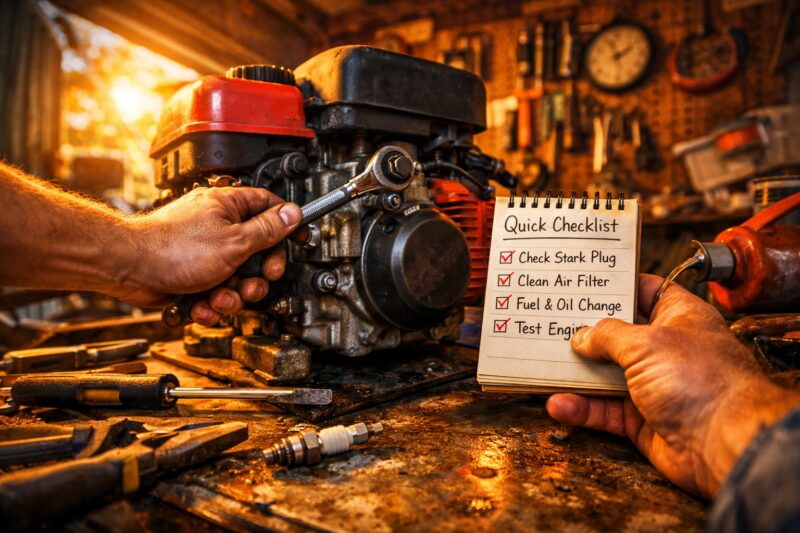
Small Engine Repair covers the commercial workflow of diagnosing small power equipment faults, sourcing the correct parts, and returning the unit to service on a realistic timeline. If you need fast Small Engine Repair with a clear checklist—so you do not lose mowing days, jobsite uptime, or generator readiness—speed matters because downtime creates lost revenue and drives customers to competitors during seasonal peaks.
This guide is a practical, checklist-oriented process you can use to achieve fast turnaround without sacrificing diagnostic quality. It applies to common small engines and powered equipment such as lawn mowers, snow blowers, pressure washers, generators, compressors, and small pumps. Throughout the article, the focus is on shop priorities: fewer follow-up visits, better estimate accuracy, and documented testing that supports customer trust.
You will see how the workflow should run from triage → diagnosis → estimate/approval → repair → QC → pickup/delivery. The goal is not to “replace parts faster,” but to make smart decisions earlier so parts ordering and labor time align with the real fault.
To ground this in safety and best practices, the same principles behind emissions-related and ignition safety guidance are reflected in manufacturer and regulator materials, including EPA appliance/emissions information and ignition safety considerations from major safety bodies (see U.S. EPA and OSHA). Where applicable, your checklist should also align with manufacturer service documentation for your engine family (for example, via OEM manuals and service bulletins).
Quick Intake Checklist to Prevent Delays in Small Engine Repair Shops
A fast job starts before any tools come out: use a standardized intake checklist that captures “time-to-need,” equipment identity, and symptom context so technicians can diagnose efficiently. In commercial Small Engine Repair, intake quality reduces misdiagnosis, prevents wrong-part waits, and shortens the cycle from estimate approval to finished pickup.
Why it matters: most delays are not caused by a slow repair—they come from incomplete customer details, missing model/variant information, unclear symptoms, or safety situations that require immediate pause. If a mower “won’t start” and the shop never records whether it was last stored with treated fuel, or whether the customer heard cranking, you lose hours guessing. A strong intake process converts vague claims into testable conditions and allows you to schedule a diagnostic window that matches shop capacity.
How it works: start with time-to-need details. Ask when the equipment is required and what happens if it remains down (e.g., the lawn must be cut before an appointment; a generator is needed for storm readiness; a pressure washer is needed for a commercial cleaning contract). Then gather engine/equipment specifics that control diagnosis speed: make/model/serial, power rating, fuel type, last service date, storage conditions (indoor vs outdoor, drained vs left with fuel), and a symptom timeline (first occurrence, worsening, intermittent vs consistent). These details influence whether the first tests should focus on fuel varnish, ignition components, air restriction, or mechanical compression.
Practical application: standardize intake photos and data to cut down on back-and-forth. A quick photo set can include the serial/model plate, spark plug (removed if safe), air filter condition, visible leaks, belt condition (for belt-driven units), and any abnormal smoke/odor. Decide early whether the repair path is “inspect-first” (verify diagnosis before ordering) or “parts-first” (only when failure mode is predictable). This is also where you incorporate a safety-critical stop: if there are signs of fuel leaks, overheating, smoke indicating internal failure, or severe abnormal vibration, the shop should pause intake-level troubleshooting and proceed with safe handling and escalation before promising timelines.
Tradeoffs and limitations: the intake checklist cannot replace on-bench verification. For example, “the carb is bad” is rarely safe to assume without checking fuel delivery and ignition fundamentals. However, a disciplined checklist can still shorten timelines by ensuring you have enough data for targeted tests rather than broad part swapping.
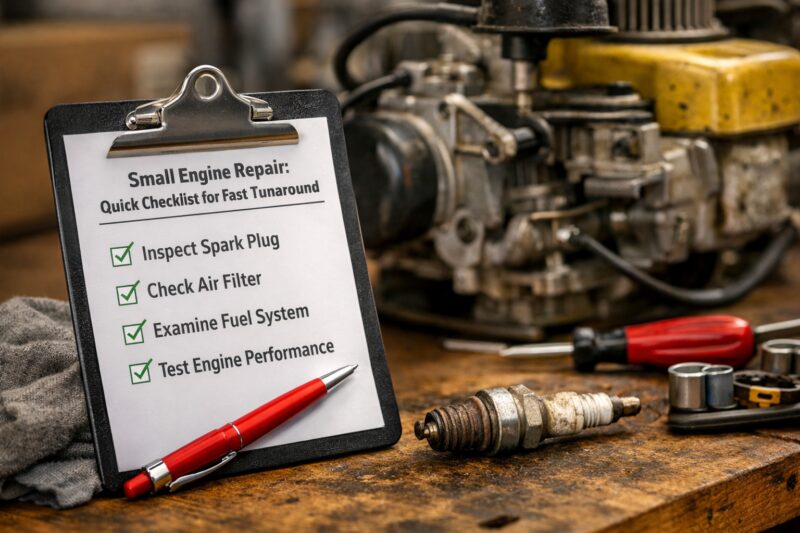
Real-world scenario: a customer drops off a generator that “starts then dies.” Without intake data, a shop might order a carb kit and wait a week. With the intake checklist, the technician notes cold vs hot behavior, records fuel age and storage ventilation, and captures a video of the “dies” moment. That enables a quicker decision on fuel flow restriction or ignition dropout. If you also run a tune-up checklist for starts in a consistent way, you reduce repeat work and improve first-time fix rates—especially for seasonal customers who arrive with similar symptom patterns.
Symptom-to-Diagnosis Flowchart: The Decision Path for Faster Small Engine Troubleshooting
The fastest troubleshooting path groups symptoms into likely cause categories and tests in a prioritized order that prevents wasted labor. When you structure Small Engine Repair troubleshooting this way, technicians spend less time chasing every possibility and more time confirming the most probable faults early.
Why it matters: most “slow diagnostics” come from starting with the wrong assumption. For example, ordering carb parts because a unit “won’t start” can be counterproductive if the real issue is no spark, a clogged air path, a venting problem, or low compression. A symptom-based approach reduces rework because you confirm fundamentals first, then move to targeted checks.
How it works: create a symptom grouping method that maps to likely causes, such as: won’t start, hard start, starts then dies, low power, surging, no spark, smoke/odor, and uneven running. For each group, define a prioritized diagnostic order. Typically, the first layer checks basics: fuel presence and quality, spark verification, air filter restriction and intake path, and (when warranted) compression or mechanical integrity. After basics, you perform targeted tests that are quick but meaningful—fuel flow/varnish inspection, air restriction checks, leak checks, and safe ignition tests.
Practical application: build go/no-go tests that produce decisions quickly without overstepping safe shop practices. For example, a spark test approach should confirm whether ignition output is present under crank conditions. Fuel checks should identify likely contamination (old fuel residue, clogged passages) and whether fuel is reaching the carb or injector system. Air restriction checks should verify filter condition and intake flow. Leak checks should confirm whether any external fuel leak or vacuum leak is contributing to failure. You can then map each symptom group to parts likelihood categories: no-parts-likely scenarios (e.g., fuel venting/air restriction) vs common-parts-likely (e.g., plug, filter, minor fuel components) vs diagnostic-required (e.g., intermittent electrical faults that need harness/module checks).
Deeper insight: intermittent faults require a different approach. Cold-start vs hot-start discrepancies often point to storage-related residue, moisture-related ignition issues, or heat-soak affecting fuel delivery and ignition stability. Instead of “chasing phantoms,” preserve turnaround by documenting conditions when the fault appears and running a focused test plan under those matching conditions. One common mistake most guides get wrong is advising generic carb cleaning for every symptom; a faster approach confirms whether the symptom truly tracks fuel delivery behavior or whether ignition and air limitations are the actual bottleneck.
To connect this troubleshooting workflow with customer-facing readiness, many shops use standardized documentation and even customer-friendly materials like a same-day tune-up checklist for shops that handle repeat seasonal equipment. If you want a structured way to communicate the basics without overpromising, the tune-up checklist for starts approach supports consistent diagnosis while customers understand what you verified before ordering parts.
Parts Sourcing & Estimate Speed: How to Quote Faster Without Rework
Speed in quoting comes from confirming the exact model/variant and linking the symptom to a fault category before ordering parts. When Small Engine Repair estimates are built on verified identity and disciplined parts cross-checking, you can provide faster approvals and avoid rework caused by wrong or incompatible components.
Why it matters: a quoted timeline only helps if the parts plan is correct. Shops lose weeks when they order a “close enough” part that fails compatibility (shaft size, manifold style, governor configuration, carb version) or when they identify the correct part but cannot obtain it quickly. Faster estimation is therefore not about cutting corners—it is about structured confirmation so you order the right parts on the first attempt.
How it works: run an estimate workflow that includes preliminary diagnosis, confirm model/spec, confirm symptom behavior, list parts with alternates, and define labor ranges based on the fault category. Alternates matter because inventory realities change the promised timeline. If an OEM part is backordered, you should identify a compatible substitute or a fast-delivery alternative at the quote stage. Labor ranges should reflect complexity: basic service parts (plug/filter/fluids) differ from carb rebuilds, ignition module diagnostics, or pump reseals.
Practical application: reduce “wrong part” risk by cross-referencing part numbers using the serial number, then verifying compatibility features that are easy to miss. For example, pressure washer pumps can require different seals or valve kits depending on model suffix and version. Small engines also differ in choke/primer style, governor linkage type, and carb mounting pattern. Your estimate should disclose assumptions and verification steps so customers know what is confirmed vs what depends on approval.
Tradeoffs and limitations: sometimes you can identify the parts family but not the exact kit until you disassemble and visually confirm internal components. In those cases, preserve speed with a staged approval approach: request authorization to continue diagnosis and order parts once a final identification checkpoint is reached. Another deeper challenge is sealed assemblies, discontinued kits, safety recalls, or warranty constraints that require only specific components. A fast shop handles these without guessing by documenting what they observed and why they need approval to proceed.
Communication matters as much as parts. Provide approval templates that clarify what “diagnosis continues” means, what the customer authorizes (inspection time vs parts ordering), and any return/refund policy if applicable. If you are choosing the right repair service, consider shops that can explain their parts sourcing assumptions and show a plan for in-stock vs fast-delivery vs backorder without hiding uncertainty.
Repair Execution & Timeboxing: Lab Workflow That Improves Turnaround in Small Engine Repair
Turnaround improves when repairs are executed with timeboxed workflow stages and QC gates that prevent repeat visits. In a commercial setting, timeboxing helps shops avoid idle-time bottlenecks and ensures Small Engine Repair stays on schedule from bench to pickup.
Why it matters: even with correct parts and estimates, downtime can happen between stages—waiting for the next authorization, waiting for a backordered component to arrive, or losing time to incomplete documentation. A lab workflow that sequences clean/inspect, replace, reassemble, and retest in a defined order shortens the overall cycle time and increases first-time completion.
How it works: set a shop workflow that timeboxes each stage such as intake triage, diagnosis window, parts waiting window, repair window, and final QC. Intake triage should verify paperwork, photos, and symptom notes are complete. Diagnosis window should produce a fault category and parts plan (or an “unknown requiring escalation” decision). Parts waiting window should set an internal trigger: when parts arrive, technicians start in the correct sequence rather than re-checking everything from scratch.
Practical application: labor sequencing should follow a “clean/inspect first” method. Clean the unit where contamination could distort results, then inspect wear items where justified. Replace components in logical order (for example, address fuel delivery or ignition issues before finishing carb adjustments). Reassemble with proper torque and adjustments reference points, then retest before final handoff. Quality control gates should verify fuel system integrity, spark verification after service, throttle/governor response, and leak checks under operating conditions when safe and feasible.
Deeper insight: rework prevention depends on documentation. Save before/after measurements such as spark plug condition, any compression readings if measured, and governor linkage adjustment reference points. Then keep a mini decision log for unknowns. If initial diagnosis is incomplete, escalate within a controlled troubleshooting time limit, and call the customer for approval with specific findings rather than vague progress updates.
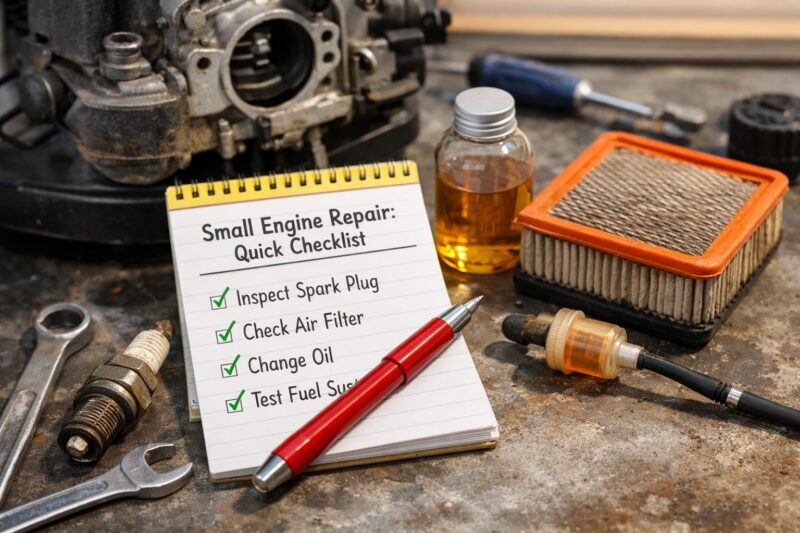
Real-world scenario: a lawn mower returns with “still surging.” Without rework prevention documentation, the shop may re-dismantle the same components and waste another cycle. With a controlled QC gate and the right faster job success checklist mindset—consistent retest conditions and recorded adjustment references—you reduce repeat visits and improve customer confidence, especially when multiple customers in a season require quick turnaround.
Common Mistakes & Misconceptions That Slow Down Small Engine Repair
Small Engine Repair slows down most often because shops skip basics, assume the wrong failure source, or under-communicate estimate and timeline assumptions. Fix the workflow gaps—not just the symptoms—and turnaround becomes both faster and more reliable.
Why it matters: the same equipment models appear across many customers each season, but symptoms vary. If a shop treats every “won’t start” as a carb problem, it will waste time ordering parts that do not resolve the real fault. Similarly, if the shop skips air/fuel/spark basics before ordering parts, it creates rework loops that extend downtime.
How it works: replace assumptions with symptom-based verification. Start with fundamentals: fuel quality and delivery, spark output, air restriction, and (when necessary) mechanical integrity. Only after fundamentals do you target common parts. Also verify model/serial/variant differences. A single specification mismatch can cause dissatisfaction even if the “part looks right,” because compatibility can depend on small mechanical or calibration details.
Practical application: avoid poor communication on estimates and timelines. Customers often accept delays if you are transparent about what is confirmed, what requires approval, and what could change the timeline. Include in your estimate what you checked, what is pending (for example, exact carb variant confirmation), and when the customer’s authorization is needed. This reduces the common mistake where customers approve parts quickly but then feel surprised when additional diagnostic time is required.
Deeper insight: troubleshooting after-market modifications can slow a job if the shop ignores them. Non-OEM parts, aftermarket mufflers, altered governors, or safety bypass modifications can change airflow and fueling behavior or disable intended controls. A fast shop does not “refuse to look”—it documents modifications, adjusts the diagnostic plan, and checks safety-critical configurations before making recommendations. Another what-most-guides-get-wrong issue is telling readers to jump straight to carb cleaning. For many intermittent surging and hard-start complaints, ignition stability, fuel venting, and air restriction are the real drivers.
If you want an organized way to evaluate service quality beyond the basics, use choose-the-right-repair-service criteria such as diagnosis transparency, part compatibility verification, and clear QC gates. That approach also supports consistent content for customers and staff training (for example, aligning with on-going service templates used across your shop).
Repair Options & Alternatives: Choose the Fastest Path (Without Lowering Standards)
The fastest outcome is choosing the right repair path—repair, rebuild/major service, or replace—based on downtime urgency, availability, and evidence of internal wear. A well-run Small Engine Repair shop treats “speed” as a decision framework, not as a shortcut that sacrifices correct diagnosis.
Why it matters: customers only feel the value of faster service when the fix lasts. If a shop pushes a low-cost repair when the engine shows signs of repeated or internal wear, you can get a quick return but more repeat failures. Conversely, if the shop replaces too early without evidence, customers pay more than necessary. The best turnaround comes from matching evidence to the repair option that is most likely to succeed quickly.
How it works: compare realistic categories of options. Repair-first works when failure mode is predictable, parts availability is good, and the unit does not show internal damage indicators. Rebuild/major service becomes favorable when repeated issues suggest internal wear, when rebuild kits are available and compatible, and when a major correction can restore reliable operation. Replacement makes sense for discontinued engines, extensive damage, severe corrosion, or when the cost-to-repair exceeds a practical threshold—especially when time-to-go is tied to a commercial schedule.
Practical application: assess economic repairability using concrete observations, not guesswork. Measurements and inspection findings should guide decisions: the severity of contamination, evidence of mechanical wear, compression status if evaluated, governor linkage condition, fuel delivery integrity, and whether multiple systems show damage. Document what you observed so the customer understands why repair is recommended vs why replacement is the better path for reliability and speed. This is where tune-up planning and structured diagnostics improve decision confidence.
Tradeoffs and limitations: “fastest option” can shift depending on parts lead time. Sometimes a repair-first approach is slower because the needed kit is backordered. In those cases, you might recommend a rebuild using a different kit that is available sooner, or even replacement if the customer’s downtime cost is high. The limitation is that you cannot ethically assume a repair option without verifying the underlying fault category.
Optional shop approach: during the estimate, present options with timeline implications and success probability ranges based on your fault evidence. Customers appreciate choices when they understand what each path includes. For shops that manage multiple service types, this decision framework also supports choosing the right repair service by demonstrating diagnostic discipline and realistic availability planning.
If you want a consistent customer-friendly way to explain what “repair-first” includes, consider aligning the communications with a same-day tune-up checklist concept—then expand the checklist into evidence-based choices about repair vs major service based on what your tech finds on inspection.
Advanced Considerations: Edge Cases Technicians Must Handle for a True Fast Turnaround
True fast turnaround requires special handling for edge cases like cold vs hot start behavior, intermittent electrical faults, governor/load mismatches, and equipment-specific constraints. If you include these checks early, Small Engine Repair shops avoid the longest delays—the “it works briefly then fails” cycle.
Why it matters: many engines appear repaired but return quickly when the underlying fault only appears under certain conditions. Intermittent issues are especially vulnerable to “incorrect replacement” because the technician cannot reproduce the problem reliably. Edge-case planning reduces guesswork and preserves the repair timeline without lowering safety standards.
How it works: start by separating cold-start vs hot-start discrepancies. Storage conditions, venting, and heat soak can cause fuel system behavior to change. Moisture-related ignition issues may appear only after humidity rises or after heat soak. A focused test plan should replicate the conditions when the fault occurs. For intermittent electrical faults, check grounds, harness integrity, and ignition control stability before replacing expensive components. For governor/throttle and load-related issues, distinguish no-load running from real load performance and validate that linkages and controls respond correctly under operating conditions.
Practical application: equipment-specific constraints matter. Generator load requirements, pressure washer pump symptoms (such as flow-related stalling), and compressor duty-cycle behaviors can cause symptoms that resemble engine faults but are actually system-level mismatches. For example, a compressor may stall under load due to valve or pressure behavior, creating a “starting” complaint. Narrow the fault scope efficiently by checking whether the engine runs correctly under the conditions that match the original complaint.
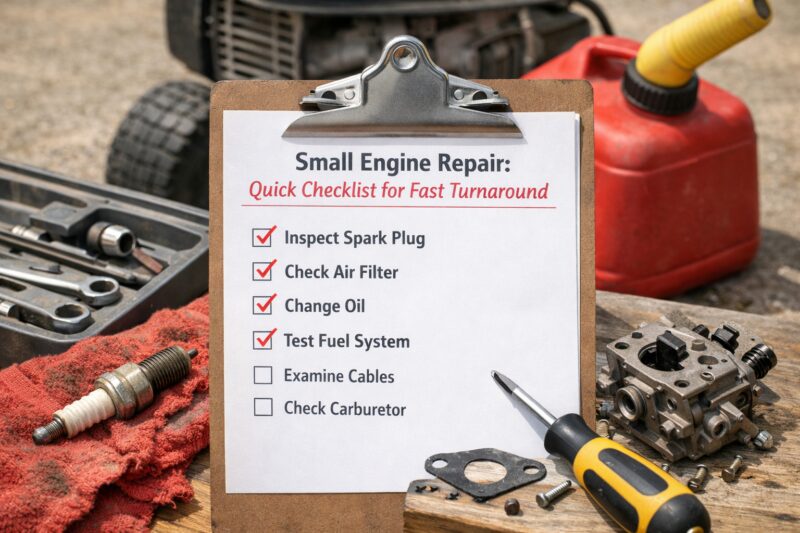
Deeper insight: warranty/coverage and compliance constraints can delay repairs if documentation is missing. Preserve speed by capturing photos, recording part numbers, and maintaining service records that support warranty claims. Another common mistake most guides get wrong is treating intermittent faults as a “repeat parts until it works” task. Instead, timebox diagnostics, log the conditions under which the symptom appears, and escalate with evidence. This approach aligns with the faster job success checklist discipline: confirm, document, and verify the fix under relevant conditions.
Real-world scenario: a customer reports “surging only when I cut long grass.” No-load testing might pass, but load testing reveals governor instability or air restriction under actual operating flow. The shop saves time by verifying throttle/governor response and airflow under realistic conditions rather than ordering parts immediately.
Where to Anchor Expectations: Region/Shop-Type Guidance for Small Engine Repair Turnaround
Fast turnaround is possible, but what “fast” means depends on the shop type, local throughput, and seasonal demand. When planning timelines for Small Engine Repair in 2026, shops should anchor expectations to capacity, parts lead times, and diagnostic windows rather than promising a universal number of days.
Why it matters: customers interpret timelines relative to their experience. A dealer service department may be constrained by brand-specific parts ordering and scheduled staffing. An independent shop might have higher flexibility but lower inventory depth. A mobile repair service could reduce transport time but may face limitations on parts availability or bench testing. Setting the right expectation protects customer trust and reduces escalations.
How it works: tailor service-level definitions by shop type. For an independent repair shop, “fast turnaround” might mean diagnostic within a defined window and repair completion within a short parts lead timeframe, assuming common parts availability. For a dealer service department, fast usually depends on OEM parts access and scheduling. For mobile repair services, fast turnaround might focus on diagnostic-first onsite checks, then quick follow-up after parts acquisition. In all cases, define what counts as “priority”: for example, priority diagnostics for safety-critical failures or time-to-need contracts.
Practical application: incorporate regional throughput patterns tied to weather and seasons. Spring lawn surges, storm generator demand, and pre-winter snow equipment preparation increase intake volumes. Capacity planning prevents overpromising by using tiered service levels such as standard service, priority diagnostics, and emergency triage (safety-related). Use intake intake notes to route jobs early into the appropriate tier so the shop does not lose time rearranging schedules after parts arrive.
Deeper insight: one way to maintain diagnostic integrity during peaks is to keep a minimum diagnostic standard for every tier, even if speed targets differ. You can still timebox diagnosis, but you should not skip fundamental checks. Another common mistake is advertising “same-day repairs” without a realistic parts plan. If you do not control parts availability or cannot verify model/variant quickly, same-day claims cause customer frustration when approvals are required.
For customers deciding where to bring equipment, comparing service tiers is part of choosing the right repair service. Look for a shop that can explain how they manage peak capacity and how they avoid overpromising, especially during major seasonal events.
Small Engine Repair starts with the basics: confirm the customer’s symptoms, check warranty coverage, and document what you find before you replace anything. A quick intake note helps you avoid rework and supports a fast turnaround, especially when parts or scheduling are tight. If you’re unsure where to begin, choose the right repair service so the work is handled the first time with the right tools and process.
Next, perform a focused inspection of fuel, air, spark, and mechanical wear, then prioritize the simplest fixes that restore safe operation. Keep notes on compression, ignition condition, and any visible damage, since that information usually shortens the diagnostics phase. With clear findings and organized parts ordering, Small Engine Repair can move from diagnosis to return faster, and you’ll have a consistent way to communicate timelines to customers.
Before testing, verify that the unit meets basic safety expectations and that all connections are correct, since small oversights can delay completion. Once you complete the repair, run a brief functional check and record the final results for the service record. For customers who want speed without surprises, choose the right repair service and maintain a clean, repeatable checklist from intake to pickup.
Frequently Asked Questions About Small Engine Repair
How long does Small Engine Repair typically take?
Typical timelines vary by symptom type and parts availability. A straightforward no-start fix with in-stock parts might be completed within 1–3 business days, while parts backorders can extend timelines by a week or more. Intermittent faults or “starts then dies” cases often require longer diagnosis windows to reproduce conditions and confirm the root cause.
What should I bring when I drop off equipment for Small Engine Repair?
Bring the exact engine/equipment make, model, and serial number, plus a short symptom timeline (when it started and whether it is cold vs hot). Include photos if possible: the air filter state, spark plug condition, and any visible leaks or abnormal smoke/odor. Also share fuel type and storage details, such as whether fuel was drained or treated before storage.
Why won’t my small engine start after a carb replacement?
If the engine still will not start after a carb replacement, the issue is often not the carb itself. Common causes include no spark, incorrect carb variant, clogged fuel delivery/venting, air restriction, or incorrect idle/speed adjustments after service. In some cases, installing the “right-looking” carb without matching choke/primer style or mounting variant delays resolution.
Can you diagnose Small Engine Repair without ordering parts first?
Yes, many cases can be diagnosed without ordering parts if the shop can verify fundamentals quickly (fuel, spark, air, and obvious restrictions). However, some repairs benefit from staged approvals where the shop begins diagnosis and confirms the exact part before ordering. If the fault category depends on visual confirmation after disassembly, expect partial ordering or an authorization checkpoint.
What are the most common causes of hard starting small engines?
Hard starting commonly results from stale or contaminated fuel, weak or failing ignition (plug, coil/module), restricted air intake, or incorrect choke/primer usage. Mechanical issues like low compression can also contribute, especially on equipment stored improperly. A fast check sequence usually confirms fuel quality, spark presence, air filter restriction, and whether choke/primer behavior matches the symptom pattern.
Is it better to repair or replace a small engine?
Repair is usually best when the fault is isolated, parts are available, and there is no strong evidence of internal wear. Replacement is often more sensible for discontinued engines, severe corrosion, extensive damage, or when the cost-to-repair exceeds the replacement threshold. A good shop supports this choice with inspection evidence and clear documentation so the decision is not guesswork.
How do you estimate labor and parts for Small Engine Repair quickly and accurately?
Accurate quick estimates come from confirming model/variant, matching symptoms to a fault category, and cross-checking parts by serial number. A disciplined estimate workflow includes preliminary diagnosis, a parts list with alternates, and labor ranges based on complexity. The estimate should also disclose assumptions and identify what requires approval to avoid rework.
Do you handle warranty work or manufacturer coverage for Small Engine Repair?
Some shops handle warranty work, but it depends on your coverage terms and whether OEM parts or specific documentation is required. Typically you need photos, part numbers, and service records to support the claim. Shops may also have limits on aftermarket components or modifications that affect warranty eligibility.
What’s the fastest way to get a generator back in service?
The fastest approach is generator-specific triage: confirm the complaint (no start, starts then shuts down, load-related failures) and check safety-critical conditions first. Then verify fuel quality and delivery, ignition/spark behavior where applicable, battery/charging state if relevant, and any venting or sensor fault indicators. Finally, source parts using model/serial verification and define an approval checkpoint before ordering.
Can intermittent surging issues be fixed fast, or do they require longer diagnostics?
Intermittent surging can sometimes be fixed quickly when the pattern is reproduced and traced to a clear cause such as air restriction, fuel venting, or governor linkage response. When the fault only occurs under certain heat soak, load, or weather conditions, longer diagnostics are often needed to confirm root cause. Timeboxing the tests and documenting conditions helps prevent repeat visits and reduces “chasing phantoms.”
Conclusion
Fast Small Engine Repair turnaround comes from a simple formula: intake quality + a symptom-to-diagnosis decision path + disciplined parts/estimate workflow + QC gates. When technicians capture time-to-need details, confirm exact model/variant information, and run prioritized tests before ordering parts, they shorten the cycle without sacrificing diagnosis quality.
Use the checklist approach to keep your repair process “speed-with-standards.” Safety-critical escalation rules, documented decision logs, and transparent approval checkpoints reduce rework and prevent customers from experiencing repeat visits that erode trust. This is especially important in 2026 during seasonal surges when capacity planning matters.
If you are a shop owner or a customer deciding who to trust, compare service quality by asking whether the shop follows a triage → diagnosis → estimate/approval → repair → QC → pickup/delivery workflow. For customers, the practical next step is to schedule an intake and provide the required model/serial details and symptom photos up front. For shops, the next step is adopting or refining your process using a consistent tune-up checklist for starts and applying structured troubleshooting to protect speed and reliability.
If you want to evaluate operational excellence, you can also align your internal training with a faster job success checklist and route intake questions using a same-day tune-up checklist concept—then expand it into timeboxed lab stages and evidence-based repair option decisions.
Updated May 2026