
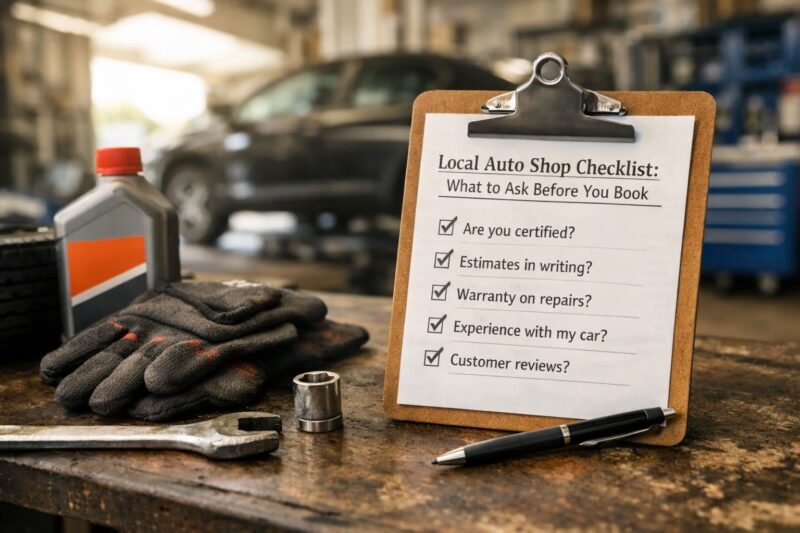
A Local Auto Shop checklist should do the heavy lifting for you before you book: reduce risk, prevent miscommunication, and help you verify answers so you get accurate next steps instead of surprises. In 2026, the best version of a Local Auto Shop checklist is the one that turns an appointment into a documented agreement—what they will diagnose, what they will do without approval, and what they will show you before work starts. This guide is designed to help you decide what to ask, how to confirm the details, and what to request in writing so you can book with confidence or walk away. You’ll also get a booking-ready call/script to request itemized estimates and warranty terms, plus a clear list of what to confirm online and in person. The checklist is built from common shop workflows, recurring customer complaint patterns (like unclear authorization boundaries and vague “diagnostic” outcomes), and typical documentation standards—so it reflects real repair processes, not dealership-style assumptions.
Below, you’ll find questions organized around how shops actually operate: service fit, intake and authorization, pricing and estimates, warranty and documentation, diagnostic methods, parts fitment, scheduling and communication, common mistakes, and alternative service options (including mobile and specialty). The scope stays focused on general service categories—diagnostics, repairs, and maintenance—so you can compare shops fairly without getting distracted by unrelated brands or product pitches.
Top 10 questions about Local Auto Shop Checklist: What to Ask Before You Book
The fastest way to avoid a bad experience is to ask a Local Auto Shop the right “top 10” questions before you schedule—especially around scope, approvals, pricing, and documentation. If you can get clear, consistent answers to these items, you dramatically lower the risk of last-minute add-ons, unclear diagnostic results, and warranty gaps. This matters because most repair disputes start long before a technician touches your car; they begin when the shop’s plan, your approval boundaries, and the estimate format were never aligned.
In practice, the best Local Auto Shop checklist works like a pre-authorization roadmap. It confirms what the shop will do first (usually diagnosis and inspection), what the shop will do next if findings expand, and how it will communicate changes. You’re not just asking for reassurance; you’re collecting verifiable details you can compare across shops and use later if something comes back or you need to support a warranty claim.
As you read the full checklist sections below, keep this “top 10” lens in mind. For example, ask how they estimate diagnostic time and what changes it; then ask for an itemized estimate format; then ask for their warranty coverage details and documentation they provide at the end. A common limitation: shops vary in how much they can predict before inspection, so you’ll want to request a structure like “what requires new approval” and “what is included in the diagnostic.”
A real-world scenario: you book for “check engine light.” If the shop only gives a vague price over the phone and does not define whether they’ll test drive, inspect related components, and verify root cause, you may end up authorizing additional work without understanding why. This article is written to help you prevent that by requiring a booking-ready scope and evidence trail—aligned with how NHTSA encourages safer vehicle maintenance decisions and how repair guidance emphasizes clear documentation practices.
Deeper insight: most guides focus on “what to ask,” but fewer emphasize “what to verify.” Verification might look like requesting the itemized estimate in writing, confirming diagnostic fee rules, and asking how they will document intermittent faults—because intermittent issues are where “code-only” outcomes can hide.
If you want a repeatable way to compare shops, this framework also supports your broader planning for choosing the right provider. You may find additional support in a step-by-step provider selection approach like the one covered in <a href="https://nrtoffroadperformance.com/auto-shop/">Shop Finder Checklist for Repairs</a>, and for narrowing technical fit you can also reference Mechanic Shop Checklist for Repairs. When you’re deciding between categories, use Choose the Right Service as a companion.
Pre-Booking Verification: What to Confirm With Any Local Auto Shop
Before you book, confirm that the Local Auto Shop is a fit for your exact job and that you understand their intake process. You want to know how they evaluate your vehicle, what information they require up front, and where their authorization boundary starts and stops.
Why it matters: service-fit and intake clarity prevent two high-frequency problems—repairers doing the wrong type of work first and customers authorizing the “wrong level” of effort. For example, a shop that primarily handles maintenance may still diagnose, but its diagnostic documentation process and tooling may differ from a shop that focuses on drivability and electrical root cause. If you skip this, you can end up paying for a vague inspection that doesn’t match your symptoms.
How it works: most shops run an intake flow that collects vehicle identity (VIN), mileage, symptom description, and sometimes prior work records or codes you already have. They then decide between appointment-only diagnosis, immediate inspection, or tow-in prioritization. Practical application: ask whether you should drop off at a specific time, whether they’ll start inspection immediately, and whether your case begins with scanning, a visual inspection, a test drive, or a combination.
Tradeoffs and limitations: a shop can tell you what they typically do, but it may not guarantee outcomes until they inspect the car. That’s why you should request what’s included in “diagnostic time” versus what needs new approval. For example, you can ask, “If you find related damage (like an oil leak) during diagnosis, what triggers you to call me before proceeding?”
Real-world scenario: your vehicle shudders under braking, but the shop assumes it’s pads unless they measure rotor condition and brake system behavior. A better approach is verifying intake expectations—ask what evidence they look for and how they decide whether the job is brake-only or requires additional inspection. This aligns with maintenance guidance principles found in resources like Consumer Reports on how vehicles should be serviced based on symptoms rather than guesswork.
Deeper insight (common mistake): customers often assume “we’ll take a look” includes diagnostic work. Many shops mean a quick inspection plus a recommendation, not a structured root-cause diagnosis. The verification step is to ask how they define “diagnosis” in their shop workflow.
To keep your process consistent, you can prepare your initial questions as a “Mechanic Shop Checklist for Repairs” style script before you call. Then, when the shop responds, capture their answers and compare the same fields across at least two Local Auto Shop options.
Pricing & Estimates: Questions to Get a Real, Comparable Cost for Your Repair
To get a real, comparable price, ask for an itemized estimate that breaks labor and parts clearly and explains how diagnostic fees work. Don’t accept one-line quotes when you need an apples-to-apples comparison between shops.
Why it matters: “pricing” in auto repair is often where misunderstanding hides. The shop may quote labor hours based on a procedure, but other shops might use different assumptions about diagnostic time, inspection depth, or parts quality tier. If you don’t normalize the estimate format, you may pay more for the same work—or pay less for less thorough diagnosis, which can cost you later.
How it works: a strong estimate lists labor hours (often tied to a published labor time or internal procedure), parts cost (with part type or quality tier), and applicable tax/fees. It should also specify whether consumables are included and how diagnostics are handled. Practical application: request an estimate that includes line items such as diagnostic labor (or diagnostic fee), inspection steps, the planned repair labor, and the parts with identifiers (at least part numbers or clearly described components).
Tradeoffs or limitations: some repairs start with incomplete information. A shop may provide a range, a “baseline” plan, or a preliminary estimate pending inspection. The solution is to require clarity on estimate accuracy—ask whether they offer a not-to-exceed cap, whether the estimate is a range, and exactly how changes will be communicated before additional work begins.
Real-world scenario: you’re quoted $120 for a diagnostic over the phone. When you arrive, the shop says the diagnostic could take longer because your complaint is intermittent. If you asked how they estimate diagnostic time and how they charge changes, you’ll know whether additional hours require approval and what documentation you’ll receive.
Deeper insight (what most guides get wrong): many guides say “ask for an itemized estimate,” but they don’t specify what to include and how to judge diagnostic line items. You should verify whether the diagnostic fee is credited toward the repair when you approve the work, and whether they will waive it under defined conditions (for example, diagnosis completed and confirmed).
Finally, confirm payment structure before work starts—whether a deposit is required, how holds affect your quote, and what receipts/invoices look like afterward. For broader selection criteria across vendors, this ties into Shop Finder Checklist for Repairs because quote-quality varies by shop model.
Warranty, Guarantees & Documentation Standards Before You Book
Ask about warranty and documentation standards before you book so you know what is covered, for how long, and how you’ll prove coverage later. A reputable Local Auto Shop should be able to explain both the warranty terms and the documents you receive at pickup.
Why it matters: warranty disputes often come down to documentation and process. If the shop provides no inspection notes, no replaced-parts identification, or unclear invoice details, it becomes difficult to support a claim if the issue returns. This is especially important for drivability, electrical, and diagnosis-related repairs where multiple systems could be involved.
How it works: most shops provide at least a final invoice listing parts and labor, and many provide inspection notes, printouts from scans, or replaced parts details. Practical application: ask what their warranty covers (parts, labor, and specific systems), the duration/mileage limits for your repair type, and how warranty claims are scheduled if a problem returns.
Tradeoffs or limitations: warranty terms can vary by parts brand (OEM vs aftermarket vs remanufactured). Some shops can offer broader coverage on workmanship, but parts warranties often depend on the supplier’s terms. This is why you should ask how they match parts to your vehicle (OEM vs aftermarket quality tiering) and whether they explain deviations before installation.
Real-world scenario: a remanufactured alternator fails after installation. If the invoice includes the exact component information and the shop follows a structured warranty claim workflow, you’ll typically get faster resolution. If the invoice only shows a generic label without identifiers, you might spend extra time arguing about what was installed.
Deeper insight (common mistake): people ask “do you offer a warranty?” but skip “how does the claim work later?” In your questions, request the process specifics: do they re-inspect, how fast they schedule, and do they require prior receipts/records. For additional baseline consumer guidance, you can review warranty-related consumer principles through Federal Trade Commission materials about consumer rights and dispute resolution.
Also confirm returns policy for unused parts and how ordering errors or cores are handled. If you reuse cores or customer-supplied parts, ask whether that affects warranty coverage and what documentation you should retain.
Diagnostic Process: How the Shop Finds the Cause (Not Just the Symptom)
Before you book, ask how the Local Auto Shop will diagnose the issue—so they focus on root cause instead of stopping at a symptom or code. The right diagnostic process should be step-ordered, documented, and designed to handle uncertainty.
Why it matters: a code is a clue, not a diagnosis. Without a structured process, shops can replace parts based on probabilities, which increases the chance of repeat failures and warranty friction. Your goal is to understand their diagnostic sequence and what evidence they gather before recommending additional work.
How it works: many shops begin with an intake scan, a visual inspection, checks for related components, and often a test drive to reproduce conditions. Practical application: ask what diagnostic steps they’ll run first and in what order—system checks, code interpretation, visual inspection, and test drives. Then confirm whether they use manufacturer-style procedures such as scan tool data analysis, freeze-frame review, and relevant service bulletins.
Tradeoffs or limitations: not every symptom is reproducible in the shop. Intermittent faults can depend on temperature, driving pattern, or load. A shop should explain what they’ll do in edge cases—collect evidence under real conditions, ask for your input about when it occurs, and confirm findings before you approve expensive next steps.
Real-world scenario: an intermittent misfire appears only during highway cruising and disappears in the driveway. A strong shop might verify with live data, examine fuel trims, check for ignition/coil patterns, and ask you to note conditions. A weaker approach might clear codes, “test” briefly, and then quote a generic replacement without evidence.
Deeper insight (what most guides get wrong): many people ask only “do you do diagnostics?” instead of asking what “success” looks like. You should request what result they will document when the diagnosis is complete—symptom resolution verification and verified measurements, not just a printed code list.
For added context about choosing technically aligned service options, cross-check how the shop’s diagnostic style fits your problem using guidance like Choose the Right Service.
What to Ask About Parts, Materials & Fitment at a Local Auto Shop
Ask what parts and quality tiers the Local Auto Shop will use and how they verify fitment for your vehicle. Fitment questions prevent incorrect parts, premature wear, and rework that can erase savings.
Why it matters: “parts” aren’t interchangeable across vehicles or even across model years and revisions. Quality tier also matters because OEM, OEM-equivalent, and aftermarket parts can vary in materials, calibration compatibility, and warranty depth. If a shop installs parts without verifying compatibility (VIN verification, cross-references, supersessions), you may get repeated failures and complicated warranty claims.
How it works: the shop selects parts based on compatibility and desired quality tier, then confirms product availability and lead times. Practical application: ask whether they use OEM, OEM-equivalent, or aftermarket parts, how they choose the tier, and what affects your final bill. Also ask whether they verify part numbers and compatibility using your VIN, and how they handle supersessions or product updates.

Tradeoffs or limitations: sometimes a required component is backordered, and substitutions may be necessary. The shop should explain lead times, where parts are sourced, and whether you can approve substitutions before installation. If you skip this, you might be surprised by a different quality tier or brand when your car is already in the shop.
Real-world scenario: you’re quoted for a radiator replacement. A deeper fitment check will confirm not only model compatibility but the specific version (fan shroud differences, sensor compatibility) and the correct coolant type. If the shop assumes “same part” without cross-referencing, you can end up with minor fit issues that create overheating or sensor errors.
Deeper insight (edge case): remanufactured vs new parts. Ask what warranties apply, what testing documentation they provide, and what failure modes they inspect for before installation. Many rework issues happen when a reman part fails because the root cause was not corrected (for example, contamination, overheating, or wiring problems).
If you want to align this with a structured decision framework, consider using Mechanic Shop Checklist for Repairs to standardize how you ask about parts and documentation across multiple shops.
Scheduling, Service Scope & Communication: Avoiding Misunderstandings
Before you book, confirm how the Local Auto Shop schedules your job, what’s included in the initial scope, and how they communicate updates. Clear communication rules reduce scope creep and prevent “we already did it” moments.
Why it matters: misunderstandings happen when arrival windows, authorization steps, and progress updates aren’t defined. Even a competent technician can create a bad customer experience if the shop’s process for check-ins and sign-offs is inconsistent. This is particularly common when “while-you’re-here” repairs appear during inspection.
How it works: shops typically define a check-in time, an inspection start time, and a customer update cadence (call/text/email). Practical application: ask what appointment handling looks like—arrival window, how they check in your vehicle, and what to do if you’re running late. Then confirm scope boundaries: what they inspect immediately vs what needs a secondary authorization.
Tradeoffs or limitations: busy shops may not offer frequent updates, but they should still document what they did and when you need to approve changes. Deeper insight: ask how they handle customer-owned parts, special instructions, and accessibility constraints such as lift availability, parking limitations, or tow coordination. If your vehicle is low or you have a compliance requirement (like a specific pickup procedure), it should be addressed before work starts.
Real-world scenario: you approve brake service, but during rotor inspection they find a caliper issue. A good shop will document the finding, explain why it changes the job, and request approval before replacing additional components. A poor process is when the shop calls after the work is done or gives a vague add-on price without explaining triggers and evidence.
Deeper insight (common mistake): assuming “authorization” is implied. You should ask exactly what the shop considers authorization—signature at counter, a text confirmation, a call with a service writer, or a written approval for each expansion. This makes later questions about scope boundaries far easier.
Finally, ensure the shop provides a clear handoff: what they review with you at pickup, how they answer questions, and how they confirm the final job list matches what was authorized. For comparing different service models that may communicate differently, use the broader selection approach in Choose the Right Service.
Common Mistakes & Misconceptions When Choosing a Local Auto Shop
Most problems with a Local Auto Shop come from a few predictable mistakes—choosing only by lowest price, assuming estimates are final, and skipping warranty documentation. Avoid these patterns to protect both your wallet and your peace of mind.
Why it matters: auto repair is not like buying a commodity. Your vehicle’s condition evolves during diagnosis and teardown. If you choose a shop primarily by price, you may inadvertently select a shop that under-scopes diagnosis, uses unclear estimate formatting, or doesn’t document findings. That can lead to repeated labor and parts changes that exceed the “difference” you hoped to save.
How it works: estimates often start as ranges because corrosion, hidden damage, and intermittent symptoms can’t be fully known until inspection. Practical application: validate the shop’s change-control rules. Ask how they communicate estimate changes, whether they provide a not-to-exceed cap, and whether you must approve each major deviation. If you don’t confirm this, you might authorize additional work without understanding why.
Tradeoffs or limitations: quotes over the phone can be useful for urgency and initial comparison, but they rarely replace in-person verification. Deeper insight: many guides incorrectly imply that a phone quote is “good enough.” In reality, intermittent issues, hidden damage, and unseen corrosion are exactly where phone estimates break down—so you should request diagnostic assumptions and what triggers deeper inspection.
Real-world scenario: a shop quotes a simple sensor replacement. After inspection, they discover wiring damage due to prior water intrusion. A shop with strong documentation will show you evidence and explain whether the original quote covered the wiring check or whether it requires new approval. A shop without that structure might try to treat the expanded issue as an entirely new transaction.
Deeper insight (pitfall): ignoring aftermarket fitment and quality. Some “cheaper” parts may be compatible but differ in tolerances, sensor behavior, or durability. Ask how the shop chooses quality tiers and how that choice affects warranty and expected wear outcomes.

If you want a more structured way to avoid these mistakes, you can anchor your process with a standardized comparison that aligns with Shop Finder Checklist for Repairs, especially when comparing shops that handle different scopes.
Options & Alternatives: Different Ways to Get Service (and What to Ask Each)
You can get vehicle service through several channels, but you need different questions for each option to ensure the scope, diagnostic quality, and documentation match your needs. This section helps you compare independent shops, dealerships, specialty providers, mobile mechanics, chains, and DIY-plus-diagnostic approaches.
Why it matters: different service models often lead to different workflows. Independent local shops might offer more personalized scope control, while chains may standardize labor and estimate formats. Dealerships often have strong access to manufacturer procedures, but parts pricing and appointment lead times may differ. Your goal is to compare the “coverage quality” of diagnosis and the clarity of authorization—not just who’s closest.
How it works: independent shops may rely on technician experience plus scan data. Specialty shops might be better for specific issues like electrical drivability or performance tuning. Mobile mechanics can be convenient, but you must confirm what diagnostics they can run on-site and how they verify results before payment. Practical application: for each category, ask what the diagnostic fee includes, what tools they use, and whether they provide documentation (scan printouts, inspection notes, parts numbers).
Tradeoffs or limitations: DIY + paid diagnostic can be effective if you clearly separate responsibilities. For example, you might remove and bring a part, then let a shop inspect and confirm the system cause. But you must ensure the shop is willing to accept the case as presented and that you agree on what they can and cannot validate given the constraints.
Real-world scenario: you suspect an electrical fault and choose mobile service. The technician may identify a probable subsystem but not confirm with advanced testing requiring a lift or specific equipment. A shop that is transparent about diagnostic limits can prevent you from paying for partial work that later needs re-diagnosis.
Deeper insight (what guides get wrong): comparing across categories without normalizing scope. For example, one shop’s “minimum inspection” may not include test drive time, corrosion checks, or scan data review. Build fairness into your comparison by requiring the same diagnostic inclusions, diagnostic fee rules, and change-control terms.
Optional comparison table idea (if you choose to include it): you can compare each option by estimates (itemized vs vague), warranty handling, documentation, diagnostic approach, and approvals. This complements the standardized selection thinking in Mechanic Shop Checklist for Repairs when you’re deciding which category fits your risk tolerance.
Advanced & Edge-Case Questions Most People Skip (But You Should Ask)
Before you book, ask advanced edge-case questions so the Local Auto Shop can handle your specific uncertainty—like additional damage discovered mid-repair, no-fault diagnostic outcomes, aftermarket modifications, and ADAS-related concerns. These questions often decide whether your repair goes smoothly or becomes a months-long dispute.
Why it matters: the more complex your case, the more likely workflow issues appear. Subframe rust, collision overlap, electrical harness complexity, and calibration requirements can’t be fully predicted from a short intake description. If you don’t ask how they handle mid-repair changes, you risk approving work you didn’t plan for—or waiting while you’re repeatedly re-contacted.
How it works: a strong shop defines sign-off rules for additional damage, documents findings, and sets scheduling expectations for warranty and parts delays. Practical application: ask how they handle additional damage found mid-repair and how your sign-off happens. For “no-fault” outcomes, ask what you will receive if diagnosis doesn’t identify a fix—like findings summaries, code interpretations, and next-step options you approve.
Tradeoffs or limitations: complex vehicles may require multiple diagnostic sessions. That’s normal, but you should still define evidence standards, communication frequency, and who makes the call when new possibilities arise. Edge case: aftermarket modifications. Ask how they approach vehicles with lifted suspension, ECU tunes, or aftermarket sensors—because they may need to treat sensors as non-OEM inputs and adjust diagnostic liability.
Real-world scenario: an ADAS recalibration requirement appears after front-end service. If you don’t ask how they verify calibration and documentation expectations, you may drive away with systems not properly calibrated, increasing safety risk. A good shop will clarify what verification steps they do (and what they require from you) before considering the job complete.
Deeper insight (common mistake): requesting warranty coverage without confirming how warranty claims are supported later. Ask whether they include part numbers, labor descriptions, and removed parts/cores handling so you can defend warranty claims. Many customers focus on the warranty length but forget to secure the evidence trail that makes the warranty enforceable.
If you want to streamline how you collect these questions across multiple potential shops, this advanced layer can be appended to your broader intake call script and aligned with Choose the Right Service.
Frequently Asked Questions About Local Auto Shop Before Booking
What should I ask a local auto shop before I book an appointment?
Ask how they confirm service fit for your exact need (maintenance vs diagnostic vs major repair) and what their intake process looks like (appointment, drop-off, or tow-in). Then request clarity on authorization boundaries—what they can do without approval and what requires a call/text sign-off. Finally, ask for itemized estimates and how they handle diagnostic fees and warranty documentation.
How do I know if a local auto shop’s estimate is trustworthy?
A trustworthy estimate is itemized with labor hours, parts cost, and the fees that make up the total, not a single vague number. Ask whether they provide a range or a not-to-exceed cap and how they communicate changes if the diagnosis finds additional issues. Also confirm whether the diagnostic fee is waived or credited when you approve the repair.
Do local auto shops charge for diagnostics, and are they refundable?
Many shops charge a diagnostic fee because diagnosis uses technician time and scan/inspection tooling. Ask exactly when that fee is credited toward the repair (for example, after diagnosis confirms the fix you approve) and when it is not. Request the diagnostic documentation you receive, like scan summaries or inspection notes, so you have proof of what was performed.
What questions should I ask about warranties on parts and labor?
Ask what warranty covers for your specific repair: whether it covers parts, labor, and the affected systems, plus the duration and mileage limits. Then ask how claims work if the issue returns, including whether they re-inspect and how fast they schedule an appointment. Make sure you understand whether aftermarket or remanufactured components affect the warranty.
Should I bring my old parts or receipts to the shop?
Yes, if you have prior receipts, part numbers, or the old components related to the repair, bring them—especially for warranty claims and returns. Receipts can help the shop match what was previously installed and determine whether the new issue is a continuation of the old problem. For cores or reused items, ask how the shop documents core handling.
Can a local auto shop install customer-supplied parts?
Many shops will install customer-supplied parts, but they may limit warranty coverage or require documentation of compatibility. Ask whether they are responsible for fitment and whether they’ll verify part numbers using your VIN before installation. Also request what happens if the part quality fails or the supplier later issues a return.
How does a local auto shop handle “while-you’re-here” repairs?
A shop that handles while-you’re-here repairs well will define triggers for additional work and request approval before proceeding. Ask how they price those add-ons (flat labor, bundled line items, or updated estimate) and whether they document findings so you can see why the additional work is needed. Confirm how the shop prevents scope creep and ensures the final invoice matches your approvals.
What’s the best way to compare two local auto shop quotes?
Normalize the scope first: confirm both quotes include the same diagnostic inclusions, diagnostic fee rules, and authorization boundaries. Compare how each shop estimates labor times and whether they base labor on published procedures or internal increments tied to troubleshooting. Also compare parts quality tiers (OEM vs aftermarket), not just the bottom-line total.
What if the problem comes back after the repair?
If the issue returns, ask how the shop will handle re-inspection and whether they treat it as a warranty claim. You should also request their troubleshooting documentation from the first visit so the second diagnosis builds on evidence instead of repeating assumptions. Ask how quickly they schedule warranty follow-ups and whether you’ll need prior invoices or receipts.
What should I ask about parts quality: OEM vs aftermarket?
Ask which quality tier they use (OEM, OEM-equivalent, or aftermarket) and how they choose the tier based on your vehicle and budget. Confirm how they verify fitment (VIN-based compatibility checks) and how warranty coverage differs by part type. Also ask what failure modes or wear expectations they see for the specific parts tier they recommend.
Do local auto shops offer payment plans or deposits in 2026?
Many shops use deposits or credit card holds to secure appointments and parts ordering, but the policy varies by shop and repair size. Ask what deposit amount is required, whether it is refundable, and how it applies to the final invoice. Also confirm what payment options exist in 2026, such as installment plans, and request written documentation of the deposit terms.
Conclusion: How to Book Confidently With a Local Auto Shop Checklist
A Local Auto Shop checklist is successful when it produces a booking-ready outcome: clear scope/authorization, itemized estimates, a diagnostic process you can understand, and warranty/documentation standards you can verify. By the time you finish, you should be able to decide whether to book or walk away based on answers that can be documented—not just promises over the phone. The core themes to carry forward are scope boundaries (what happens without approval), cost transparency (itemized and diagnostic-aware), evidence-based diagnostics (what “success” means), and parts fitment plus warranty proof (what you’ll receive at pickup).
Your next step should be practical: prepare a short call script and bring your VIN, mileage, and symptom timeline. Then ask for itemized estimates and warranty terms in writing, including diagnostic fee rules and documentation they will provide (scan notes, inspection results, parts identifiers, and final invoice details). This makes your comparison fair and reduces the chance that you’ll be pressured into approvals you didn’t understand.
Finally, compare at least two Local Auto Shop options using the same questions. When you normalize scope, diagnostic inclusions, and warranty/documentation expectations, you can spot where a lower price is actually paying for less diagnostic effort—or where a higher price is buying clearer process and better evidence. If you want to systematize your comparison process further, use the selection frameworks referenced earlier like Shop Finder Checklist for Repairs and Choose the Right Service.
Updated May 2026