If your mower won’t start, your ATV won’t build power, or your generator fails during an outage, downtime quickly turns into lost work, missed jobs, and repair budgets that spiral. A Small Engine Shop that diagnoses fast and fixes correctly the first time can protect your schedule and reduce repeat costs in 2026. In this guide, you’ll learn how to choose the right repair service using a commercial, outcomes-first checklist—so you don’t just get a receipt, you get a verified fix with parts and warranty clarity.
Choosing the right shop matters commercially because quality shows up as turnaround time, parts availability, and warranty coverage that actually holds up when the same symptom returns. A great shop prevents repeat failures by matching the symptom-to-cause chain (fuel/air/ignition/compression/safety interlocks), sourcing correct parts, documenting what was tested, and setting realistic expectations before you approve any work. When you’re running equipment for home use or for a fleet of a landscape or off-road operation, “good enough” repairs are expensive—because they fail at the worst moment.
You’ll get a step-by-step selection process, evaluation criteria, and a “what to ask” checklist you can use during phone calls or when requesting written estimates. This article focuses on selecting a repair service rather than self-repair. However, the decision criteria below are designed to protect buyers from common pitfalls, vague scope creep, and repairs that can’t be backed by testing or documentation.
For legal and technical context around safe engine work and emissions-related equipment handling, reputable guidance is often published by official organizations such as the U.S. EPA and equipment manufacturers’ service documentation. For general principles of emissions and proper maintenance that affect starting and drivability, see U.S. EPA Small Engines. For diagnostic and safe handling standards, many manufacturers also publish service bulletins and owner guidance that shops should follow.
What should a top-rated Small Engine Shop deliver first?
A top-rated Small Engine Shop delivers measurable outcomes: a correct diagnosis, transparent pricing ranges, realistic turnaround, and a repair you can trust to run under real conditions. Instead of selling parts, the best shops prove the cause—then document it so you can validate the work later.
Why this matters commercially is simple: you are buying reduced downtime, not just labor. A shop that accurately identifies whether the issue is fuel starvation, ignition failure, compression loss, belt/drive slip, or a safety interlock problem prevents you from paying twice. Turnaround matters because spring and fall peaks create queues; if your equipment is scheduled for work, “we’ll get to it soon” without a clear bench plan can derail operations.
How to evaluate this at intake is to follow the service lifecycle the best shops run: intake → inspection/diagnosis → parts quotation → repair → test/run verification → warranty handoff. During this lifecycle, you should expect updates that match each gate. For example, “we did spark and fuel checks, and we ruled out the safety switch” is more useful than “we inspected it.” Transparent pricing should include what is known (confirmed diagnosis) and what is contingent (parts that must be ordered to complete teardown-based confirmation).
Practically, the differences show up in how they handle tradeoffs. Same-day repair may be possible for common carb cleaning or simple drive belt replacements when the cause is obvious, but “same-day” for intermittent overheating, hard-start-after-cooldown, or stalling under load usually requires scheduled bench time and parts availability. Ask the shop what “urgency mode” looks like: which tests they prioritize first, what approvals they need before ordering parts, and how they will communicate if the diagnosis changes.
Real-world scenarios a quality shop should handle include: no-start issues (often fuel, ignition, compression, or safety interlocks), rough idle (air leaks, clogged jets, vacuum issues, or governor problems), stalling under load (fuel delivery restriction, ignition weakness, or overheating), belt/drive issues (tension, pulley alignment, worn clutch components), and overheating (cooling airflow obstruction, impeller/baffle issues, or timing/governor problems). A good shop doesn’t just claim “it runs”—it confirms stable starting, idle-to-load behavior, and repeatability after cooldown.
Deeper insight: since you can’t see the internal diagnosis, you evaluate “quality” by signals like test results, teardown notes, and clear symptom-to-cause explanations. If the shop can’t tell you what they ruled out and why, you’re left guessing—one of the most expensive mistakes in small engine service. For context on maintenance principles that affect engine performance and emissions, the U.S. EPA is a useful reference for why proper fuel handling and maintenance matter to engine operation.
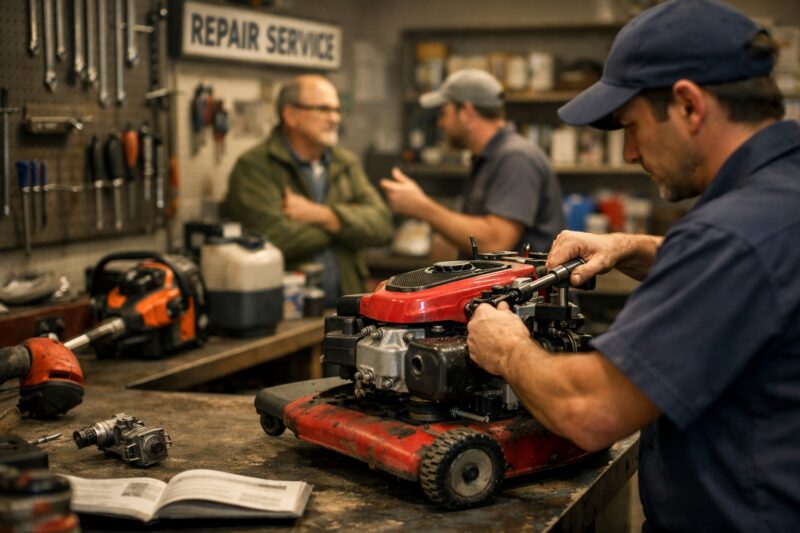
Step-by-step: How to choose the right repair service at a Small Engine Shop
Choose the right repair service by running a short, structured process: shortlist 2–4 shops, request written estimates, verify warranty/parts policies, confirm communication cadence, and schedule with clear expectations. This reduces the odds of surprise scope changes and repeat failures.
Start with a commercial mindset. Your goal is not “who sounds friendly,” it’s “who can explain the diagnostic path and commit to measurable outcomes.” A practical step-by-step decision path looks like: shortlist 2–4 shops → request estimates (ideally written by text/email) → verify warranty and parts policy → confirm how they update you at each stage → schedule the work with a defined approval process. If a shop won’t put key policies in writing, assume you will be negotiating under time pressure later.
When you contact a shop, bring or provide the intake data that makes diagnostics faster and more accurate. Include model and serial numbers, photos or video of the symptom (especially throttle changes, cold-start behavior, and any smoke/odor), fuel type and age (and whether it sat with ethanol), and your maintenance history (last oil change, spark plug type, carb service if applicable). Also mention storage conditions: does it sit indoors, does it sit with fuel in the tank, and has it been started recently? These details matter because ethanol-related gumming, water contamination, and airbox/cooling airflow obstruction can masquerade as unrelated failures.
Estimate vs quote structure is another key decision point. A diagnostic fee may be credited toward repair, and labor/parts should be itemized. “Minimum vs maximum” should be communicated clearly: for example, “If inspection confirms a clogged carb, cost range is X–Y; if teardown reveals an ignition module, it may change to Z.” If the shop gives a single number without explaining what could change, that is not a quote—it’s a guess.
Deeper-than-obvious angle: interpret conflicting symptoms correctly. “Won’t start” might be fuel (stale/contaminated), ignition (weak spark), compression (valve or ring wear), or an interlock (kill switch, neutral/safety circuit). A good shop uses systematic checks to map symptoms to likely systems. If they only do a single test and then order parts, you may lose diagnostic rigor and waste time while waiting on unnecessary parts.
Edge cases include commercial/landscaper fleets and seasonal peaks in spring and fall. For fleets, you should ask how the shop prioritizes multiple units and whether they can standardize parts sourcing for common models. You can request prioritization by urgency without sacrificing diagnostic rigor: ask what “queue” method they use (e.g., triage by critical path, then bench tests) and whether you can authorize limited tests before full disassembly.
To streamline your call, consider using a troubleshooting guide for small engines to collect essential information such as model specifications, symptom descriptions, and your availability for scheduling. When dealing with off-road equipment, ensure your questions align with established service workflows to enhance the efficiency and outcome of the repair process.
Pricing, diagnostics, and warranty: What to ask before you pay a Small Engine Shop
Ask about itemized pricing, the diagnostic method, and the warranty terms before you approve any work at a Small Engine Shop. The best shops make those details predictable and documented.
Pricing should be broken into components you can understand: diagnostic charge, labor rates, parts brand and part numbers, parts markup/tiers, disposal fees, and applicable taxes. If the shop can’t provide a line-item structure, you cannot compare quotes fairly. Even when budgets are tight, a slightly higher diagnostic transparency is often cheaper than a low upfront fee followed by repeated “round-two” repairs.
Diagnostics best practices usually include confirming fuel delivery, spark quality, and basic mechanical health. Many shops will perform compression checks where relevant, inspect air filtration and intake pathways, verify fuel system function, and check electrical safety interlocks. For problems that stall under load or act like power is “cutting out,” load testing or controlled run verification may be appropriate—especially for generators, pressure washers, or equipment that must run at sustained throttle.
Warranty clarity is a commercial requirement. A good shop will tell you the duration and whether warranty covers parts only, labor only, or both. Exclusions should be specific: for example, damage from misuse, stale fuel, improper storage, or unauthorized modifications. If warranty requires using OEM parts, the shop should say that upfront. Also confirm the claim process: what documentation you must provide, how the shop re-inspects the equipment, and whether you must return the unit for re-diagnosis if the issue repeats.
Deeper-than-obvious angle: detect bait-and-switch pricing. Red flags include vague “labor bucket” descriptions (no defined steps), missing parts numbers, sudden scope creep after you authorize initial work, or “we’ll figure it out as we go” without an approval threshold. A trustworthy shop will pause and request authorization when new findings change the repair plan. That is especially important when multiple symptoms could share a root cause.
Practical buyer scripts make this easy. You can ask: “What’s your diagnostic method for this symptom?” “What happens if parts change the scope—what is your approval process?” and “Do you reuse gaskets/seals or replace them during reassembly?” When a shop responds with specifics (tests performed, documentation provided, and how they decide what must be replaced), you’re more likely to avoid repeat failures.
If you want service guidance related to transport, urgency, and approval flow for off-road assets, aligning your questions with Less downtime ATV repairs can help you structure calls around diagnostic triage and communication cadence. For dirt bike-specific systems like ignition mapping, jetting variations, and carb/EFI differences, you can also leverage principles behind Fast, reliable dirt bike fixes to ask the right questions about run verification and symptom-to-cause explanations.
Certified, experienced, or specialist? Picking the right fit for your equipment
Pick the right fit by matching the shop’s competence to your engine type and equipment use case—rather than assuming “small engine” expertise is universal. The best Small Engine Shop for your unit depends on whether it’s carbureted or EFI, 2-stroke or 4-stroke, and whether safety-critical systems are involved.
Competence signals can include years of experience, training, and demonstrated familiarity with your exact engine family. A shop that works mostly on lawn mowers may still be good, but specialists often recognize patterns faster for generators, snow blowers, or off-road engines that behave differently under vibration, temperature swings, and sustained load. Ask what they’ve repaired recently that matches your symptoms and equipment model series.
Specialization vs general service is a tradeoff. General service shops can be helpful if you have a mixed fleet: mower, generator, and pressure washer all in one season. Specialized shops may be faster and more accurate when your unit requires deeper knowledge (for example, EFI diagnostics, advanced carb calibration, or drive systems with specific tolerances). The key is verifying fit through questions about component systems and diagnostic approach, not just reputation.
Parts sourcing verification is crucial for reliability. Ask how the shop chooses between OEM, equivalent OEM, and aftermarket parts. “OEM vs aftermarket” is not a yes/no question; it’s a compatibility and quality-tier question. You want parts with correct fitment for your model year and revision, and you want the shop to confirm part numbers before installing. If the shop can’t provide part numbers or show they confirmed compatibility, you may get a “works briefly” failure when tolerances don’t match.
Deeper-than-obvious angle: safety-critical components. Some equipment includes governors, safety switches, blade/brake systems, and interlock circuits that can create dangerous behavior if bypassed or incorrectly reassembled. A competent shop won’t treat these as optional; they test them and verify safe operation under realistic conditions. Also note: “it starts” is not the end test—governor response, clutch engagement, and shutdown safety are often the actual success criteria.
Fit-by-use-case examples: a homeowner mower often benefits from carb and ignition checks plus drive/belt inspection; a pressure washer may need stable fuel delivery and thermal management verification; a generator requires load behavior and electrical output checks; a snow blower needs reliable starting at cold temps and airflow/cooling integrity; and utility engines on mini skid steers or off-road equipment can have higher vibration and drive-related complexity. Ask how the shop aligns its testing to the type of work your equipment does.
To shortlist effectively, compare not only credentials but also how their intake and communication resemble your operational reality. If you’re dealing with recurring ATV downtime or off-road scheduling constraints, structuring your fit questions similarly to Less downtime ATV repairs can help you verify that they understand the symptoms that show up in the field, not just the bench.
Common mistakes and misconceptions when hiring a Small Engine Shop
Avoid the most common mistake—choosing the cheapest quote without diagnostic transparency—because it often leads to repeat costs and unresolved root causes. Many “quick fixes” fail when the equipment is tested under real load, temperature, and vibration.
One of the biggest commercial risks is treating a low upfront diagnostic fee as a bargain. If a shop doesn’t test systematically, they may guess the component, replace it, and hope. When symptoms recur, you pay again for re-diagnosis and additional parts. A better approach is to evaluate whether the shop can explain what they ruled out and why, and whether their estimate includes documented tests and clear approval gates.
Another misconception is “If it runs briefly, it’s fixed.” Brief operation can mask issues that only appear when warm, under sustained throttle, or after repeated starts. For instance, stalling under load may be a fuel restriction that doesn’t show until flow increases. Overheating can be intermittent due to airflow obstruction that becomes worse as cooling fins and baffles heat-soak. A top shop will verify starting consistency, idle-to-load behavior, and repeatability after cooldown.
Many buyers also skip maintenance history or assume the fuel system is the only culprit. But engines are interconnected: a weak spark can mimic “carb problems,” and air restriction can masquerade as ignition failure. Belt or drive slip can look like “low power” when the engine is actually running fine. If you don’t provide maintenance history and symptom patterns, you reduce the speed and accuracy of diagnosis—and you risk paying for guesswork.
Deeper-than-obvious angle: seasonal effects can confuse the diagnosis. Cold-start issues, water in fuel, ethanol-related gumming, and storage practices can make an engine look like it has an ignition or mechanical problem. A good shop probes these factors instead of jumping straight to parts. They also verify storage-related issues like fuel age and tank contamination, because those are common root causes of “worked last season, now it won’t start.”
Finally, ignoring warranty details is a costly misconception. If the shop doesn’t clearly define warranty duration and exclusions, you might not know whether a repeat failure qualifies. Ask what happens if the problem returns: do they re-diagnose, how fast, what documentation is required, and whether you must provide proof of fuel quality and maintenance handling.
If you want to reduce repeat-cost patterns for equipment that cycles through frequent field use, align your call questions to a structured plan such as a Faster job success checklist, and request that the shop explain what tests would confirm the fix is truly complete.
Alternatives and service categories to consider instead of “just any” Small Engine Shop
Instead of choosing any Small Engine Shop, consider service categories that match your warranty status, urgency, and technical needs: independent shops, dealer-authorized service, mobile repair, and warranty-approved networks. The “best” option depends on whether you need OEM parts, specialized tooling, or rapid turnaround.
Local independent repair shops often excel at flexible scheduling, practical diagnostics, and cost control, especially for common mower and off-road repairs. Dealer-authorized service can be advantageous when your equipment is still under warranty or when specific manufacturer procedures must be followed. Mobile repair can reduce downtime for fleets when transport is impractical, but it depends on whether the issue requires bench diagnostics, teardown, or part replacement that cannot be completed on-site.
When each option tends to win: a dealer or authorized center often wins for equipment under warranty and for systems with manufacturer-specific EFI diagnostics. Independent shops often win for fast triage, transparent labor explanations, and mixed fleets. Mobile repair can win when you have limited access to transport or the job needs immediate triage to protect schedules. Warranty centers/approved networks win when warranty acceptance rules are strict; however, you should verify whether their parts lead times create longer delays during peak season.
Deeper-than-obvious angle: avoid losing warranty coverage when using third-party repairs. Request paperwork that documents what was inspected and what parts were replaced, including part numbers, dates, and labor performed. Confirm with your warranty provider whether OEM part requirements apply and whether aftermarket parts are acceptable at specific quality tiers. A shop that can provide service documentation helps you avoid the “warranty denied because paperwork is incomplete” problem.
Even if you choose different service categories, the selection questions should remain consistent: diagnostic method, approval process, communication cadence, and warranty terms. What varies by category is often parts availability speed, OEM requirements, and the type of documentation provided. A dealer may provide more manufacturer-specific documentation, while an independent shop may provide more flexible testing and quicker parts substitutions.
Optional comparison at a glance:
| Service category | Best for | Watch-outs |
|---|---|---|
| Independent local shop | Cost-effective diagnostics, mixed fleets | Ask for test documentation and parts numbering |
| Dealer-authorized service | Warranty-covered equipment, brand-specific EFI | Turnaround and parts lead time can be longer |
| Mobile repair | Reduced transport downtime, triage in-field | Bench tests/teardown may still require transport |
| Warranty-approved network | Strict warranty acceptance requirements | Confirm authorization steps and documentation needs |
If you’re trying to minimize delays, use your local constraints to guide the category choice. For example, aligning your call structure to an urgency-first workflow similar to Less downtime ATV repairs helps you decide whether mobile triage, in-shop bench work, or authorized service is the best commercial fit.
Advanced considerations: Edge cases most buyers miss in a Small Engine repair decision
Edge-case failures often cost the most, so treat them differently: multi-issue symptoms, decisions about repair vs replacement, complex fuel systems, and “works in the shop” test gaps. The right Small Engine Shop should handle these with documented testing and realistic outcome expectations.
Multi-issue repairs are common because symptoms overlap. A unit that stumbles may seem like a carb problem, but the underlying cause could be ignition misfire that only appears under certain RPM and heat. Similarly, drive/belt issues can look like engine power loss, and an overheating symptom can actually be airflow blockage, a cooling fan failure, or timing/governor behavior. A quality shop addresses overlaps by ruling out systems in a logical order rather than replacing parts randomly.
Another missed decision is when replacement is more rational than repair. Use a cost-to-repair vs remaining life framework: consider the repair cost relative to your equipment’s expected remaining service, the frequency of recurring failures, and the availability risk of discontinued parts. If your equipment is older and key components are hard to source, a shop should warn you early and suggest options that prevent repeated delays. This is especially relevant when parts lead times create longer downtime than the repair itself.
Complex fuel systems are a major edge case in 2026. Ethanol-related effects can cause gumming in carb passages, sticky valves or diaphragms in fuel pumps, and inconsistent fuel delivery. If the shop is cleaning components, ask what they will inspect and how they confirm cleanliness and flow afterward. Also confirm safe practices for fuel handling and storage during diagnosis—shops should avoid unsafe testing that introduces fire risk or contaminated fuel spread.
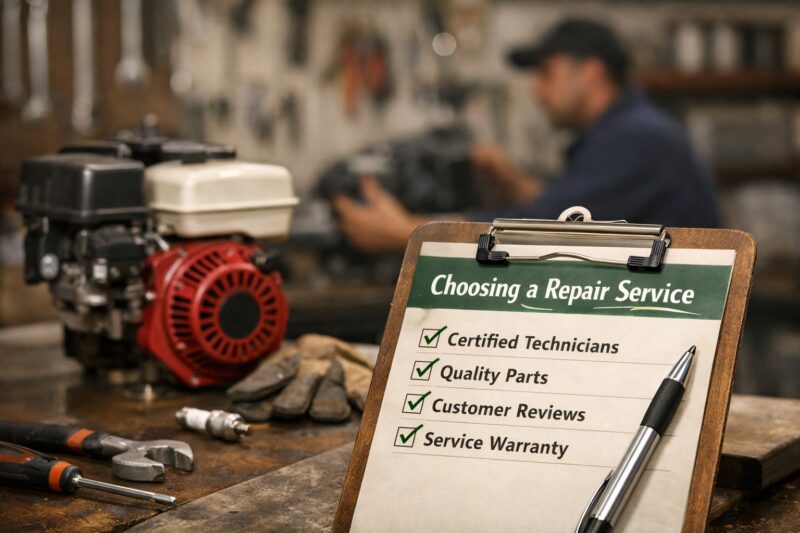
Deeper-than-obvious angle: ensure test documentation matches real-world use. A unit may idle fine on the bench but fail to sustain load at working throttle or fail to restart reliably after cooldown. Ask for evidence of idle-to-load behavior, starting consistency across warm/cold cycles, and verification of safety interlocks. This prevents the “it ran in the shop” outcome that doesn’t translate to your driveway, field, or jobsite.
Buyers may raise objections like “I don’t want OEM parts,” “I need it by a deadline,” or “I’m worried about upsells.” A trustworthy shop responds by offering quality-tier options, explaining tradeoffs, and providing an approval process before work changes scope. If you need it by a deadline, ask which diagnostic steps can be done immediately to confirm the fastest path to completion, and which parts can be sourced quickly versus after-market alternatives.
When these edge cases are part of your situation, treat selection as risk management. Align your urgency request with a documented diagnostic plan using a Quick checklist before you call so the shop understands your deadline, equipment context, and what success looks like beyond “starts once.”
Local options to search: Finding a Small Engine Shop in your area
Find the right Small Engine Shop locally by using a consistent search workflow: narrow by service area radius, confirm hours and seasonal intake rules, then request written estimates and documentation of parts fit. This prevents you from guessing based on reviews alone.
Local intent is common for small engine repairs because transport and turnaround are part of the real cost. Anchor your search to your region and use consistent query filters. If you’re located in the United States, try searches like “small engine repair + your city,” “ATV repair + your zip,” or “generator service + your county,” then constrain by a distance radius (for example, within 20–40 miles) based on whether pickup/drop-off is offered. Many shops operate seasonally—intake rules in spring/fall can mean you need to plan earlier for reliable lead time.
When evaluating local shops, compare service logistics alongside technical capability. Does the shop offer pickup/drop-off or require transport by the buyer? Travel/transport cost impacts total cost of downtime. Parts availability speed matters because some parts require ordering and may take days. Ask whether the shop can prioritize critical units in a fleet and whether they can communicate queue status rather than vague “we’ll call when it’s ready” updates.
Deeper-than-obvious angle: interpreting review patterns in 2026. Recent reviews often reflect current staffing and process, but look for repeated themes. Distinguish communication complaints (lack of updates) from repeat repair failures (same symptoms returning quickly). A shop can be imperfect at updates but strong on diagnostics; your goal is to ensure their process prevents repeat-cost failures.
Mini research workflow: first, call and request the diagnostic method and approval process. Second, ask for a written estimate by text/email after initial checks. Third, request proof of parts numbers/spec matching before parts are ordered when possible. Finally, confirm warranty terms and what documentation you will receive when the repair is complete.
To keep this practical, use a standardized call script and follow up with the shop in writing. For off-road scheduling constraints, aligning your communication expectations to a structured approach like Less downtime ATV repairs can help you choose based on real turnaround behavior instead of marketing language.
Frequently asked questions about Small Engine Shop selection (commercial repairs)
What should I ask a Small Engine Shop before approving a diagnostic?
Ask what diagnostic method they use for your exact symptom and whether the diagnostic fee is credited toward repair. You should also ask how results translate into a written estimate, including which parts or tests are likely contingent. A strong shop will explain the inspection steps and what they rule out before suggesting replacements.
How do I compare quotes from different Small Engine Shops fairly?
Compare line-item scope: diagnostic charges, labor rates, and part brand/part numbers. Make sure each quote covers the same diagnostic baseline; otherwise, a lower number may hide incomplete testing. Also verify the authorization process so you can judge whether “minimum vs maximum” is communicated transparently.
Do Small Engine Shops use OEM parts or aftermarket parts?
Ask how they select parts and whether they can provide exact part numbers that match your model and revision. Then request information about quality tiers and whether aftermarket parts affect warranty coverage. The best answer will be specific about compatibility rather than vague “equivalents.”
What warranty should I expect on repairs from a Small Engine Shop?
Expect clear terms that specify duration and whether the warranty covers both parts and labor. Ask for exclusions in plain language, such as misuse or stale fuel, and confirm how claims are handled if the symptom returns. You should also ask what documentation you need to provide for the warranty claim.
How long does a typical repair take at a Small Engine Shop in peak season?
Lead time can vary due to parts availability and queue length during spring and fall. Ask what timeline they can commit to after diagnosis, and whether there is an escalation path if your deadline is urgent. A realistic shop will explain what determines the wait and how they will update you.
Should I choose a dealer or an independent Small Engine Shop for my equipment?
If your equipment is under warranty, a dealer or authorized service may be the safest choice for warranty acceptance. Independents can be a strong option for cost control and flexible scheduling, especially for common carb and ignition issues. Decide based on warranty requirements, diagnostic documentation, and parts sourcing speed.
What if my equipment fails again after it’s been repaired?
Ask for a re-diagnosis path and how warranty claims are approved. Keep your paperwork and confirm what tests or documentation the shop needs to verify the claim. A professional shop should treat repeat failures as a troubleshoot-and-verify problem, not just a chargeable reset.
Can a Small Engine Shop diagnose problems if I only describe symptoms?
Yes, but the best shops will still request model/serial numbers and symptom evidence like photos or video. They will start with initial checks—such as fuel/air/ignition and safety interlocks—then proceed to deeper testing if needed. Clear symptoms help, but ambiguity is normal and part of why systematic diagnostics matter.
How can I tell if a Small Engine Shop is upselling unnecessary repairs?
Watch for vague scope descriptions, missing parts numbers, and changes to the plan without approval. Request test results and ask what was ruled out before recommending replacement parts. A good shop will explain why each suggested item is necessary to fix the diagnosed cause.
Is it worth repairing a small engine if the cost is close to replacement?
It can be worth it if the equipment has remaining useful life and the repair addresses the true root cause reliably. Ask about recurrence risk, parts availability for future repairs, and whether the failure pattern suggests a more cost-effective fix now. Safety and downtime impact also factor heavily into the decision.
What are the most common causes of “won’t start” that a Small Engine Shop should check?
Common causes include fuel issues (stale/contaminated fuel or delivery restriction), ignition problems (weak spark or faulty components), compression/mechanical limitations, and safety interlocks such as kill switches or neutral/start circuits. A systematic shop confirms what is working before replacing parts. You should expect them to explain which checks they performed and what the results mean.
Conclusion
The commercial takeaway is straightforward: a Small Engine Shop should deliver verified outcomes, not just repairs that “kind of work.” When you evaluate first-time fix rate signals like diagnostic accuracy, realistic turnaround, transparent pricing ranges, and clear warranty handoff, you reduce downtime and repeat costs. Use the step-by-step selection process in this guide to shortlist 2–4 shops, request written estimates, and confirm test documentation and parts policies before authorizing repair.
Recap the themes to apply immediately: (1) evaluate outcomes you can measure, (2) follow a step-by-step selection and approval workflow, (3) demand transparent pricing, diagnostic method details, and warranty terms, (4) match shop competence to your equipment and fuel/engine type, and (5) prevent repeat-failure scenarios by requiring run verification and explanation of the symptom-to-cause chain.
Before you book the work, your next step is a buyer-focused checklist for calls and estimates: diagnostic method, diagnostic fee/credit policy, line-item pricing, parts brand/part number compatibility, approval process for changing scope, turnaround expectations, and warranty duration plus exclusions. If you follow that structure, you’ll be buying reliability—and the equipment you depend on will be more likely to perform when it matters.
For quick prep, run your intake using Quick checklist before you call so your initial contact already contains the details that speed diagnostics and protect your budget. If your equipment is off-road or deadline-sensitive, align your urgency conversation to a workflow like Faster job success checklist so you can prioritize the right tests first without sacrificing diagnostic rigor.
Updated May 2026