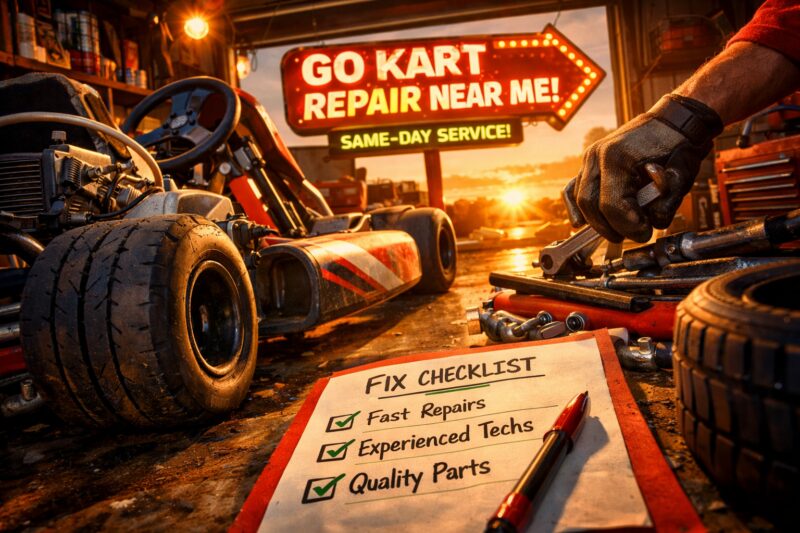
“Same-day go kart repair near me” usually means a shop can quickly diagnose the fault, confirm required parts are on hand, and perform labor the same day—or at least within a tight triage window—so your kart is back on track safely. If you’re searching Go Kart Repair Near Me, your first move is to call with the right symptoms, engine/powertrain type, and photos or video so the technician can decide fast whether it’s a quick fix (common consumables and ignition/fuel/electrical checks) or a parts-dependent repair. In 2026, karts fail for many reasons that look similar (for example, a spark issue can mimic a carb problem), so urgency matters: every repeated start can flood a two-stroke carb, overheat components, damage a battery, or loosen drivetrain hardware. In this guide, you’ll learn how to vet same-day candidates on the phone, what to request before work starts, and what to verify when you pick up your kart—covering common categories including rental/track karts, gas 2-stroke, gas 4-stroke, and electric.
Fast-path checklist to find reliable Go Kart Repair Near Me (same-day oriented)
To get a same-day fix, you need more than a close address—you need a shop that can triage your kart quickly, verify the root cause, and either complete repairs immediately or tell you honestly when parts will bottleneck the job. A reliable process starts before you dial: gather the basics so the shop can estimate diagnostic time and parts availability without guessing. When people search “near me,” they often assume distance alone determines speed, but in reality the schedule, intake window, and whether the shop stocks kart-specific wear items affect turnaround as much as location.
Step one is a call-to-check-in path. First, gather kart identity and symptoms, then ask for a diagnosis window (how many hours they can triage the kart today) and what repair work can be done while parts are being verified. Next, confirm parts availability up front—plugs, filters, belts, chains, throttle cables, fuses, battery leads, and typical small-engine ignition or carb components are often the difference between “same day” and “next week.” Finally, lock the turnaround with a simple authorization threshold: what work they can do up to a defined dollar amount if the initial test points to a common failure.
Before calling, collect the fastest-to-use details: kart model/year if you know it, engine type (gas 2-stroke, gas 4-stroke, or electric), what it does when you try to start (cranks but won’t fire, starts then dies, bogs under throttle), and any recent changes (new fuel, battery swap, fresh tires, after a crash, after winter storage). If possible, take short photos or video that show the spark plug, air filter condition, fuel level and line routing, and for electric karts the battery/charger connections and any controller indicators.
Here’s a same-day feasibility test you can use to set expectations. Fuel/air/ignition/electrical basics that are easy to test often lead to same-day outcomes: a fouled plug, clogged filter, loose kill switch wire, corroded battery terminal, dead fuse, or a worn belt/chain that the shop can replace immediately. Repairs that frequently require specialized parts or extended troubleshooting take longer: carb rebuild kits that aren’t stocked, ignition stator replacements that require sourcing, gearbox or clutch overhaul parts, or intermittent electrical faults that only occur under heat or high RPM. “Same-day” is most realistic when the shop can confirm quickly that you’re dealing with a common, locally available component or a safe, fast test.
Also consider what “near me” means operationally. Some shops are geographically close but have limited intake hours, no tow support, or require you to drop off before they can schedule testing. Others can do an on-site pickup for karts or offer a transport appointment so the technician can test immediately. That operational reality can be the difference between a today diagnosis and a tomorrow diagnosis even if the shop is only a few miles away.
Use this script-style ask to filter out unprepared shops. “What’s your diagnostic fee and can you triage within two to three hours today?” “If the fault is something like a plug, filter, belt, chain, throttle cable, or a simple electrical component, can you fix and test before close?” “Do you keep kart-specific parts in stock, or what parts would require ordering?” “What’s your maximum authorization before you call me for approval?”
What to ask on the phone to confirm same-day diagnosis and pricing
When you call, the goal is to confirm whether the shop can diagnose quickly, price transparently, and prevent surprise charges. Same-day repair starts with clarity: a shop should tell you the diagnostic fee, the expected triage time, and how they handle estimates if tests reveal a bigger issue than the initial symptom suggests. If they can’t explain their process in plain language, treat it as a risk—because “fast” without a defined test plan often leads to wrong parts swapping and delayed turnaround.
Start with the questions that filter out shops that aren’t ready for your powertrain. Ask for the diagnostic fee and whether they separate “diagnosis” from “repair labor.” Then ask about their max hours for triage today—many reputable shops can commit to a test window even if final repair takes longer. Finally, ask what symptom-to-fix timeline they usually see for your specific category: for example, electric karts often come down to charger/controller/battery checks, while gas karts may involve spark, fuel delivery, and valve/carb adjustments depending on the model. You’re looking for a technician who can say, “We will test X and Y first,” not “We’ll try a few things and see.”
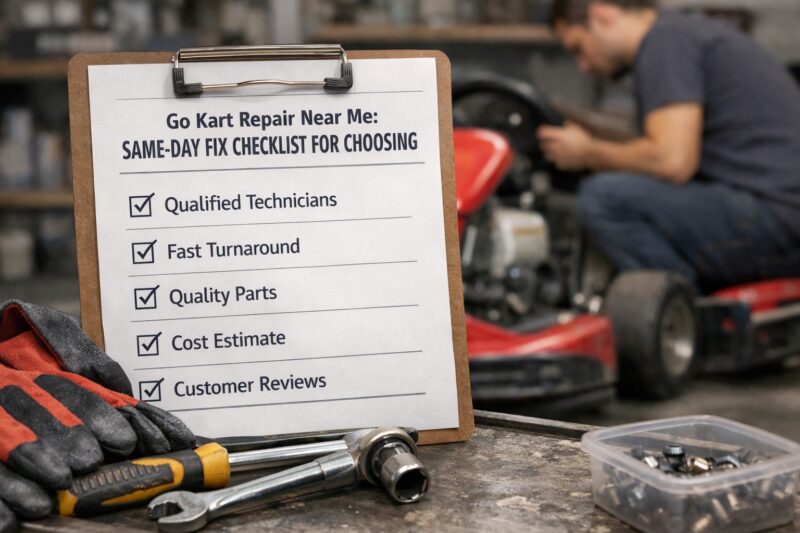
Pricing clarity matters because kart repairs can change once inspection begins. Ask for the labor rate, whether diagnostic time is credited toward repair, and how they provide estimates after the inspection. Confirm whether they require pre-authorization once a repair crosses a threshold, and ask for itemization: separate labor and parts in the work order. This helps you avoid the common trap where a shop starts additional work without updating the estimate, which can be especially frustrating when you’re trying to meet a weekend event.
Make them confirm drivetrain specifics too. A gas kart might use chain drive with a clutch, or belt drive with a torque converter-style setup, and the failure points differ. Electric karts introduce controller behavior, fault codes, wiring integrity, and charger/battery health—so ask the shop how they verify the electric system’s signals and protections rather than assuming the controller is bad. If they can’t discuss the powertrain and transmission type in a way that matches your kart’s layout, you’re more likely to get the “replace parts until it runs” approach, which is slower and riskier.
Be wary of “quote by symptom” without data. A shop should not charge you for a carb kit or a clutch replacement just because the kart won’t start; that’s how misdiagnosis costs add up. Instead, require that they confirm root cause with test results: spark checks, fuel delivery verification, compression basics if appropriate, and for electric, charger voltage and controller fault-code readings if available. Request documentation before work proceeds: a work order describing tests, an itemized parts list, and labor line items. Ask what warranty they offer on labor and parts, and how long it lasts.
To ground this in real best practice, reference official guidance on safe small-engine maintenance and troubleshooting fundamentals. For example, the U.S. Consumer Product Safety Commission emphasizes the importance of safe operation and addressing mechanical issues that can create hazards Consumer Product Safety Commission. While it does not cover karts specifically, the safety mindset applies: do not ignore throttle/brake faults or drivetrain problems that could cause loss of control.
How to evaluate go kart repair shops near you (credentials, process, and proof)
The best way to choose a repair shop near you is to evaluate their credentials, how they work, and the proof they provide—not just their reviews. A same-day repair is only worthwhile if it’s accurate and safe, because a “quick fix” that ignores root cause can fail again immediately, waste your time, and create safety risks for riders. When you’re picking up a kart, look for evidence that the technician tested systems and confirmed compatibility before replacing parts.
Start with credibility signals that indicate they understand kart-specific systems. Ask whether they have experience with small engines, motorsports, or kart fleets; generic “we work on everything” shops may not know the differences between chain clutch engagement points, belt tension specs, gas carb jetting ranges, or electric controller diagnostics. The right shop should describe procedures such as verifying correct belt/clutch condition, checking alignment and chain tension, and confirming that ignition and fuel delivery are within expected behavior. This is also where “rental track karts vs private karts” changes expectations: a fleet shop may have faster access to common consumables and may prioritize speed for high-utilization schedules.
Process transparency is your next filter. A reputable technician should explain their inspection steps and test plan: what they check first, what measurements they take, and how they confirm the root cause rather than just replacing parts. For gas karts, they should describe how they verify fuel delivery, spark presence/quality, air flow, and basic engine health. For electric karts, the proof should include battery/charger checks, wiring inspection, controller indicator interpretation, and continuity/ground integrity tests.
Demand parts standards and compatibility checks. Ask whether they use OEM-equivalent parts or aftermarket substitutes, and whether the replacement component matches the correct heat rating, jetting specification, belt size/grade, or clutch engagement design. Even when a “replacement plug” seems universal, correct reach and heat range matter for two-strokes and air-cooled engines. For belts and chains, the wrong length, pitch, or profile can lead to slipping, accelerated wear, or improper drivetrain ratios.
Require proof-based updates as part of their work culture. Real-world examples: a shop that shows photo updates of the damaged part, records compression/spark test observations, captures controller fault-code readings, and performs a before-and-after test (idle behavior, throttle response, drivetrain engagement) is demonstrating accountability. Most guides skip this “proof expectations” step and focus only on price; in practice, proof reduces misdiagnosis and helps you claim warranty if the issue repeats.
If you want a reference for electrical safety and safe battery handling principles, consult National Fire Protection Association (NFPA). Electric kart troubleshooting often involves battery leads and chargers; proper handling reduces risks like arcing, thermal damage, and short circuits—especially during same-day rush work.
Common reasons karts won’t run—and which failures are actually same-day fixable
If your kart won’t run, the fastest path is to match the symptom cluster to the most likely checks a qualified shop can do quickly. Many “won’t start” problems are resolved same-day because the root cause is a straightforward item: spark plug condition, fuel delivery, a clogged filter, a loose wire, a dead fuse, or a worn belt/chain. However, some failures look similar at first—so the same-day goal depends on correct triage, not just speed.
Organize by what the kart does when you attempt to start. If it won’t start at all (no cranking or no fire), a shop will typically do quick checks for ignition and power delivery. For gas karts, this usually includes verifying spark presence, kill switch operation, fuel reaching the carb, and air filter condition. For electric karts, they should check charger/battery state, fuse status, main switch/wiring connections, and controller behavior. These checks are often test-first and parts-second, which is why they fit same-day workflows.
If it starts then dies, expect a different fast-check pattern: gas issues may involve fuel starvation, clogged jets, an air leak, or a choke/idle adjustment mismatch; electric issues may involve voltage drop under load, a bad connection, or controller protection behavior. If it bogs under throttle, many owners assume a carb problem immediately, but a good shop will also consider ignition timing symptoms, air filter restriction, or for electric, controller current-limiting behavior. Same-day fixability often improves when the fault is consistent and appears immediately during testing.
For “won’t move/drive,” the issue may not be the engine at all. Drivetrain engagement can fail due to clutch/belt slippage, chain tension/alignment, broken springs, worn sprocket teeth, or seized components. A shop can often check engagement quickly and replace common wear parts the same day if they have stock. The misdiagnosis trap is real here: replacing ignition parts won’t solve a slipping clutch, and replacing a battery won’t fix a broken belt tensioner.
Lose top speed or weak acceleration can come from restricted airflow, incorrect jetting (for gas), improper clutch engagement, or for electric, battery health or controller settings. Many of these can still be same-day if the shop has baseline tuning knowledge and uses data-driven tests—like measuring RPM behavior under load or reading controller indicators for electric faults. Common mistake: repeatedly trying to start or rev the kart “to see if it clears,” which can flood the carb, overheat a two-stroke, or stress a weak battery.
If you’re waiting for a shop, preserve evidence. Don’t aggressively clean or replace multiple components before the diagnosis, because fuel/plug condition can be diagnostic. Instead, document: how it sounds at crank, what the plug looks like after a failed attempt, what the fuel level does, and for electric, which lights or fault codes appear. This is especially important for intermittent faults—heat-related shutdowns, weak grounds, and connection problems can disappear when cooled or when you change things.
Common mistakes and misconceptions when searching Go Kart Repair Near Me
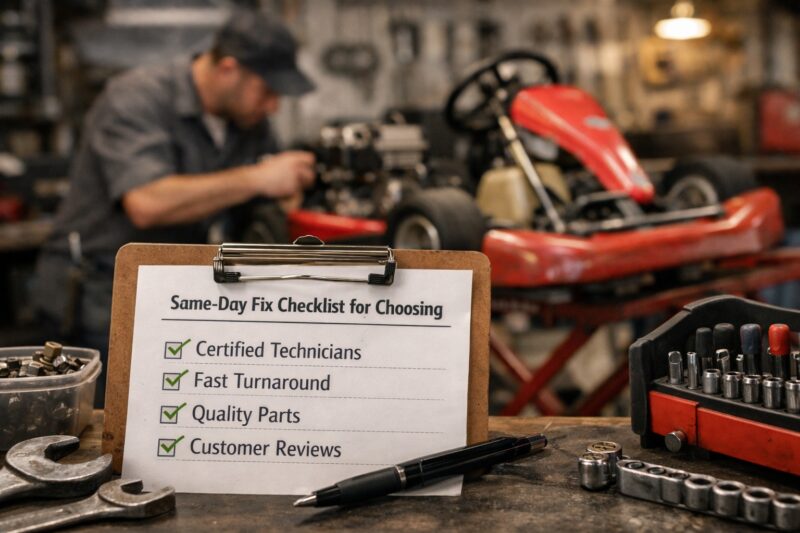
The biggest misconception in “Go Kart Repair Near Me” searches is that the closest shop is automatically the fastest option. Distance matters, but turnaround often hinges on intake scheduling, parts inventory, diagnostic rigor, and whether the shop can commit to a triage window today. If you choose purely by proximity, you may end up waiting longer—or authorizing work before the shop confirms root cause.
A common mistake is skipping symptom documentation. Without photos or video, some shops spend extra time guessing, which pushes you out of same-day timing even if the repair itself is quick. Capture the basics: plug condition, visible leaks or disconnections, filter status, and for electric, any controller/charger indicators. This helps the shop choose the right first tests and reduces misdiagnosis.
Another pitfall is asking for a “cheap fix” without defining safety scope. Karts depend on brakes, throttle response, secure drivetrain engagement, and safe fasteners. A low-cost repair that ignores these can fail during the very ride you need it for. A responsible shop should include safety verification within the repair process, not only “make it run.”
Warranty confusion also causes frustration. Some shops warranty labor but exclude consumables (like belts, chains, plugs, or filters), while others may warranty parts only if installed correctly. Ask what exactly is covered, how long it lasts, and what documentation you’ll receive. This avoids the common scenario where you pay again for a repeat failure because the root cause wasn’t fully addressed.
Finally, assume compatibility across karts can be wrong. Many people believe “all karts use the same clutch/belt or jets,” but even small differences in engine variants, belt length, or controller voltage can make a replacement component ineffective. Mis-installation or mismatched parts can lead to repeated failures and delayed returns, which is the opposite of a same-day goal.
To reduce these mistakes and improve outcomes, use a pre-structured approach aligned with a shop’s workflow—starting with your initial “pre-repair checklist for shop” and the key details they need. This helps you choose the right service based on process, not just urgency. You can also cross-reference reliability planning with a maintenance checklist for reliability to reduce repeat breakdowns after you get your kart back.
Your best options besides “same-day repair only” (compare approaches)
“Same-day only” is a useful constraint, but the smarter goal is choosing the approach that matches your fault type and parts bottleneck. Sometimes same-day diagnosis and partial repair is the best outcome, while other times a faster overall result comes from the right specialist shop—even if full completion takes a day or two. The key is deciding where the delay is acceptable: diagnosis uncertainty, parts sourcing, or extended troubleshooting.
Dedicated kart/mechanic shops are often the best option when you need deeper diagnosis, drivetrain accuracy, and kart-specific parts choices. They’re more likely to understand clutch engagement details, belt specs, carb jetting ranges, and electric controller behaviors. These shops can still be fast, but their strength is reducing misdiagnosis so you don’t pay for the same failure twice.
Small-engine or motorcycle repair shops can be excellent for gas karts if they have genuine kart experience. Their advantage is often strong general troubleshooting skills and access to small-engine parts suppliers. The tradeoff is that they may not always stock kart-specific driveline components or may require time to match exact clutch/belt/jet specifications.
Track or rental fleet service channels can be the fastest access point for common consumables in high-utilization environments. If your kart resembles a fleet model, they may already have the right belts, plugs, and basic ignition components. The limitation is that their intake may be restricted to qualifying clients, and they may prioritize throughput over thorough root-cause documentation for occasional private repairs.
DIY triage plus local parts pickup can help when the fault is low-risk and clearly identifiable—like a dead fuse, obviously broken belt, or an unplugged battery lead. However, boundaries matter. Do not attempt complex carb rebuilds, transmission disassembly, or electrical controller troubleshooting unless you can do it safely; those steps can hide evidence or worsen damage if the root cause is elsewhere.
Choosing the right option depends on symptom type and safety urgency. If your kart’s throttle/brake response is unreliable, drivetrain engagement is questionable, or you suspect a wiring short, prioritize professional inspection over DIY. If your issue is likely consumables-based and you can provide clear evidence, you can keep same-day momentum. For many owners, the decision framework aligns with a “pre-repair checklist for shop” so the shop can confirm what’s safe to address immediately and what must be tested first.
Advanced considerations most guides skip: safety, compatibility, and long-term reliability
Most “same-day repair” guides focus on getting the engine running and ignore the safety and compatibility details that decide whether your kart is reliable next weekend. A truly correct repair verifies safety-critical components (brakes, throttle return, guarding, drivetrain security) and ensures replacement parts match your exact configuration. This matters because a kart that runs today but fails under load tomorrow is not a win—it’s a repeat repair cycle.
Safety verification should be part of the shop’s process, not an afterthought. Ask what they check: brake function and proper engagement, throttle return/spring behavior, chain tension and alignment, and the condition of fasteners, guards, and any rubbing components. For gas karts, they should check air intake cleanliness and verify that idle and choke behavior are correct so the kart doesn’t stall unexpectedly or surge uncontrollably. For electric karts, they should ensure safe battery connections, proper wiring routing, and that fault protections behave correctly under test conditions.
Compatibility and calibration depth is another often-missed area. For gas engines, correct carb jetting and idle mixture can be the difference between “it runs on the stand” and “it runs under throttle.” For drivetrains, clutch or belt tension must match the kart’s setup so engagement is smooth and predictable. Electric karts require correct controller settings, correct battery voltage compatibility, and verification that the charger and battery health won’t trigger protective shutdowns mid-ride. If a shop rushes these steps, you might get immediate start success but experience intermittent failures later.
Plan for long-term reliability by asking what they will inspect beyond the immediate symptom. A good shop should discuss wear intervals and heat management—especially for two-strokes where mixture, plug heat range, and air filtration affect longevity. If your repair involves ignition or fuel delivery, ask for a post-repair verification ride/test and what they observed. You can then follow up with “maintenance checklist for reliability” guidance and consider additional tune-up work if the repair exposed underlying tune issues.
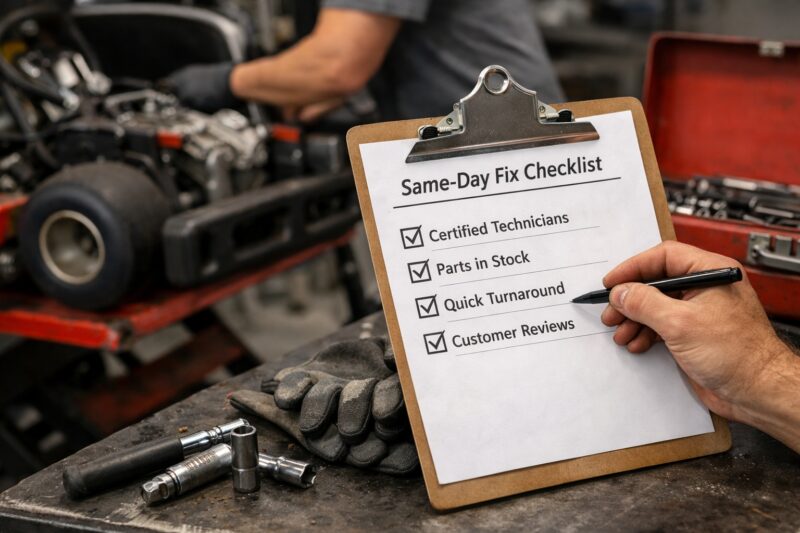
Edge cases need extra attention in same-day workflows. Intermittent faults can be heat-related shutdowns, weak grounds, battery sag, or sensor intermittency that only appears after running. These may not be fully replicable during short triage time. If the shop finds potential intermittent causes, ask how they plan to validate under load and what the risk is if you ride immediately.
To keep your investment durable, request a “prevent repeat failure” discussion. Ask what they checked to prevent the same issue from coming back, what was adjusted or replaced (and why), and what warning signs to watch. This is also where you can ask whether “smoother rides after tune-up” makes sense for your kart category once the immediate failure is addressed.
Geographic focus: how to choose in your area when you search Go Kart Repair Near Me
When you search Go Kart Repair Near Me, “near me” should be evaluated as time-to-intake, not just miles. Two shops at similar distances can offer very different same-day outcomes because one has open intake slots and stocked parts, while the other may require next-day scheduling. To make your search transactional and effective, anchor your choices around drive time and the shop’s operational capacity: call center hours, drop-off windows, and whether they can accept karts during the day for same-day testing.
Use local availability checks that directly impact turnaround. Ask about drop-off procedures and whether they require advance scheduling for testing. Inquire about tow/transport options if your kart can’t be safely driven to the shop; some shops coordinate pickup for non-running karts, while others require you to bring it in under your own transport. Also ask whether they have a same-day triage queue, and what happens if initial tests reveal the need for parts that aren’t in stock.
Account for how local parts supply changes by region and season. Specialty kart parts, carb rebuild kits, and certain electric components can have longer lead times, especially outside peak kart season. Even common items like belts, chains, and plugs may vary in availability by region, and the shop’s distributor relationships influence whether they can source quickly. A good shop will tell you what they can do today versus what they would need to order, and it should be specific about which components cause delays.
Use map results responsibly by reading review content for powertrain relevance. Many reviews mention “small engine” or “motorcycle” but not whether the shop has actually worked on karts’ clutches, belts, throttle cables, chain tension, or electric controller systems. Prioritize reviews that reference those details, because they indicate compatibility knowledge and reduced misdiagnosis risk. If possible, call 2–3 providers and compare their diagnostic clarity and willingness to provide proof before repair.
If you want to write a place-based version later, reference the closest metro/region the business serves rather than guessing a city. For example, you can mention that the shop should be within a realistic travel window from your local area, but keep the selection criteria the same: intake availability, powertrain knowledge, parts stocking, and transparent authorization.
Frequently Asked Questions About Go Kart Repair Near Me
How do I get a same-day Go Kart Repair Near Me?
Call with your powertrain type (gas 2-stroke, gas 4-stroke, or electric), the exact symptom pattern (won’t start, starts then dies, bogs under throttle, won’t move), and share photos or short video of the plug, filter, wiring, or controller lights. Ask for the diagnostic fee, the triage time window, and the maximum authorization limit before they do additional work. Same-day outcomes are most common when the shop can complete the first round of tests and replace commonly stocked items immediately.
What should I tell a mechanic when my kart won’t start?
Describe what happens when you try to start: does it crank but not fire, is there a clicking sound, does it crank and die quickly, or does it do nothing electrically. Mention fuel freshness, whether the choke/air filter was recently changed, and any recent impact or maintenance. If you can, tell them what the spark plug looks like after a failed start or what the electric controller indicates.
How much does go kart diagnostic usually cost?
Diagnostic fees vary by shop and region, but it’s typical for the diagnostic fee to be separate from repair labor and sometimes credited toward approved repairs. Ask whether the diagnostic fee covers a powertrain inspection and test plan, and confirm whether they’ll provide test results or only a final verdict. To avoid surprises, request the diagnostic scope in writing on the work order.
Can a shop fix an electric go kart the same day?
Yes, sometimes, if the fault is proven quickly via charger/battery checks, wiring inspection, and controller fault-code or LED indicator readings. The most common same-day electric fixes are replacing a fuse, correcting a connection/ground issue, swapping a battery if compatible, or addressing a charger problem. If the issue requires non-stock controller or specialty parts, turnaround may shift to parts lead time.
What are the most common go kart problems that take longer to fix?
Intermittent faults that appear only under heat or after running often take longer because the shop must reproduce the failure safely. Specialty parts (specific carb components, drivetrain internals, less common controller parts) also extend timelines. Misdiagnosis can add time too, especially when shops swap components without confirming spark, fuel delivery, or electric protection behavior first.
Should I replace parts immediately or wait for a diagnosis?
In most cases, wait for diagnosis before replacing anything beyond clearly safe consumables, because parts swapping can mask the actual root cause. If you have an obvious failure like a broken belt or a clearly dead fuse, replacement may be reasonable, but preserve the old part for inspection. For gas karts, avoid repeated starts that can foul plugs and flood the carb before the shop tests fuel and spark behavior.
What questions should I ask about warranty for go kart repairs?
Ask whether the shop warranties labor, parts, or both, and what the coverage period is (for example, how many weeks or rides). Request the exclusions—consumables and normal wear often aren’t fully covered—so you know what’s included. Also ask for proof of work documentation like an itemized parts list and labor line items.
How do I know if the shop understands kart clutches and transmissions?
Ask what they inspect in the drivetrain: clutch engagement behavior, belt or chain condition, tension, alignment, and how they test that power transfers correctly under load. A shop that understands karts will use correct terminology and explain how they verify engagement and smooth operation rather than only focusing on the engine. Request a before-and-after test description or evidence such as measurements or test observations.
Is it safe to ride the kart while waiting for repairs?
Only ride if the kart’s brakes and throttle response are functioning reliably and the drivetrain engagement is secure. If the kart won’t accelerate smoothly, stalls unexpectedly, or shows signs of electrical/wiring issues, don’t ride—get it inspected first. If there’s any chance of a throttle return failure, brake malfunction, or loose drivetrain components, the correct guidance is to stop riding and prioritize safety inspection.
Do I need to bring my exact model info for go kart repair?
Model information helps the shop confirm compatibility for belts, jets, controller voltage, and other kart-specific components. If you don’t know the model, you can still provide engine type, approximate year, serial/label photos, and clear photos of the drivetrain and wiring. Electric karts especially require battery voltage and controller/charger compatibility details for safe, correct repairs.
Conclusion: To maximize your chances of a same-day fix, follow a transaction-focused workflow: gather key details → call 2–3 shops with the right pre-repair information → confirm triage time, diagnostic scope, and parts availability → authorize only what fits your safety threshold and budget. Vet shops with proof-based expectations: test results, parts compatibility, itemized estimates, and safety checks like brakes, throttle return, chain/belt condition, and guarding. Then choose your approach based on the real bottleneck—diagnostic time versus parts lead time—rather than distance alone. CTA: Contact providers, compare diagnostic fees, turnaround commitments, and warranty terms, and choose the option that’s both fast and evidence-based for your kart’s powertrain and symptoms.
Optional related steps after your repair: plan a follow-up schedule using an internal guide like “maintenance checklist for reliability,” and consider a tune-up if the symptom pointed to tuning drift. If you want to align the shop’s workflow with your own preparation, review the internal “pre-repair checklist for shop” before your next service visit. To explore ongoing improvements, see how “smoother rides after tune-up” can apply after repairs, and use “choose the right service” when comparing future options.
Sources used for safety and maintenance context include Consumer Product Safety Commission and National Fire Protection Association (NFPA), which support the principle that safe mechanical and electrical handling is essential before riding or authorizing complex repairs.
Updated May 2026