
If your car AC is blowing warm air, smells strange, or seems to run incorrectly, treat it as a repair need, not a “wait and see” issue. These are some of the most searched car AC repair signs, and they often point to problems that can worsen quickly. In this guide, you’ll learn which symptoms mean immediate attention and which ones can wait a short time. You’ll also learn how to gather simple evidence before a shop starts testing.
In 2026, many AC problems still share the same root cause categories: refrigerant loss, airflow restriction, or control/electrical faults. However, symptoms can overlap. For example, weak cooling can come from low refrigerant or a clogged cabin filter. That is why diagnosis matters more than guessing.
“Immediate” usually means you should stop using the AC in certain conditions, or schedule service the same day. In other cases, you can keep driving, but you should book diagnostics quickly. Either way, you’ll reduce the chance of compressor damage and avoid repeated re-freezing of an already restricted system.
Car AC behaviors that mean you should not delay repair
You should treat several car AC repair signs as urgent because they can protect the compressor and limit refrigerant loss. Some issues also affect air quality, so comfort and safety become part of the decision. If you ignore these signs, the AC can fail completely, or the system can become more expensive to fix.
Start with symptoms that suggest refrigerant loss or electrical trouble. Warm air that appears suddenly after the AC worked normally can indicate a refrigerant leak. Rapid on-and-off cycling can also show low charge, a failing sensor, or blocked airflow. Loud compressor noises, such as grinding or loud knocking, can signal internal compressor strain.
Next, pay attention to smell and residue. A burning or chemical odor often means something is heating where it should not. Oily residue near lines, fittings, or the condenser is another high-signal clue. Even if cooling seems “mostly okay,” visible oily areas can mean a leak is active.
Finally, consider fast worsening. If cooling drops within minutes of turning the AC on, something is likely failing under load. Debris on the condenser, low airflow, or a control fault can cause pressure spikes. Meanwhile, a cabin airflow problem might make the system feel weak even when refrigerant is acceptable.
Here’s the practical triage logic. If you notice refrigerant odor, visible leaks, or warning lights, schedule immediate diagnosis. If the AC warms quickly along with strange noise or odor, stop using it until checked. Meanwhile, if it cools but feels slightly weaker, you may be able to monitor while you plan service.
How refrigerant-side failures change cooling performance in real driving
Refrigerant-side problems often show up as inconsistent temperature performance. The system depends on refrigerant moving through the evaporator and condenser. When that flow is restricted or missing, cooling can become weak or disappear quickly.
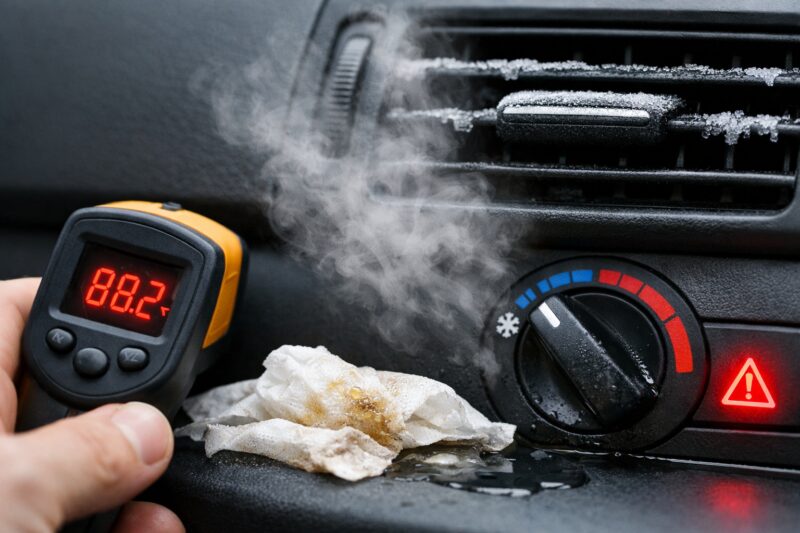
Low refrigerant is a common cause, but it is not the whole story. A leak can reduce charge, and the compressor may cycle to protect itself. You might notice that the AC blows cold at first, then turns warm after the system “struggles.” Also, the evaporator can ice up when airflow is low or refrigerant dynamics change.
Blockages on the refrigerant side can mimic “low charge” too. For example, debris or a restriction can reduce pressure and make cooling intermittent. In contrast, an airflow-side issue may still allow refrigerant to circulate, but the cabin air won’t cool well. That is why vent temperature trends and airflow observations help separate causes.
In addition, some symptoms look like refrigerant problems but are actually control behavior. A faulty temperature sensor can tell the system to shut down early. Then the AC may feel like it “runs out of steam,” even if charge is normal. Therefore, you should avoid concluding “it just needs more refrigerant” when patterns suggest cycling or sensor issues.
A common mistake is to chase coldness by adding refrigerant without finding the leak or fault. This can temporarily restore cooling, yet the underlying issue remains. After a short time, the system can face the same problem again, and the compressor keeps working under stress.
Airflow-side issues that can make the AC feel weak or uneven
Airflow problems change the way the AC cools, even when the refrigerant circuit is healthy. The evaporator needs enough airflow to transfer heat. If cabin airflow drops, the evaporator can cool incorrectly, and the system may not reach steady performance.
A clogged cabin air filter is a frequent cause of weak cooling. It can reduce airflow, which makes the vents feel less cold and can also contribute to ice on the evaporator in some conditions. However, a filter issue usually does not create obvious oily residue or refrigerant odors. So it tends to look like weak airflow, not a leak.
Another airflow factor is blower speed control. If the blower only works on certain fan settings, the AC can feel fine at one speed and poor at another. You may also notice uneven cooling between vents or between recirculation and fresh-air modes. Meanwhile, a failing blend door or mode control can cause mixed air that feels “never cold,” even when AC components are running.
Outside the cabin, condenser airflow matters too. The condenser needs airflow to release heat. If the condenser fan does not run when the AC calls for it, pressures can rise, and cooling may fade quickly. You can often notice this by whether the fan engages when the AC is turned on.
Real-world scenario: in stop-and-go traffic, the AC might struggle more if condenser airflow is weak. Then it could feel better on the highway if airflow improves. Still, strong improvement with speed does not rule out refrigerant issues. It just suggests airflow deserves priority during the inspection.
Control and electrical faults that can imitate a “total AC failure”
Control and electrical issues can stop cooling while leaving the system looking “partly normal.” Many AC systems rely on signals from sensors, switches, and relays. If any part misreports conditions, the compressor may not engage or may cycle too early.
For example, you may hear the compressor clutch engage and still feel weak cooling. That can happen if the system is commanded off by sensors or if mode/door positions do not match your selected temperature. Also, a failing evaporator or cabin temperature sensor can cause incorrect regulation. The result is often a short burst of cooling followed by warm air.
Electrical symptoms can also include unusual behavior when you turn the AC on. The blower may change speeds abruptly, or warning lights may appear. In some cases, the issue ties back to power delivery, not the AC itself. That is where the battery condition for AC becomes relevant. If voltage drops under load, the system may protect components by reducing operation.
A nuance that matters: a weak cooling complaint is not always an AC failure. Sometimes the HVAC controls can get confused after a sensor fault. Then the system can send the wrong signals to the compressor, fans, or blend doors. Diagnosing command signals helps avoid replacing parts that are not actually failing.
A common misconception is that “no cold air” means the compressor is always bad. However, control and electrical faults can prevent the compressor from doing its job. That is why a scan of HVAC commands and sensor readings often speeds up the diagnosis.
Steps to prepare a shop diagnosis and avoid part guessing
You can prevent wasted time by organizing what you observed before the mechanic shop begins testing. A clear timeline helps them narrow whether the problem is refrigerant loss, airflow restriction, or a control fault. This approach also supports a better car AC repair diagnosis because the symptom pattern often points to specific subsystems.
First, confirm exactly when the symptom happens. Note whether it occurs only when the engine is idling, only while driving, or only at certain fan speeds. Next, describe whether the vents blow warm suddenly or gradually. Also mention whether recirculation affects performance.

Then gather simple, practical evidence. Check for warning lights. Look for puddles under the car after AC use, but remember that condensation can be normal. Watch for oily residue near lines and fittings, and sniff for refrigerant-like odors if you can do so safely near the engine bay. If the condenser fan never runs when AC is on, note that.
After you collect details, use a short intake script. Tell the shop your “first cold, then warm” timing, any odors or noise, and whether the blower feels strong. Ask what tests they plan, such as leak testing, airflow checks, and sensor scanning. A mechanic shop checklist approach makes it harder for a shop to guess.
One tradeoff is that you may have to wait longer for diagnostic work if the shop is busy. However, guessing can cost more over time. For example, charging only may temporarily improve cooling while you still have an active leak. As a result, you might pay twice before the real cause is fixed.
Common myths that turn minor AC issues into expensive failures
Many AC failures worsen because people follow myths instead of symptoms. For instance, low refrigerant can be a root cause, but it also is often the result of a leak. If you only refill without finding the leak, the system will likely repeat the same problem.
Another misconception is that “if it blows cold sometimes, it’s fine.” Intermittent cooling can mean the compressor is cycling to protect itself. It can also mean airflow is restricted sometimes, such as when the cabin filter loads up or mode doors stick. In either case, ignoring it can cause repeated stress cycles.
Some owners also assume that condensation equals a leak. Water dripping under the car can be normal when the AC is running, because the evaporator removes moisture. But visible oily residue near the same area is not normal. Odor matters too, because refrigerant leaks and electrical issues can smell different.
A deeper issue is compressor damage risk. When refrigerant is low or airflow is blocked, compressor workload can rise. Over time, that can lead to internal failures that are harder to repair. In addition, if debris repeatedly blocks the condenser, pressures can spike and the system may fail sooner.
The best prevention is simple. Stop running the AC when you see strong leak evidence or smell burning. Then book diagnostics so the shop confirms root cause before repairs.
How to compare repair options that address the root problem
When AC needs urgent attention, you should compare service options based on process, not just the final price. A good estimate explains what failed and how the shop will verify it. It should also cover whether they will confirm leak sources and airflow performance.
In many cases, shops start with troubleshooting and car AC repair diagnosis. That can include scanning HVAC commands, checking fan operation, and verifying airflow path condition. Then they decide whether repair is limited to a component or whether multiple parts need attention.
Repairs can include leak repair and replacing related parts. Shops may repair or replace hoses, valves, or fittings based on where the leak is located. Other repairs target airflow, such as replacing a clogged cabin filter or addressing blower or condenser fan issues. If the evaporator or condenser is damaged or contaminated, replacement may be necessary.
Recharging is usually part of the fix, not the fix itself. Proper procedures matter, because the shop should not just add refrigerant blindly. They typically should test for leaks first, then recharge using correct system behavior checks. You can ask how they confirm the cause and not only the pressure.
To avoid surprises, ask for specific items in the estimate. Request leak test details, verification of condenser fan operation, and steps to confirm airflow through vents. In addition, ask whether they will check mode door and control signals. If a quote skips leak detection while you have leak evidence, be cautious.
In the US, shop practices can vary by state due to environmental handling requirements. Therefore, it helps to verify that the shop follows local refrigerant handling rules. For drivers looking for nearby support, searching for auto repair in Milwaukie can help you find a local shop and confirm their diagnostic approach.
Edge cases that make “immediate repair” decisions confusing
Not every symptom maps neatly to a single failure. Some edge cases can make you think the AC needs emergency work when it is really a related system fault. Others hide a refrigerant issue behind a confusing cooling pattern.
For example, the AC can work at idle but feel weak while driving. That can point to condenser airflow, engine load changes, or electrical control behavior. Meanwhile, some owners report intermittent cooling only at certain speeds. That may be mode door issues, blower control faults, or a failing sensor that responds to vibration or heat soak.
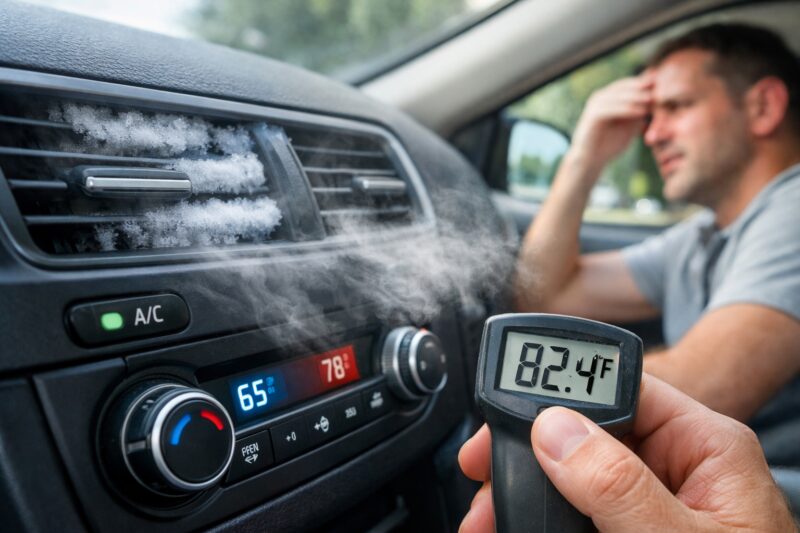
Another confusing case is strong airflow with poor cooling. That can mean the compressor is not engaging fully, or that the evaporator cannot transfer heat due to airflow restriction. In contrast, you can also have cold air early then warmer later. Cycling could come from low charge, but it can also come from sensor command errors.
Odor without obvious leaks is also tricky. Burning smells might come from debris on hot components, like condenser fins. Refrigerant-like odors can be faint, and oily residue may not show immediately. Therefore, visible evidence is helpful, but it is not the only way to judge urgency.
Vehicle history matters too. If the system was recently recharged, repeated attempts can change how the symptoms appear. After prior repairs, a “new” symptom might be a secondary issue. That is why documenting when symptoms began helps the shop connect the dots.
When you can keep driving and when you should stop using the AC
You can usually drive to a repair appointment with reduced risk if the AC issue is mild and there is no leak evidence. However, you should stop using the AC right away if you smell burning, see smoke, or notice visible refrigerant-like residue. Those signs can indicate electrical trouble or an active leak that may worsen quickly.
Comfort and safety also matter. If the AC affects visibility by causing windshield fogging, fix it sooner. Warm air itself is less urgent than warning lights plus noise plus odor. Yet warm air paired with signs of leaks can become urgent fast.
If you suspect a refrigerant leak, avoid long AC use. Instead, use fan-only ventilation if your vehicle has it and if it does not worsen the symptoms. Keep the cabin filter in mind too, because restricted airflow can make the system work harder. Meanwhile, if your battery condition for AC seems weak, monitor for electrical warning signs and reduce electrical loads.
For the call/service timeline, use symptom severity as your guide. If the AC stops after a short time, or the system cycles rapidly with strange noise, aim for same-day diagnosis. If the AC cools but feels weaker, book the soonest available appointment. Finally, if the AC is running normally but you just want long-term prevention, you can monitor while you schedule.
A practical approach helps you make decisions with less stress. Test the AC for a few minutes, then stop if odor or abnormal noises appear. If everything feels normal and there are no leaks, you can still drive, but arrange diagnostics soon.
Frequently asked questions about signs your car AC needs immediate repair
What are the first signs my car AC needs immediate repair?
Immediate attention is called for when you notice warm air after the system previously worked well, especially if it happens suddenly. Also treat loud compressor noise, a burning or chemical smell, and visible oily residue near lines or the condenser as urgent. If warning lights appear with AC activation, schedule diagnostic service quickly. For car AC repair signs like these, waiting can increase system strain.
How can I tell if my AC is low on refrigerant or has a bigger problem?
Patterns matter more than a single symptom. Low refrigerant often shows as cycling, cooling that fades after a few minutes, or inconsistent vent temperatures. However, clogged airflow or sensor faults can also create similar “weak cooling” complaints. The surest way is leak testing and system checks, so you don’t recharge without addressing the cause.
Why does my AC blow cold for a few minutes then warm up?
This often happens when the system cycles due to low charge, a restriction, or a sensor command issue. Airflow restrictions can also cause the system to work briefly, then struggle as conditions change. A technician confirms by checking refrigerant pressures, verifying fan and blower operation, and scanning HVAC sensor readings. If evaporator icing occurs, airflow usually plays a major role.
Is it safe to drive with a refrigerant leak suspected?
It can be risky if you have strong leak evidence, such as an oily wet spot or a clear refrigerant odor. If you suspect a leak and the AC performance drops fast, avoid using the AC and schedule service right away. You can usually drive without AC if the cabin stays tolerable and there are no electrical warning signs. However, do not keep reusing the AC in hopes it will “hold.”
What does a burning smell from the AC system usually mean?
A burning smell can come from electrical components, wiring, or a relay related to HVAC operation. It can also come from debris heating on hot parts like the condenser area. If the smell is strong and the AC acts abnormal, treat it as urgent. A mechanic should inspect for electrical faults and look for leak indicators near the smell source.
Can clogged cabin air filters cause AC failure symptoms?
A clogged cabin air filter can reduce airflow and make the AC feel weak, especially on high fan settings. It can also contribute to poor vent output and uneven comfort. However, a filter typically does not cause refrigerant odor or oily residue. If you suspect leak evidence, prioritize leak testing over replacing only the filter.
What should I ask a mechanic to diagnose my AC quickly?
Ask what tests they will run for leaks, airflow, and control command behavior. Provide your symptom timeline, such as when it went from cold to warm. Also mention whether condenser fans run and whether the blower works on all settings. If possible, ask if they will perform leak detection before recharging.
How long will car AC repair take in 2026?
Most diagnostic visits can take a few hours, but exact times vary by shop workload and access to parts. Simple repairs like filter or fan fixes may take less time. Leak repairs and component replacements often require additional steps and can take longer, especially if a part must be ordered. Your best estimate comes after the shop confirms the root cause, not before.
Are DIY “AC recharge” kits a bad idea?
DIY kits can mask the real problem by restoring cold air temporarily while leaving the leak or control fault unresolved. They also risk using the wrong refrigerant amount or creating inaccurate performance expectations. In addition, improper use can interfere with later diagnostics. Professional service is better when symptoms suggest active leaks, strong odor, or abnormal cycling.
What are the most expensive AC repairs I might face, and how do I avoid surprises?
Repairs become costly when the evaporator, condenser, or compressor needs replacement, or when multiple parts are affected. That is why correct diagnosis matters, because it prevents replacing the wrong component. Ask the shop to explain which tests confirm the failure and which repairs follow those results. Also confirm that estimates include leak testing and verification of airflow and control operation.
Conclusion: use the symptoms to choose urgency and get the right diagnosis
The fastest way to protect comfort and avoid bigger damage is to recognize high-urgency car AC repair signs early. When you see warm air plus noise, odor, warning lights, or leak evidence, treat it as an immediate repair need. When the symptoms are milder, you can still plan a prompt diagnostic visit instead of guessing.
Your decision path should focus on observation and verification. Gather key details, note timing, and ask for leak and system checks. Then compare repair options based on process, not only the refrigerant amount. A correct car AC repair diagnosis often starts with the right questions and ends with repairs that match the root cause.
Finally, remember that AC performance issues rarely have just one cause. Refrigerant leaks, airflow restrictions, and control faults can overlap. If you want a practical next step, schedule diagnostic service promptly when urgent indicators appear, and request the tests that confirm the failed component. That approach usually reduces repeat visits and helps you move forward with confidence.
Updated September 2026