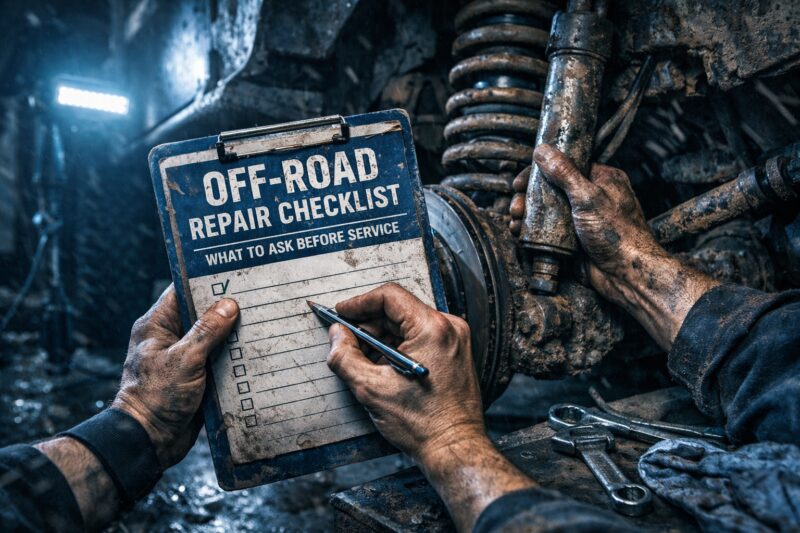
Before you book Off-Road Repair, you should confirm how the shop diagnoses the real cause, how it prices and documents the scope, and what proof you get before you’re handed keys. That’s how you avoid misdiagnosis, surprise add-ons, and a repair that “feels better” for one drive. When shopping for Off-Road Repair, prioritize shops that capture evidence, explain decision points, and communicate clearly as parts and findings change.
This article gives you a practical, call-ready checklist of what to ask before service. You’ll learn what a quality diagnosis sequence looks like, how to pin down included work versus excluded work, and how to vet parts sourcing and compatibility for off-road conditions. You’ll also get guidance on turnaround planning, warranty expectations, and the “root cause story” you should demand at delivery.
Use this as your decision path. If the shop can answer with specifics and documentation, you move forward. If it answers vaguely or won’t show evidence, you pause and ask for clarification or walk away.
Start with a symptom-to-system conversation that prevents guesswork
A good off-road repair starts with your symptoms, then maps them to the most likely systems. That means the shop asks about when the problem happens, what changed before it started, and what conditions trigger it. If you only describe the outcome, many shops can still diagnose, but quality drops because off-road failures often hide behind load and terrain.
How it works is simple. The technician listens for patterns like noise under throttle, leaks after trail heat, driveline binding on turns, or warning lights that clear and return. Then they tie those patterns to common off-road wear points, such as suspension components, transfer case behavior, axle seals, cooling flow, and sensor logic. A shop that does this well will also explain what it does next, instead of tearing down immediately.
In practice, you should ask how they plan a diagnosis sequence. For example: what inspection they’ll do first, whether they’ll test under controlled conditions, and what measurements they’ll take before ordering parts. Also ask, “What would change the diagnosis?” A serious shop will answer with decision gates, like “If temperature stays normal, we focus on airflow and fan control; if temps spike, we inspect cooling paths next.”
One common mistake is asking for a part replacement without confirming the cause chain. Another is assuming a quick scan alone proves the fault. Off-road conditions can create intermittent sensor faults or mechanical issues that only appear under load. If the shop can’t explain uncertainty and next steps, you’re paying for exploration, not evidence.
Ask what their diagnosis process produces and how it feeds your estimate
Before approving Off-Road Repair, confirm what documentation the shop creates during diagnosis. You should expect more than “it was bad.” You want photos or video, scan results, and measurement notes tied to the estimate. That documentation becomes the bridge between what they found and what they plan to replace or adjust.
A quality diagnosis process usually follows an inspection-to-verification path. First, the technician checks for obvious damage, fluid status, and visible signs of wear. Next, they verify with targeted tests, such as functional checks, compression or leak checks where relevant, and fault code correlation when warning lights appear. Then, they summarize findings in a way that connects symptoms to measurable causes.
Practical application matters. Ask who reviews the diagnostic data and how it turns into labor hours and parts line items. Also ask how they handle diagnosis uncertainty. For example, “If measurements are borderline, do you stop and re-evaluate, or do you proceed with additional teardown?” A clear shop will explain stop criteria and approval steps, not just “we’ll.”
Tradeoffs exist. Some repairs require staged teardown to confirm hidden damage. However, a professional process still documents what changed after each stage. Edge case: intermittent electrical issues can vanish during testing. In that case, the shop should describe how it reproduces the fault or how it sets up a plan to confirm after parts replacement.
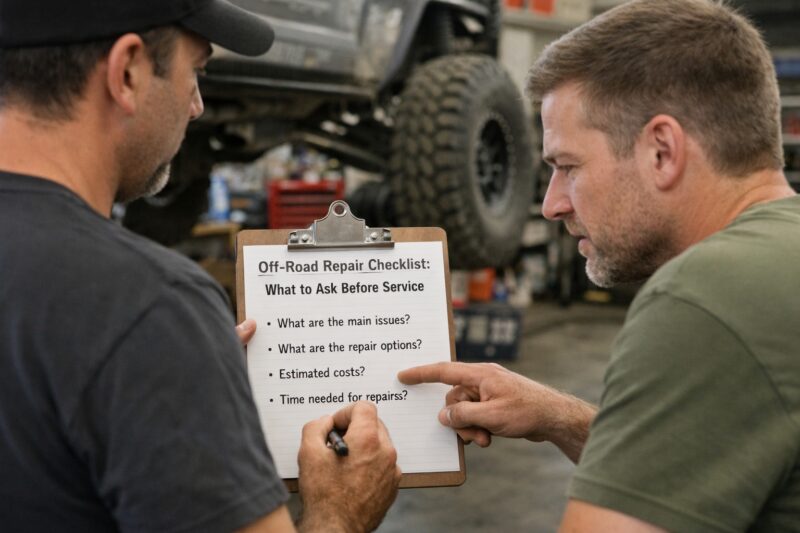
When you shop, use a right technician checklist to keep the conversation grounded in evidence. It helps you compare shops on documentation quality, not just price promises.
Define the scope clearly: included work, excluded work, and scope-change rules
Scope clarity prevents the most common off-road repair disputes. Before authorizing work, confirm what the estimate includes, what it excludes, and how the shop handles new findings once teardown starts. If the scope is fuzzy, costs and timelines often drift because off-road repairs uncover hidden damage.
How it works is by translating your diagnosis into scope categories. Usually that includes diagnostic time, labor hours, a parts list, and consumables. It may also include sub-systems like suspension repair, axle work, transfer case service, cooling inspection, or electrical diagnostics. You should ask for a breakdown that shows assumptions and limits, not a single lump sum with no explanation.
Practical questions should cover authorization and communication. Ask, “If you find additional damage, do you call me first?” Then ask how they re-quote after teardown reveals new issues. You also want a hidden damage policy prompt. For off-road failures, examples include cracked housings, seized fasteners, compromised seals, and bent components that weren’t visible from the outside.
A key limitation is that every shop can discover hidden damage, but not every shop documents it the same way. Your goal is to require evidence and a decision gate before additional replacement. Real-world scenario: a leaking axle seal might reveal a damaged bearing surface. A quality shop documents the new finding, explains impact on labor and parts, and asks for re-authorization.
Verify parts sourcing, compatibility, and off-road durability decisions
Off-road repairs fail when parts fit is wrong or when components aren’t suited to harsh use. Before service, ask what part sources the shop plans to use and why. You should also confirm compatibility details, not just “we’ll replace it.”
How it works starts with choosing parts type. Ask whether they use OEM components, quality aftermarket parts, or rebuild options, and what that choice means for fit and warranty. Then require a compatibility check list. That can include fitment identifiers, mating surface prep requirements, spline counts, gear ratio alignment where applicable, brake system spec matching, and correct electrical connector or sensor mating.
Next, ask how parts move from order to installation. Will parts arrive in-stock, through distributors, or with lead times? What happens if a part is delayed? Also ask whether substitutions trigger a re-quote or re-authorization. This is where you protect your estimate and avoid “approved price, different part” problems.
Off-road durability is the deeper layer. Ask what they recommend for harsh use, including correct fluids, corrosion protection practices, and component quality for dust and moisture exposure. Tradeoff: bigger is not always better. For example, a component that’s overbuilt for one condition can create stress elsewhere if alignment or lubrication practices are off. Edge case: a lift-related geometry change can make a replacement look fine on a bench but fail under real angles.
If the shop talks in generalities, ask for specific warranty coverage language. Good shops can explain why their parts choices hold up, and they can show you their suspension repair warranty terms when relevant.
Plan realistic timing and prevent turnaround drift from off-road hold-ups
Timing matters because off-road vehicles often sit waiting for parts, approvals, and verification checks. Before you authorize Off-Road Repair, ask for a work-back schedule that includes intake, diagnosis, parts arrival, repair, test, and handoff. Then ask what happens when anything slips.
How it works is by breaking the job into stages with decision points. For example, diagnosis might end with a call to approve a teardown stage. Repair might pause for parts lead times. Verification might require a second check once the vehicle is heat-cycled or tested under conditions similar to the complaint.
Practical questions should include legitimate hold-up triggers. Ask how they handle backorders, safety holds, and waiting on approvals. Then ask when they will update you. A serious shop doesn’t just “check in later.” It tells you the cadence, like daily or after each major stage, depending on the situation.
prevent timeline drift by asking about re-estimates. Ask, “At what point do you re-estimate labor hours?” and “If parts arrive early or late, what changes in the plan?” Tradeoffs exist because seized fasteners and hidden damage can add hours. Still, good shops document each stage so the schedule remains truthful.
If you’re dealing with suspension work, confirm the turnaround timing for lifts. Lift jobs often involve geometry checks and re-torque steps that affect verification time.
Confirm warranty, guarantees, and liability boundaries before you approve the work
Warranty clarity protects you after the job is done. Before authorizing repairs, ask what warranty covers, what it excludes, and how claims work if the issue returns. You also want to know how workmanship is handled for off-road-specific labor.
How it works is usually split between parts coverage and labor coverage. Parts warranties can vary by brand and source. Labor coverage should cover proper installation and correct diagnostic steps within the agreed scope. Ask about time limits and whether there are distance limits, plus what counts as a “defect” versus normal wear.
Practical questions should include documentation requirements. For example, “What do you need from me to submit a warranty claim?” Many shops will ask for photos, records of the symptoms, and sometimes proof of how the vehicle was used after the repair. Also ask whether they need you to bring the vehicle back to diagnose before deciding if coverage applies.
One common mistake is misunderstanding estimate liability versus final invoice liability. A clear shop explains when diagnostic fees apply, and when labor hour changes require signatures. Edge case: complex driveline repairs can have multiple interacting causes. A shop should explain workmanship coverage on items like seal installation, driveline alignment verification, and electrical diagnostic work.
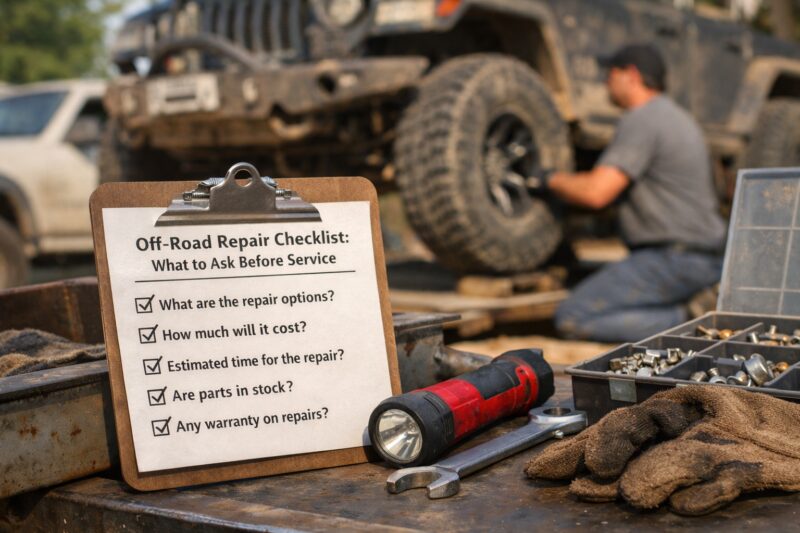
Finally, confirm the authorization ladder. Ask what can be done without your consent and what must be approved first. This keeps scope changes from becoming surprise liabilities.
Vet pricing transparency by comparing evidence, assumptions, and line items
Price is only “fair” if your estimate matches the same scope and assumptions. Before you approve Off-Road Repair, request itemized pricing that breaks down labor, diagnostic time, parts unit costs, and fees. If the shop can’t explain labor hours, parts selection, and extra charges, you can’t compare value.
How it works is through transparent line items and clear assumptions. Ask what condition the shop assumes about your vehicle at intake. Then ask what evidence supports those assumptions, such as measurements, scan reports, or visible damage. You should also ask for consumables and shop supplies, plus environmental disposal fees if applicable.
Practical application: create comparison-ready estimates. Ask each shop to list the same categories: diagnostic fee coverage, labor hours by task, parts list with source type, and any consumables. You can then compare apples-to-apples without guessing why one shop seems cheaper. Also ask about add-on conditions, like reinspection time if teardown reveals new issues.
Pricing red flags are predictable. A vague lump-sum quote with no parts list, no labor breakdown, or no explanation of diagnostic uncertainty should raise questions. Another red flag is refusing to discuss assumptions. Off-road repairs change after inspection, so good shops should explain how they manage that uncertainty.
In addition, if your repairs touch emissions-related components or fuel systems, reference how tampering rules can apply to installed emissions equipment. For a baseline on emissions-related labeling and tamper considerations, see EPA guidance on vehicle emissions. It helps you ask informed questions if your repair overlaps with regulated systems.
Demand proof of work with test results tied to the original complaint
A quality repair ends with verification, not hope. Before you drive off, ask for a final deliverable packet that proves what was fixed and how it was confirmed. That packet should link completed work to the original symptoms you reported.
How it works is by matching verification tests to the complaint. If you had a leak, there should be a leak check or pressure verification where relevant. If you had overheating, there should be temperature monitoring or cooling system function checks. If warning lights were involved, there should be fault code review and confirmation after the repair.
Practical questions should be concrete. Ask for photos of completed work, plus any torque or installation notes when applicable. Also ask which replaced parts were installed and whether the parts match the approved list. Finally, ask them to explain the “root cause story” and the evidence that supports it.
off-road problems can appear only under load, angles, or repeated heat cycles. A brief parking-lot test can miss recurring symptoms. So ask how they account for realistic stress. For example, do they verify driveline function in a controlled test that mimics the complaint? Or do they document that the vehicle passes functional checks before release, then advise you what to watch for on your first trail run?
Edge case: intermittent electrical issues can return later. A good shop will set expectations for what should trigger a prompt return. That’s also how warranty claims become smoother, because you can show symptoms aligned with the verified repair scope.
Understand common off-road repair mistakes that create repeat failures
Many repeat off-road failures come from the same mistakes. The most common one is treating “it starts” or “the light is off” as a complete fix. However, drivetrain, cooling, and suspension problems often show under real load, not at idle.
Another mistake is skipping documentation. If photos, scan output, and measurements aren’t saved, disputes become hard. Warranty claims also get tougher because you may not have evidence showing the original condition or what changed during repair.
Third, some shops rely on broad “do whatever it takes” language. That approach can be helpful in rare, emergency situations. Still, without an authorization process and scoped decision points, you risk paying for exploratory parts replacement rather than an evidence-based plan. Ask the shop to define what it needs approval for before it starts.
over-replacing parts is a classic off-road “parts cannon” trap. Shops can fall into it when they don’t confirm the fault chain. You should ask how they avoid replacing multiple components before measurement proves what’s responsible. Also ask about fluids and greases. Incompatible fluids can pass a bench test but fail after heat cycles and dust exposure.
Finally, remember that some off-road issues are “systems problems,” not single-part failures. For example, a leak can be caused by seal damage, but also by misalignment or venting changes. A good shop ties cause and effect together.
Compare repair approaches and decision paths before you commit to a single option
Not every repair shop works the same way, and that affects risk. Before committing, compare service categories based on how they reach a diagnosis and how they manage uncertainty. Ask how they decide between diagnosis-first, diagnose while disassembling, or targeted troubleshooting based on prior records.
How these approaches differ is mostly about evidence and speed. A diagnosis-first approach often reduces “guess parts” but can require more initial testing. A disassembly-assisted approach can reach hidden issues faster, but it increases the chance of uncovering extra damage that needs re-authorization. Targeted troubleshooting works best when you bring good records and clear symptom history.
Practical application: ask for the decision path tailored to your risk tolerance and budget. For example, staged repairs can reduce up-front cost but may extend overall time. Safety-first repairs focus on drivability and preventing further damage. Meanwhile, a full repair path might address root causes in one.
Also compare parts strategy. Some shops recommend OEM-like replacements for critical sealing surfaces. Others prefer quality aftermarket parts for cost control. Rebuilt components can be sensible when the core is verified as reusable. The key is documentation and compatibility checks, not the brand name alone.
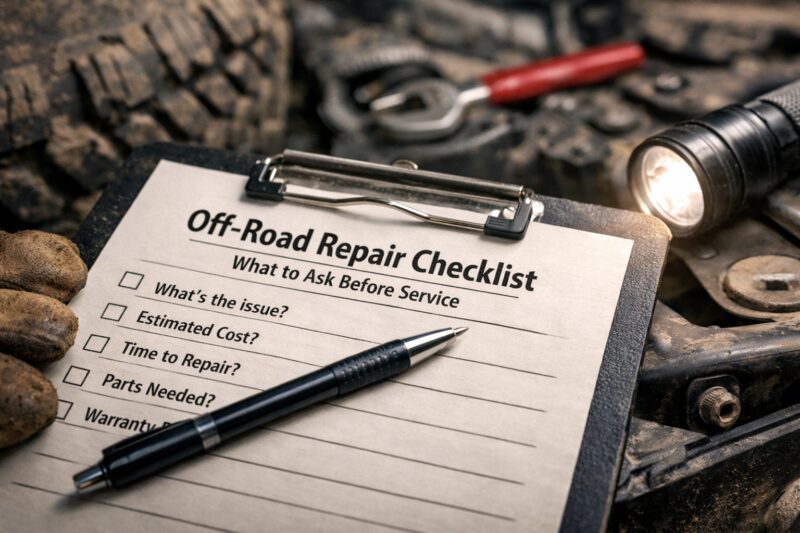
If you want a structured comparison, you can ask the shop to fill in details for each option. Here’s what your job success checklist should capture for any approach.
| Approach | Best for | Tradeoffs | Documentation to require |
|---|---|---|---|
| Diagnosis-first | Unclear symptoms and warning lights | May take longer before parts are ordered | Test results, scan data, measurements |
| Diagnose while disassembling | Likely hidden mechanical damage | More re-quotes if new damage appears | Photos by stage and updated scopes |
| Targeted troubleshooting | Clear history and prior work | Depends on accurate records | Cause hypotheses and confirmation tests |
Get evidence-based answers for intermittent, recurring, and hard-to-prove failures
Some off-road problems won’t stay put long enough for a single test. Intermittent electrical faults, recurring vibrations, and leaks that appear only after trail duty are common examples. When the problem won’t go away, ask how the shop handles re-diagnosis cycles.
How it works is by setting thresholds and stop criteria. A quality shop will define what triggers a second round, what additional measurements it will take, and how it decides whether the original root cause remains unproven. It should also explain what changes since the last attempt, so you can see progress rather than repeating steps.
Practical questions should separate customer responsibility from shop responsibility. Ask whether modifications, driving patterns, or prior repairs can influence the fault. Then ask what they will do to confirm their diagnosis despite those variables. Many off-road causes are “systems-linked,” such as worn hubs, axle seal migration, misalignment effects, and overheating that can temporarily mask a symptom.
escalation should be clear when evidence is missing. Ask what they do if parts arrive defective, if labor time exceeds the estimate, or if the root cause can’t be proven after a first diagnostic cycle. A professional shop offers an escalation ladder, such as additional testing, second-opinion review, or agreed staged next steps.
Also ask how they handle customer expectations. If the fault is intermittent, a good shop may ask you to reproduce conditions safely. It should still maintain documentation and keep warranty rules clear.
Off-Road Repair service checklist questions to bring to the shop
Use these questions as a practical script when you call or when the vehicle is on the rack. This is the fastest way to compare shops and confirm diagnosis quality, scope boundaries, and accountability. It also helps you document answers so you can decide without pressure.
How to use it works like this: ask for the answer in three parts. First, ask what they will do. Next, ask what evidence they will record. Finally, ask what approval they need from you. That structure forces clarity and reduces the chance of surprise decisions.
- What is your diagnosis sequence, and what measurements or tests do you document?
- What would change the diagnosis, and when do you stop to re-evaluate?
- What exactly is included in the scope, and what requires re-authorization?
- How do you handle hidden damage discovered during teardown?
- Which parts sources do you plan to use, and how do you confirm compatibility?
- How do you handle backorders, safety holds, and update frequency?
- What warranty covers parts and labor, and what are the exclusions?
- How does authorization work if labor hours change?
- Can you provide an itemized estimate with assumptions and all fees?
- What proof of work and post-repair tests will you provide before handoff?
This list supports a right technician checklist mindset. It also sets you up for a job success checklist view of evidence, communication, and verification. If you’re planning a suspension repair, ask for suspension repair warranty terms early so you’re not guessing later.
Frequently asked questions about Off-Road Repair checklist planning
What should I ask first when my off-road vehicle won’t start or won’t move?
Start by asking what immediate triage they’ll do for safety and what they need from your symptom description. Then ask if they’ll follow a structured diagnosis before teardown, and what evidence they document. For example, ask how they confirm whether the issue is driveline-related, power/charging-related, or related to cooling and overheating symptoms.
How do I get an estimate that’s detailed enough to compare between shops?
Ask for an itemized estimate that separates diagnostic time, labor tasks, and a parts list with the intended sourcing type. Also request the assumptions behind the estimate, plus how they handle changes once hidden damage is found. When you compare, use the same categories and ask each shop what will trigger a re-quote.
Should I bring my own parts for Off-Road Repair, and what do I need to confirm?
Yes, but confirm compatibility first. Ask whether the shop will verify fitment details such as connectors, spline counts, and mating surfaces, and whether substitutions affect scope and warranty. Also ask how labor responsibility works if customer-supplied parts are delayed or don’t match spec.
How do I ask about parts warranties and labor guarantees without getting vague answers?
Ask for the exact warranty boundaries: time window, parts versus labor coverage, and any exclusions. Then ask what documentation they require for a warranty claim and how they confirm the problem returned. A specific answer should include the shop’s authorization steps for re-diagnosis under warranty.
Can the shop refuse to give a written scope or itemized estimate?
Some shops may offer a verbal estimate first, but written scope helps protect both sides. Ask for a written, itemized estimate that includes the parts list and labor tasks before you authorize work. If the shop will not provide it, consider walking away because scope disputes become harder later.
How do I handle it when the shop finds extra damage during teardown?
Ask how they will contact you, what documentation they will provide, and what approval they will request before expanding scope. Then ask for an updated estimate that explains the labor change and the new parts list. Finally, confirm whether timeline changes will trigger a new scheduling expectation.
How long does off-road repair usually take, and what counts as a legitimate delay?
Timing depends on diagnostic findings, parts availability, and teardown complexity, so expect variation. Many jobs follow a stage plan: intake and diagnosis first, then parts arrival, then repair and verification. Legitimate delays include backorders, safety holds, and additional measurements required to confirm root cause.
What proof of work should I request before I drive off the lot or trail?
Request photos of completed work, a list of installed parts, and post-repair test results tied to the original complaint. Ask how they verified the repair, such as leak checks, temperature checks, fault code review, or functional drivetrain checks. Also ask what symptoms should be reported immediately if something feels off again.
What should I do if the issue comes back after the repair?
Stop driving if the symptom suggests safety risk, then contact the shop promptly with a clear description of what returned. Document when it occurs and under what conditions, like angles, speed, or heat. Ask the shop to re-diagnose under warranty and follow the same evidence-based process as the first repair.
What if the root cause can’t be proven after the first round of diagnosis?
Ask what they will do next, including additional measurements and how they’ll decide when to stop repeating tests. You should request updated evidence and a clear threshold for a second round or escalation. Also ask how the shop will communicate uncertainty so you don’t end up paying for repeated guesswork.
Make your decision with evidence: proceed, pause, or walk away
You can use this checklist to decide fast. Proceed when the shop answers with specifics, documents diagnosis findings, and ties repairs to measurable verification. Pause when answers are vague, when scope boundaries are unclear, or when documentation is refused.
Your practical next step is to copy the question list and ask for a written estimate before approval. Confirm the diagnosis sequence, the included versus excluded work, and the authorization steps for scope changes. Then request proof of work tied to the original complaint and ask about suspension repair warranty terms when the repair touches suspension systems.
Finally, compare at least two shops using the same job success checklist questions. When you do that, value becomes easier to. You should feel confident that the repair fixes the cause, not just the symptom.
Updated November 2026