
A Go Kart Maintenance Service keeps go karts reliable and safe by performing structured inspections, measurement-based diagnostics, and verified repairs—so fleets, track owners, vehicle operators, and high-volume rental shops can reduce breakdowns, downtime costs, and customer-facing ride inconsistency. In practice, a strong Go Kart Maintenance Service doesn’t just “fix what broke”; it uses a repeatable checklist to catch early wear, confirm root causes, and document results. This article gives you a practical service checklist structure—what to inspect, how often to inspect it, and how to evaluate a provider—so you can standardize uptime and ride feel across shifts and seasons.
Commercially, reliability matters because one unscheduled failure can cascade into missed bookings, staff overtime, refunds, and damaged reviews. Consistent throttle response, stable braking, and predictable steering reduce customer complaints and improve retention—especially for rental fleets where riders vary widely in weight, skill, and use intensity. Scope-wise, this guide focuses on maintenance/service reliability and verification (not racing strategy, rules interpretation, or choosing a new kart model).
You’ll also see “deeper-than-obvious” guidance that many generic blogs skip: adjusting inspection timing by duty cycle, using condition-based checks when calendar intervals are too coarse, and accounting for rain/dust/corrosive environments. You will leave with a framework to compare providers and demand the documentation that prevents disputes and repeat failures—supported by real-world maintenance and safety principles used in the broader transportation and vehicle-repair world, aligned with guidance such as Federal Motor Carrier Safety Administration maintenance concepts and OSHA’s general emphasis on hazard prevention and safe work practices. For commercial quality assurance thinking, you can also reference ISO 9001 quality management principles as a helpful lens for process discipline.
What does a go kart maintenance service do for commercial reliability and safety?
A Go Kart Maintenance Service ensures karts meet reliability and safety expectations by performing scheduled inspections, diagnosing faults before parts are replaced, and verifying repaired systems under realistic conditions. It’s designed for operators who cannot afford inconsistent performance—commercial rental fleets, track owners, fleet managers, and high-volume shops where uptime and ride feel directly impact revenue and reviews.
Why this matters commercially is simple: when maintenance is reactive, failures show up during peak sessions, and the cost is not just the repair bill. Downtime can mean lost ride time, staff scrambling for replacements, missed events, and customer churn. A service that follows an end-to-end checklist helps reduce “surprise” repairs because it catches early wear patterns like brake fade risk, clutch engagement drift, drivetrain misalignment, and fuel delivery degradation before they become session-stopping faults.
How it works in practice is a structured workflow: intake and symptom capture, diagnostics and measurement, service execution, test ride verification, and documentation. For example, instead of swapping “whatever looks worn,” a good provider records measured conditions (pad thickness, rotor scoring, chain/belt tension readings, linkage free play, electrical resistance/voltage checks, and throttle/idle behavior). This approach improves accountability and helps you spot systemic issues across multiple karts—useful when multiple operators share a fleet or when shift handoffs mask defects.
Tradeoffs and limitations exist. Maintenance service can’t guarantee zero failures—especially with harsh duty cycles, rain exposure, or debris ingestion—but it can drastically reduce frequency and severity by targeting common failure modes and verifying outcomes. A real scenario: a rental fleet reports “power loss after 10–15 minutes,” and a reactive shop replaces a part and sends it back; a checklist-driven service tests fuel delivery and air filtration under heat soak, verifies mixture/flow, checks for vacuum leaks (or equivalent system issues), and confirms stable throttle under simulated rider load. That is what turns “a fix” into “reliable rides.”
For teams who want a process-based approach to repair quality, it helps to use a broader vehicle repair shop checklist mindset: clear intake notes, documented measurements, and a defined acceptance test. And if your shop also supports core powertrain work, a focused reference for propulsion systems can be useful via a dedicated Go kart engine service page for engine-specific scope boundaries.
Go Kart Maintenance Service checklist: what reliable rides require end-to-end
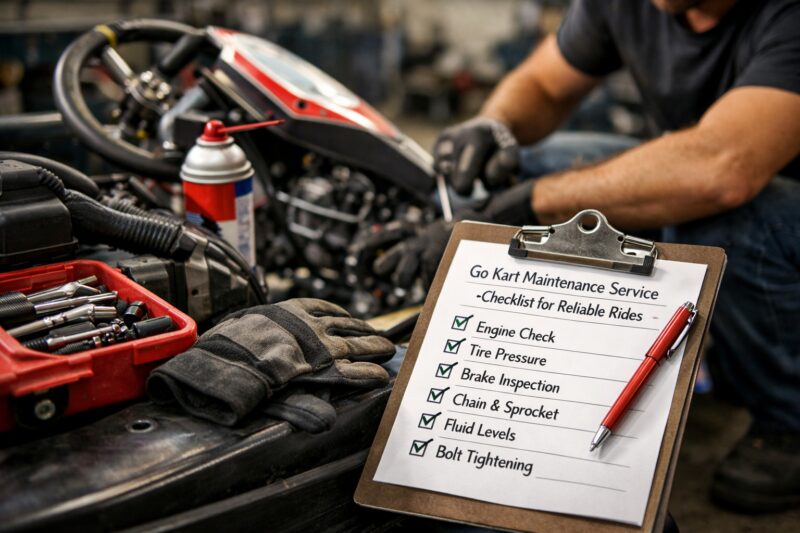
A reliable Go Kart Maintenance Service checklist produces uptime, consistent performance, predictable safety checks, and fewer “surprise” failures by covering every kart system and verifying results after repairs. The goal is not only to make the kart run today, but to ensure it behaves the same way tomorrow across different riders, sessions, and environmental conditions.
An end-to-end checklist flow typically looks like this: intake → diagnostics → service → test ride → documentation. Intake is where you capture symptoms and usage context (when the issue appears, which shifts/operators reported it, weather exposure, and whether it’s intermittent). Diagnostics are where measurement replaces guessing, ensuring the provider can explain what was found, what it caused, and why a specific repair is needed. Service execution is the repair work performed to spec, using correct consumables and the appropriate adjustment/torque practices. Test ride verification checks whether the kart meets defined acceptance criteria under representative conditions, and documentation closes the loop so you can track recurrence and warranty disputes.

To be complete, the checklist needs coverage across these categories: engine/power delivery, fuel & air (as applicable), drivetrain, brakes, steering/suspension, tires/wheels, and electrics/safety. Missing a single category is where commercial reliability breaks down. For example, replacing brake pads without checking rotor surface condition, caliper slide freedom, or steering alignment can lead to repeat issues: customers perceive “pulling” or unstable braking feel, and technicians later discover that earlier work accelerated wear elsewhere.
A deeper nuance is that checklist timing must reflect duty cycle and environment. Rental fleets often see high run counts, variable rider technique (hard launches, curb impacts, frequent full-throttle usage), and frequent restart/stop cycles. Private or light-use karts may show early wear more slowly. Dust and rain add another layer: grit can contaminate steering bearings and brake components, while moisture can accelerate corrosion or electrical intermittents. Condition-based checks—triggered by measured signals like vibration trends, brake temperature symptoms, or observed throttle surging—should override simple calendar intervals when warning signs are present.
Commercial deliverables you should expect from a serious provider include service logs, defect tagging (e.g., “issue observed before work” vs “issue found after disassembly”), parts traceability (batch/identification when possible), and before/after test results. Those records help you answer recurring questions like “Did the fault exist before service?” and “Which adjustment did we make, and what changed in performance afterward?” This is also where a provider’s process maturity matters, and it aligns with the same quality logic used in structured ISO 9001 quality management systems principles.
Inspection & preventive maintenance plan: by interval and usage, not guesswork
A good inspection and preventive maintenance plan sets intervals based on usage and failure mode, then uses condition-based overrides when symptoms or measurements indicate the kart is diverging from expected wear patterns. In commercial settings, this prevents both over-servicing (wasted labor) and under-servicing (peak-session failures).
Structuring intervals generally starts with three layers: pre-shift/operational checks, weekly or periodic inspections, and monthly or deeper maintenance cycles. Pre-shift checks are the “front line” for fast verification: brake lever/pedal feel and travel, obvious tire damage, steering bind or looseness, throttle response sanity checks, and functional electrics/safety controls (like kill switch behavior). Weekly/periodic inspections expand the scope to measurement-based items (pad thickness, chain/belt tension trends, fastener checks, alignment indications, electrical connector inspection, and air intake cleanliness). Monthly/deeper cycles include more involved disassembly inspections, detailed wear measurements, and calibration or rebuild-level work as required by component life.
The key is deciding interval frequency using usage metrics: operating hours, number of laps/runs, rider volume, fuel type (and its storage handling), and storage conditions (dry/indoor vs humid/outdoor). A rental kart that runs 6–10 hours a day for 6 days has a very different duty cycle than a privately used kart. Practical application: track owners should record “runs per kart per day” or total engine hours, then map those to service intervals. When you don’t measure usage, you end up with “one interval fits all,” which increases drift across a fleet and causes uneven reliability.
Failure-mode-driven checks are the deeper differentiator. Some issues degrade gradually and give early warning—clutch wear often changes engagement feel over time, and chain/belt wear can increase vibration. Other problems can degrade suddenly—certain electrical intermittents or brake system hydraulic/seal issues can appear without long warning. Providers should design their plan so that early-warning items are checked more frequently by measurement, while sudden-failure risks have rapid inspection triggers and escalation rules. A common commercial scenario: if multiple karts start showing similar throttle surging after a rainy weekend, calendar intervals alone won’t catch moisture-related fuel/air behavior quickly enough; condition checks should override the baseline schedule.
For fleets operated by multiple drivers with frequent shift changes, it's crucial for service providers to clearly outline what adjustments are needed based on each operator's use. For instance, a "hard use" shift might necessitate additional inspections the following day, while other procedures remain standardized. This approach minimizes inconsistencies and aligns with key questions to confirm repairs by ensuring clear responsibilities and documented acceptance criteria, rather than relying on informal confirmations.
Diagnostics and service execution: how a go kart passes after work
A Go Kart Maintenance Service should diagnose first, then service, then prove the kart is reliable with a defined acceptance test after repairs. This prevents random part swapping and ensures the kart performs correctly under realistic load—not just on a bench or a short idle test.
How diagnostics should work: start with symptom capture (when it occurs, under what rider/load, during acceleration vs braking vs cruising, and whether it’s intermittent). Next is a structured inspection and measurement across relevant subsystems—compression/ignition/fuel delivery for power issues, drivetrain alignment/tension, brake pad/rotor health, steering free play, and wheel balance. Only after that should parts be replaced, and even then, the service should document why each replacement addresses the measured root cause.
Practical application in commercial fleets: acceptance criteria should be written and communicated. Examples include stability under braking (no grabbing/pulsing), throttle response consistency (no surging or dead spot), and no abnormal vibration or noise at defined speeds/load. A provider should also specify test conditions: surface type (grip level), kart temperature, ambient humidity, and load simulation (a rider weight range or equivalent test mass). “It starts and idles” is not reliability; heat soak and repeated acceleration reveal issues like fuel starvation, vacuum leaks, ignition drift, or clutch engagement instability.
Deep nuance: service verification must match the failure context. If a kart fails only after 20 minutes, a 2-minute spin-up won’t reproduce the fault. If a steering vibration appears only after braking, you need to test in sequences that mimic customer rides. Similarly, brake fade concerns may only show after repeated stops or in wet conditions where contamination changes friction behavior. Providers should be willing to reproduce conditions or explain why they can’t, and to document risk when exact reproduction is not possible.
Documentation expectations should be concrete. A good service report includes measurements (before/after), observations (what was worn or contaminated), test results (what conditions were used), and parts notes (what was replaced and what remained). That documentation reduces disputes and makes it easier to feed failure-history learning back into your interval tuning. If you want engine-scope specificity for power diagnostics, the workflow principles still map directly to a focused provider page like Go kart engine service.
Brake, steering, and chassis safety checks: non-negotiables
Brake, steering, and chassis checks are non-negotiable because they directly determine rider safety and also strongly influence perceived ride quality. A high-quality Go Kart Maintenance Service should verify brake feel, steering play, and chassis integrity with clear “good” criteria after every service cycle that touches these systems.
Brake system inspection should include more than pad replacement. Technicians should check pad thickness and wear pattern, rotor condition (scoring, thickness variation where applicable), caliper or linkage movement, and the overall feel of lever/pedal travel. For commercial operations, it also matters to watch for brake fade risk indicators and contamination sources such as brake dust buildup, debris ingestion, or wet-weather performance changes. In practical terms: a provider should confirm that braking remains stable across repeated applications and that the kart returns smoothly without sticking or dragging that could accelerate wear or create uneven handling.
Steering and suspension checks are where repeat failures often start after “routine” brake work or quick adjustments. The service should verify steering linkage play, binding, bushing and bearing condition, and secure mounting fasteners. Proper alignment and chassis tightness matter because misalignment can cause repeat pad wear, pull under braking, or steering wander that riders interpret as “unsafe.” Real-world scenario: a shop replaces pads and “centers” the caliper, but does not verify steering linkage geometry or axle mount tightness; within weeks, multiple karts show uneven braking feel and increased vibration because systemic mounting issues were not addressed.
Operational safety edge cases require explicit attention. In wet weather, friction coefficients change and debris can form slick patches on tires, affecting braking distance and stability. Brake dust contamination can reduce effective friction; dust intrusion into bearings can increase steering effort or create intermittent stiction. A robust provider should also incorporate checks for debris ingestion—especially for rental tracks near construction zones, dirt corners, or high-wind environments where grit can infiltrate steering and brake components.
Finally, map responsibilities. Operators can do between-ride checks (visual tire integrity, obvious steering looseness, and functional safety control checks), but technicians must verify structural and adjustment-critical items—torque, alignment, bearing condition, brake component health, and mechanical linkage integrity. This is the kind of boundary that you’d expect from a vehicle repair shop checklist approach, where accountability is defined at the process level, not left to informal memory.
Engine, fuel, and electrical reliability: keeping power consistent for customers
Engine, fuel, and electrical reliability are what keep throttle response consistent and prevent the “power loss after a while” customer complaint. A Go Kart Maintenance Service should maintain air filtration, fuel delivery cleanliness, ignition health, and safety/control electrics with measurement-based verification, not guesswork.
Engine and power reliability begins with airflow and filtration—dirty intake elements can change mixture behavior and create inconsistent acceleration. Fuel and fuel-air delivery systems should be checked for cleanliness and correct operation; technicians should verify key components as applicable to your kart type (carburetor vs other configurations), including fuel delivery flow, jet cleanliness where relevant, and assurance that air paths are not restricted. Ignition health checks should include spark capability and condition of wires/connectors, because weak or intermittent ignition can look like “random” loss of power under load.
Electrical reliability should cover battery/charging systems where relevant, wiring integrity, secure connections, and correct function of kill switches and cutoffs. Safety implication matters: an intermittent cutoff can stop a rider unexpectedly, which is both a customer experience problem and a risk scenario during sessions. The deeper prevention strategy is root-cause correction—e.g., clogged jets or hoses, incorrect fuel mix, vacuum leak equivalents, and grounding problems that create repeating electrical anomalies.
A deeper nuance many guides miss is fuel storage and contamination handling. Stale fuel, water intrusion, or inconsistent fuel handling can cause hard starts, surging, and load-specific bogging. A commercial provider should assess how fuel is stored and dispensed (container cleanliness, exposure to moisture, rotation practices) and confirm whether observed symptoms align with fuel contamination signatures. Practical application: if you see surging after refueling from a particular tank or during humid periods, the service should treat “system-wide fuel handling” as part of the diagnosis, not only the kart.
Customer feel criteria should also be part of acceptance. Throttle response smoothness, stable idle, consistent acceleration, and minimal surging reduce complaints and reduce the number of “it feels off” returns. This is how maintenance turns into measurable ride quality improvements that matter to retention, especially in rental fleets where riders notice inconsistencies fast.
Drivetrain, clutch/transmission, and wear items: preventing recurring jobs
Drivetrain and clutch/transmission maintenance prevents recurring reliability failures by addressing alignment, tension, and wear thresholds—so karts don’t “wear out again” immediately after service. A Go Kart Maintenance Service should measure and set wear items correctly and verify engagement behavior under realistic load.
The drivetrain checklist typically includes chain or belt condition, sprocket alignment, engagement smoothness, bearings, and correct tension settings. Visual inspection alone can be misleading; commercial wear patterns (from hard launches, frequent full-throttle operation, and occasional curb impacts) can cause stretched chains, glazing, or alignment drift that doesn’t look dramatic until performance degrades. A measurement-based approach—combined with correct adjustment—prevents accelerated wear.
Wear item policies should emphasize measuring vs eyeballing, setting replacement thresholds, and avoiding mismatched parts that shorten lifespan. For instance, replacing only a clutch component without confirming alignment and tension can lead to abnormal engagement, overheating, and premature re-wear. Similarly, replacing a sprocket without verifying chain/belt condition and tracking alignment can create rapid chain stretch or noise complaints.
Maintenance after abnormal events is critical for commercial operations. If a kart stalls repeatedly, gets hard-launched, hits debris, or experiences rider abuse (common in high-volume rentals), the provider should inspect immediately after the incident: mounts, alignment, fasteners, linkage, and wear components. Deeper-than-obvious insight: many recurring failures are “service cannibalization” issues—quick fixes restore operation temporarily but mask the root cause. For example, if you replace a worn belt and reset tension but the underlying misalignment remains, you’ll get another belt replacement soon, plus ongoing customer complaints about vibration.
On the commercial economics side, technicians can reduce downtime by planning parts staging and batching similar jobs safely—when they know which wear items are trending across the fleet. That’s a practical reason to keep detailed logs and part traceability in your service reporting.
Provider selection: how to choose a go kart maintenance service you can trust
Choose a go kart maintenance service you can trust by evaluating documented checklist usage, measurement-based diagnostics, transparent recommendations, and post-repair acceptance testing. For commercial customers, trust is less about promises and more about observable process discipline and reliable documentation.
Start with technician competence: ask whether the provider can explain diagnostics logically (what they measured, why they measured it, and how it informed the repair). Then require evidence that a checklist is actively used—not just a printed sheet. A trustworthy provider should demonstrate how they capture intake notes, perform inspections methodically, and avoid “trial and error” parts swapping. If you’re deciding on staffing or partner capabilities, it also helps to know how to choose a go kart mechanic with the right focus on measurement, documentation, and consistent post-repair verification.
Compare service models based on your operational calendar and downtime tolerance. On-site service for fleets can minimize disruption but may require scheduling discipline and may be limited by equipment availability. Scheduled pickup/return can reduce per-job cost but can create peak-week bottlenecks if turnaround time isn’t protected. A hybrid approach—on-site for urgent safety items plus off-site for rebuild-level work—often balances reliability with cost. Your decision should reflect shift patterns and peak ride demand.
Transparency is non-negotiable. Providers should clearly separate “found vs fixed vs recommended,” show how they estimate labor and parts, and communicate what risks remain if you defer work. Deeper nuance: ask about failure-history learning. Do they track recurring faults by model, rider-load pattern, shift handoff, or environment? A provider who can say “these karts commonly re-fail because of alignment drift after X conditions” demonstrates process learning, not just wrench work.
Commercial-proof signals include service reports with photos/measurements, parts quality standards, turnaround-time commitments with escalation paths, and a defined urgent breakdown protocol. If you want a structured way to evaluate estimates and scope boundaries, use the what to ask before pay framework to ensure your provider’s process is documented and auditable. This reduces disputes and supports warranty accountability.
Common mistakes and misconceptions about Go Kart Maintenance Service
The most common mistakes in Go Kart Maintenance Service come from treating maintenance as only repairs and skipping verification steps that prevent repeat failures. Misconceptions like “if it starts, it’s fine” lead to transient faults being missed—then they reappear during customer sessions.
One frequent mistake pattern is ignoring adjustment specs and torque checks after vibration. In commercial use, fasteners can loosen and alignment can drift, creating repeat problems that show up as noise, vibration, or uneven handling. Another mistake is skipping documentation and measurement. Without before/after measurements and test conditions, it becomes hard to prove whether a fault pre-existed service, and it’s harder to prevent recurrence because your team lacks data.
Misconceptions also include over-reliance on trial runs. A short “runs fine on the bench” test can miss load-specific issues like bogging, heat soak power loss, or intermittent electrical cutoffs that only show after repeated acceleration cycles. A deeper insight is to think in failure mode categories: some faults are obvious immediately, but others show early warning only under sustained load or after exposure to humidity/dust. A provider that doesn’t replicate conditions gets stuck in a cycle of replacing parts that don’t address the root cause.
Another pitfall is incorrect consumables or fuel mixes (where relevant). Using the wrong fuel handling practices or consumable equivalents can create surging, hard starting, and power inconsistency that customers directly experience. Finally, service cannibalization risk is real: quick fixes can mask systemic mounting, calibration, or alignment problems. Good documentation and structured acceptance tests reduce these risks by making repairs verifiable rather than hopeful. In a disputes-heavy environment, a process anchored by a vehicle repair shop checklist philosophy is often what separates reliable partners from “one-off” vendors.
Options and alternatives: what your service contract can include
Your go kart maintenance contract can (and should) specify scope boundaries, verification steps, and response expectations—not just a vague “maintenance” label. Choosing the right contract structure helps you balance uptime, monthly cost, and operational control.
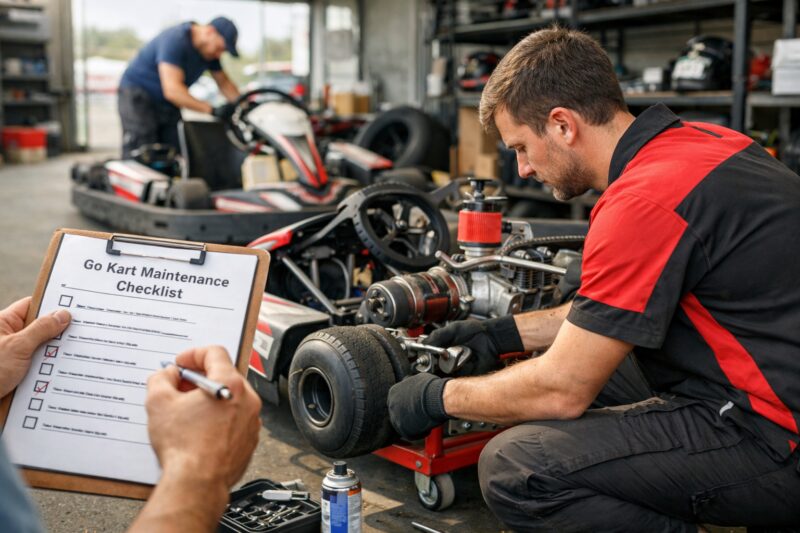
Realistic contract approaches usually fall into four categories. First, a basic preventive maintenance plan focuses on scheduled inspections and common adjustments, minimizing emergencies but requiring you to handle urgent issues as they happen. Second, a full-service model includes diagnostics plus repairs with test ride verification and documentation. Third, on-site emergency coverage provides rapid response for safety-critical or session-stopping faults, reducing peak downtime. Fourth, operator training/support for checks helps you reduce between-service defects by improving consistency at handoff points.
Tradeoffs are predictable. On-site emergency coverage improves uptime during peak hours but increases monthly cost and may require clear escalation procedures and service window limits. Off-site repairs can lower cost but add logistics overhead, which becomes expensive when peak-week downtime multiplies lost bookings. Basic checklists are cheaper but less effective for fleets with high variability in operator habits or rapid environmental stress; those environments benefit from tighter diagnostics and more frequent condition checks.
Bundling add-ons can be efficient without bloating costs—wear parts kits staged by measured thresholds, seasonal inspections that specifically target corrosion/dust ingress risks, and parts inventory management based on failure history. Deeper-than-obvious angle: match contract type to operational maturity. New fleets with inconsistent break-in or unknown fault patterns need tighter diagnostics and learning cycles; mature fleets with stable histories can tune intervals and reduce unnecessary labor while keeping condition-based overrides.
Optional comparison table note: a provider might offer different service tiers by scope and deliverables, but your internal decision should always map to measurable outputs: fewer breakdowns, faster turnaround on urgent faults, and improved post-repair acceptance test results.
Advanced considerations: edge cases big fleets must plan for in 2026
Big fleets in 2026 need Go Kart Maintenance Service plans that adapt to workload spikes, inconsistent operator habits, and environmental stressors—because generic intervals break under real-world variation. Reliability improvements must be verified with quantitative service-level metrics, not just “we performed maintenance.”
Edge cases to plan for include multi-shift workload spikes (when too many karts require attention at once), inconsistent operator habits (uneven use intensity and handling), and repeat downtime during peak hours. A mature provider should help you design escalation rules: which failure types trigger immediate swaps, which are safe to defer, and which require on-site intervention vs scheduled repair. They should also support batching strategy safely—sequencing work so that brake/steering issues don’t conflict with power system diagnostics and so that test rides can be performed under representative conditions.
Seasonal and environmental stressors can change how components wear and fail. Humidity/corrosion affects electrical connections and can alter brake performance. Dust intrusion changes air filtration behavior and can contaminate steering bearings. Storage transitions (indoor to outdoor or off-season shutdown) can introduce fuel stability issues and moisture-related intermittents. What most guides get wrong is treating intervals uniformly; instead, high-dust, wet-weather, or high-humidity periods should trigger additional condition checks and tighter acceptance verification.
Service-level verification is a deeper requirement for commercial customers. You should confirm reliability improvements quantitatively using metrics like reduced breakdown frequency per kart per week, faster restart after faults, fewer repeat jobs for the same component family, and fewer customer complaints tied to ride feel. In practice, this means using your service logs as a dataset. If a fleet claims “we’re more reliable,” you should be able to show it by comparing the rate of session-stopping failures before and after contract changes.
Another 2026-fresh reality: digital service logs and clearer accountability expectations. Providers that produce structured reports (with measurements, photos, and condition-based flags) reduce internal ambiguity and help your operations team schedule efficiently. Faster turnaround is valuable, but accountability and verified acceptance tests are what ensure reliability, not just speed.
Frequently asked questions about Go Kart Maintenance Service
How often should a Go Kart Maintenance Service inspect rental fleet brakes?
Brake inspection frequency should be driven by run hours and rider volume, not just a calendar date. A common commercial approach is pre-shift visual/feel checks plus more detailed weekly checks for pad wear, rotor condition, and brake feel consistency, with deeper verification monthly or when environmental conditions increase contamination risk. If symptoms show up (pulsing, pull, fade complaints), condition-based checks should override the schedule immediately. After service, acceptance criteria should include stable braking over repeated applications and documented before/after measurements.
What does a complete Go Kart Maintenance Service checklist include?
A complete checklist follows an end-to-end workflow: intake → diagnostics → service → test ride → documentation. It must cover engine/power delivery, fuel & air behavior (as applicable), drivetrain, brakes, steering/suspension, tires/wheels, and electrics/safety. Practical checklist execution also includes defined acceptance tests that confirm ride feel and reliability under representative conditions. Documentation should record measurements and observations for accountability.
Can a maintenance service fix chronic power loss without replacing parts randomly?
Yes, but only if the provider performs root-cause diagnostics before replacing components. A strong process captures when power loss occurs, measures ignition/fuel delivery/air conditions as relevant, checks for alignment and load-specific behavior, and verifies the fix with a repeatable test ride. Random parts swapping often produces temporary improvement but fails when underlying causes like fuel contamination, airflow restrictions, or electrical intermittents remain. Reliable service includes “before/after” proof tied to acceptance criteria.
What should I look for in service documentation from a go kart repair provider?
Look for measurements (before and after), clear findings tied to symptoms, and test conditions used during verification. The report should specify what was found, what was repaired, what parts were replaced (with identifiers if possible), and what remains recommended. Photos of key components, plus recorded results for throttle response, braking stability, vibration/noise, and steering play, help prevent disputes and recurrence. Good documentation is essential for continuous improvement across a fleet.
Is on-site Go Kart Maintenance Service worth it for busy tracks?
On-site service is often worth it when downtime during peak hours is expensive and when faults are safety-critical or frequent enough to justify rapid response. The key tradeoff is cost and scheduling: you’ll want a defined response time (SLA), coverage boundaries, and escalation procedures for urgent breakdowns. If on-site work is limited to basic fixes, more complex repairs should be scheduled with realistic turnaround commitments. The best decision comes from comparing downtime economics against contract price and verified turnaround performance.
How do I prevent clutch wear from recurring after repairs?
Recurring clutch wear typically means the root cause wasn’t fully corrected—often alignment, tension settings, or load/engagement behavior. A reliable service should measure engagement behavior, verify drivetrain alignment and tension, and apply wear thresholds with correct replacement policies. After service, acceptance testing should confirm stable engagement under realistic acceleration and repeated sessions. If rider abuse or operating technique is a factor, training and operator feedback may also reduce recurrence.
What are the signs your electrical system needs immediate Go Kart Maintenance Service?
Intermittent cutoffs, failure to start consistently, unexpected loss of power under vibration or heat, and inconsistent kill switch behavior are clear warning signs. You may also see erratic throttle response that doesn’t match engine condition, or safety-control anomalies that appear only after a short run. Electrical issues matter immediately because they can stop karts mid-session and create safety risk. A competent provider should perform wiring/connectivity checks and verify cutoff function during acceptance tests.
What’s the difference between preventive maintenance and condition-based service for go karts?
Preventive maintenance follows set intervals (pre-shift, weekly, monthly) based on expected wear and duty cycle averages. Condition-based service uses real-time signals—measurements, symptoms, trends in vibration/noise, and observed performance—to trigger inspections or repairs earlier than the calendar. In strong commercial programs, condition-based checks override scheduled work when warning signs appear. This prevents both over-maintenance and under-maintenance during abnormal operating periods.
Can Go Kart Maintenance Service help reduce customer complaints about ride feel and throttle response?
Yes, when the service verifies throttle response consistency with realistic test conditions and records measurements before and after repairs. Customers often complain about surging, dead spots, delayed response, or inconsistent acceleration, which can reflect fuel delivery, ignition health, or air intake cleanliness problems. A reliable provider should test for stability under load and heat soak, not just idle performance. Because ride feel is repeatable, documented acceptance criteria make improvements visible and trackable.
Should I bundle emergency coverage with routine Go Kart Maintenance Service?
Bundling emergency coverage is usually beneficial for fleets where session-stopping failures cause meaningful revenue loss or safety risk. The right contract includes scope boundaries, response SLAs, escalation paths during peak hours, and clarity on what qualifies as “emergency” versus scheduled repair. While emergency coverage increases monthly costs, it can reduce total downtime costs and protect customer experience. Choose based on your peak demand patterns and your provider’s proven turnaround reliability.
Conclusion: how to demand reliable rides from a Go Kart Maintenance Service
Reliable rides come from structured inspections, root-cause diagnostics, and verified post-repair acceptance tests—not from quick fixes or vague checkups. A strong Go Kart Maintenance Service checklist covers every kart system, accounts for duty cycle and environmental stress, and proves the kart is safe and consistent after work through repeatable test conditions and clear documentation.
Provider selection should be evidence-based: prioritize documented checklist usage, measurement-driven diagnostics, transparent recommendations, and failure-history learning. When your provider produces service logs with before/after results, parts traceability, and defined acceptance criteria, you reduce downtime, prevent recurrence, and improve rider experience. That’s the commercial payoff your operations team can feel immediately.
Your next step is practical: compare contract options, request a sample checklist and service documentation format, and evaluate whether their workflow matches the end-to-end model in this guide. If you do that upfront, you avoid the most common failure pattern—fast repairs that don’t actually eliminate the underlying cause. In the process of comparing vendors, use structured questions aligned with a what to ask before pay approach to confirm scope, verification, and accountability.
- Request a sample service report showing measurements, test conditions, and before/after results.
- Ask how they set intervals based on usage metrics and when condition-based overrides apply.
- Confirm acceptance criteria for brakes, steering, throttle response, vibration/noise, and stability under load.
Updated May 2026