
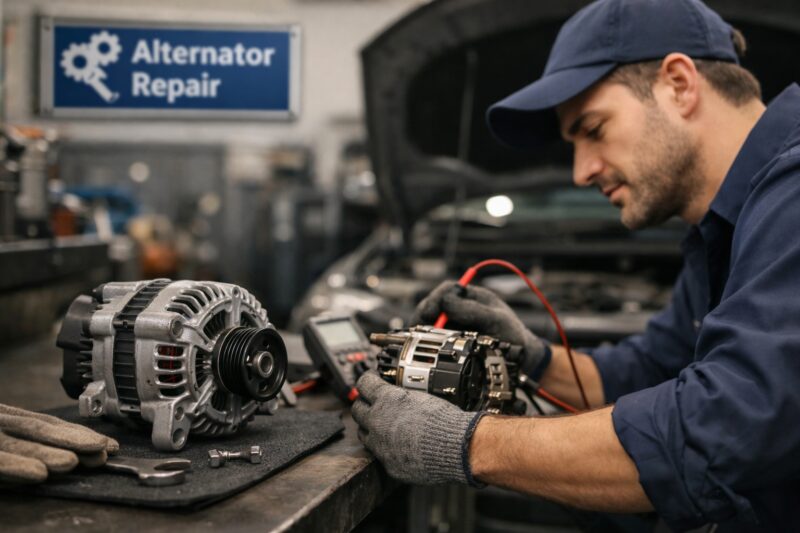
If your alternator is failing, the fastest way to find trustworthy alternator repair services near you is to ask what tests they run and insist on a written estimate before work begins. When you call, expect a clear plan for diagnosis, documented voltage readings, and parts choices that match your vehicle’s build. In 2026, commercial customers want fewer “guess repairs” and more proof the root cause is fixed, not just masked. This guide shows how to evaluate local shops, what expert testing looks like, and when replacement is smarter than repair. You will also learn what documentation to request so you can decide confidently with a reliable paper trail. If you are comparing quotes, you can use the service center checklist questions in this article to separate true alternator repair from quick swaps.
How to choose the right local alternator repair shop for reliable results
Choosing the right shop starts with verifying competence, not just availability. For commercial buyers, the goal is a correct diagnosis, a repair that holds, and communication you can trust when schedules and uptime matter. A good shop will treat alternator issues as a measured electrical problem, not a guess. Ask early whether they test on a bench or test the charging system in the vehicle, and how they document results.
A strong decision path looks like this: verify work history and credentials, confirm the testing approach, confirm parts sourcing and compatibility, then confirm warranty and reporting. During the call, ask what symptoms they handle and how they isolate faults. If they only ask, “What warning light is on?” you should dig deeper. For example, weak charging can come from battery state, ground connections, belt load, or wiring faults.
“Near you” matters for commercial needs, but it should not reduce diagnostic rigor. A local shop can schedule priority jobs sooner, communicate daily, and offer easier follow-up if something fails. You also gain the ability to revisit the vehicle quickly for rechecks. Still, do not let convenience replace evidence. Request a written estimate that reflects the tests they plan and the failure mode they expect to find.
Before you approve any repair, ask for an explanation of the failure mode they believe is present. Ask for the estimate in writing, including labor steps they will perform and what parts they will use. Be cautious with low bids that skip electrical testing or propose swapping parts without confirming root cause. That approach often brings the same failure back, especially when the real issue is a wiring drop, corrosion at a connector, or a mechanical drive problem.
What expert diagnosis includes before any alternator repair begins
Expert alternator repair diagnosis begins with isolation, so the shop proves where the failure lives. The first step is a symptom review, like when the warning light appears and whether the problem changes under load. Then the expert checks the battery and the charging system before judging the alternator. This matters because many “bad alternators” are really weak batteries, poor grounds, or cable issues that starve charging.
How it works in practice is methodical. The tech checks battery state of charge, inspects charging cables and ground points, and evaluates belt condition and tension. Next, they test alternator output and voltage regulation under the right conditions. They also verify ripple behavior, because unstable output can be missed if someone only checks a single static voltage.
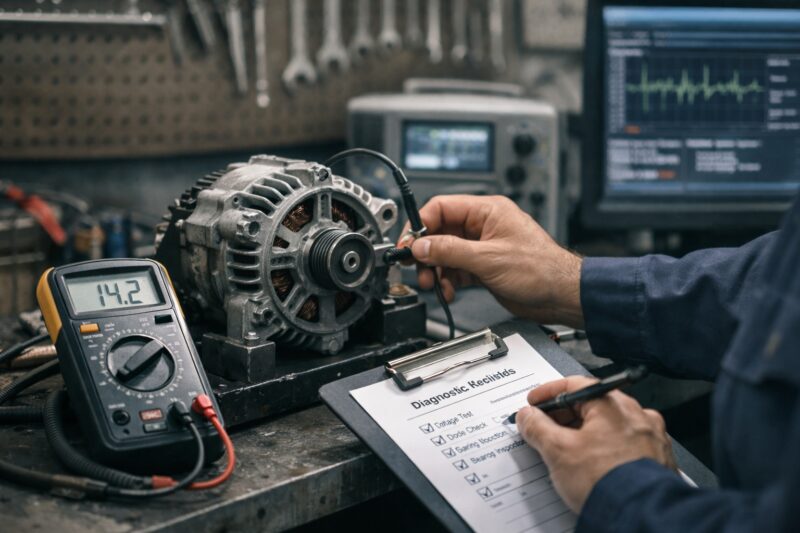
To confirm fault location, the shop compares what the system does versus what it should do. If output is weak or regulation is unstable, they determine whether the alternator, the regulator circuit, or the mechanical drive is at fault. If charging seems normal at idle but collapses under load, they often suspect a heat or connector contact issue. This is where documentation matters most.
Good documentation includes recorded readings and a test summary that ties to the repair decision. Look for notes that show the measurements, not just a diagnosis sentence. Photos of connector wear, housing damage, belt glazing, or corrosion can help justify the recommendation. That paper trail matters when you need warranty coverage or fleet reporting for business records.
Intermittent faults are a common edge case. A loose connector can pass a quick test and fail only after driving. A heat-related regulator problem can appear after idling with headlights and HVAC running. Experts reduce these misses by testing under relevant load conditions and verifying connector contact resistance, not by checking only one quick number.
Alternator repair methods and component-level outcomes you should expect
Alternator repair can mean different work scopes, and the shop should explain which category applies to your unit. Expert shops match the repair method to the measured failure, not to a one-size rebuild script. When you ask what they plan, you should hear about component-level outcomes, not just “we’ll fix it.” This matters because the alternator must regulate voltage correctly over time, not just produce a momentary charge.
Most repairs fall into a few realistic categories. Component-level rebuilds can address rectifier diodes, the regulator, brushes, or other internal parts depending on design. Some cases need pulley and bearing service if the mechanical drive has wear or wobble. In certain alternators, internal rewinding or replacement of windings may apply when heat or contamination damages the electrical core.
Repair tends to succeed when the root cause is confirmed and the replacement components match the alternator’s specifications. The shop should verify regulation behavior after reassembly, not only check that it spins. If a regulator or rectifier quality is poor, you can see charging instability sooner than expected. That is why “correct parts” includes the correct spec and the right fitment.
After reassembly, expert shops bench verify output and regulation before returning the unit. They also confirm the behavior that matters for real driving, like stable charging across loads. The nuance here is that some failures look fine at rest. An alternator can “charge” while still producing excessive ripple or unstable voltage under load, which can trigger warning lights and cause battery drain over time.
In “it charges but still fails” cases, the shop should run tests that reflect your real symptoms. If your lights flicker or accessories act up while voltage seems acceptable, ask whether they checked regulation and ripple. A common mistake is stopping after a basic output test and skipping behavior verification, especially when the warning light is intermittent. A good outcome is not just a repaired alternator, but a bench-verified alternator that behaves correctly.
Costs, warranties, and estimates: how to evaluate value without getting overcharged
Alternator repair pricing varies because the scope ranges from small component replacement to full internal rebuilding and mechanical service. A fair quote includes diagnostic work, a clear parts line item, and labor that reflects what the shop will do. The best way to evaluate value is to compare what each estimate includes, not just the total cost. For commercial customers, also consider downtime and whether the shop supports priority scheduling.
When you request a quote, ask how they break it down. You want diagnostic fees separated from labor, and you want parts listed with their grade and compatibility. Ask whether they will perform additional electrical tests after repair to verify regulation behavior. Legit cost increases usually relate to wiring repairs, housing machining, bearing or pulley replacement, or multiple internal component failures.
Warranty terms should be specific and enforceable. Ask what the warranty covers, whether it includes parts and labor, and how long it lasts for your alternator type. Also ask how the shop handles warranty claims, since documentation makes repeat issues easier to trace. If a shop is vague about what is covered, you may be paying again for the same underlying problem.
Commercial owners should plan for scheduling realities. If your vehicle is down for parts sourcing or bench retesting, ask if the shop can coordinate around fleet operations. If towing is required, confirm whether the shop offers mobile support or has a practical handoff plan. In any case, request a written estimate so you can approve work with clear scope.
A deeper estimate nuance is the “low bid trap.” Some quotes look cheaper because they omit key tests or rely on unclear part quality. Another trap is warranty language that excludes electrical testing documentation. Always ask how they will show their work. If they cannot explain the failure mode and how the fix addresses it, the savings may become repeat labor.
Common pitfalls and misconceptions that lead to repeat alternator problems
Repeat alternator failures usually come from the wrong root cause being treated or from incomplete verification. One common misconception is that alternators are always the cause. In reality, battery issues, charging cables, and ground faults can mimic alternator failure. If the shop skips battery and connection checks, the repair may fix symptoms but not the true electrical path.
Another pitfall is assuming any replacement part will work. Fitment matters, including connector style and voltage regulation behavior. Some regulators and internal components must match the alternator design for correct charging under your vehicle’s load conditions. If a shop swaps “an equivalent” without verifying performance, you may see unstable charging or early wear.
Reusing contaminated connectors and grounds is also a major repeat-failure trigger. Corrosion or loose terminals can cause voltage drops that look like weak alternator output. The vehicle then drains the battery and can trigger warning lights again. In these cases, you need inspection evidence and a repair plan that includes cleaning or replacing compromised contacts, not just internal alternator parts.
Experts also watch for symptom patterns that indicate broader electrical trouble. For example, warning lights plus stalling or fluctuating dash voltage can point to harness issues or power distribution problems. If multiple accessories fail at once, the shop should confirm whether the alternator is being asked to perform under unusual conditions. A common mistake is blaming one component when the system has multiple interacting faults.
An edge case involves mechanical drive issues. Belt slip or misalignment can heat the alternator and damage internal components prematurely. If the shop repairs the alternator but does not address belt alignment or tension, you can get a “repaired once, failed again” outcome. That is why a solid diagnosis checks the whole charging system, not only alternator internals.
Repair vs. replacement: choosing the best option when alternators fail
Repair or replacement depends on diagnosis certainty, measured alternator condition, and the warranty value you want. An expert shop will recommend repair when they can confirm the internal failure and correct it with verification. Replacement can be the better choice when the alternator has severe internal damage or when consistent long-term regulation is hard to guarantee through repair. For commercial uptime, you also weigh parts availability and the lifecycle cost.
A practical decision framework starts with test results. If the failure is isolated and the affected components can be corrected, repair may provide strong value, especially when the shop bench-verifies regulation afterward. If tests show multiple internal failures or the unit is near end-of-life, replacement can reduce repeat risk. Some alternators also respond better to replacement when housing or mechanical integrity is compromised.
There are also hybrid outcomes. For example, a shop might replace certain subassemblies while servicing bearings and the pulley if those parts fail inspection. Experts decide this based on measured readings and physical checks. They should be able to explain what they found and why their approach reduces failure probability.
Replacement should include correct reman or rebuilt spec and bench verification expectations. Installation checks are part of a true “replace and go” job. The shop should confirm belt alignment, torque specs for mounting, and clean ground connections. If the mechanical drive or electrical connections are wrong, even a new alternator can perform poorly.
A deeper nuance is how to evaluate “remanufactured” versus “rebuilt” claims. Customers should ask for proof in the form of test records, warranty terms, and component sourcing clarity. Do not assume quality based on a label alone. Ask whether the unit meets regulation behavior in testing, not only whether it produces charging voltage.
Advanced edge cases experts handle in the real world
Some alternator failures only show up under specific driving conditions. Heat-related problems and intermittent charging issues often evade quick tests. If your vehicle fails after a period of driving, idling, or higher electrical load, a competent shop will adjust testing conditions. That matters because a “clean pass” at idle can hide regulation instability during real load.
For intermittent faults, experts look for patterns. They may check charging stability under load, verify connector contact integrity, and evaluate voltage drop through the charging path. A loose terminal can act fine until vibration and temperature change contact pressure. Another mistake is stopping at a basic alternator output reading without testing behavior that matches how your vehicle actually fails.
Vehicles with modern electrical demands add another layer. Many systems manage loads and battery health using smart charging and control logic. While you do not need to learn every control strategy, the key is that alternator performance must match the vehicle’s expectations. Experts test the charging system as a system, not as a single component.
Water intrusion and corrosion can also cause tricky outcomes. Experts inspect housings, connectors, and internal contamination before they conclude “just replace the alternator.” Corroded connectors and internal contamination can drive repeat failure even with a new unit. You want evidence of inspection and a clear plan to stop the electrical path from degrading again.

Aftermarket modifications can confuse diagnosis. Wiring changes, nonstandard battery setups, and added accessory draws can trigger symptoms that look like alternator failure. Experts should interpret these changes carefully and confirm the real electrical fault location. A final nuance is that faults downstream, like ground bus issues or sense wire problems, can lead to unnecessary alternator replacements if the shop skips electrical isolation.
Finding alternator repair services near you in 2026 without sacrificing quality
In 2026, you can find local alternator repair services quickly, but you still need evidence of bench testing and documented diagnostics. A shop that only offers quick swap services may save time, yet it can increase repeat failures when the root cause is elsewhere. To choose well, verify that they isolate alternator versus battery versus wiring with test results. Ask what they record and how they provide documentation for your approval and records.
For commercial buyers, ask business-focused questions. Can they schedule fleet vehicles with priority? Will they provide estimates in advance and written warranty terms? Can they supply invoices and documentation you can keep for internal records? These details make it easier to track cost and avoid disputes later when you need warranty-covered solutions.
Pay attention to communication signals. A quality shop explains the diagnosis clearly and ties it to measured results. They also communicate parts sourcing and compatibility before approval. If the unit needs additional testing, they discuss why and what changes in the estimate. This transparency reduces the risk of approval delays or surprise charges.
If you need towing or mobile support, gather key info before the vehicle leaves. Note the symptoms, warning lights, and when they occur. Also record any recent battery work and take photos of belt condition and wiring connections if it is safe. This helps the shop plan diagnostic steps and avoid guessing.
When options are limited, you can still set a minimum standard. Even a smaller shop should provide test results, a written estimate, and clear component-grade details. If they cannot meet those minimums, consider expanding your radius. If you are located near service centers in the Portland area, for example, you can ask whether they offer charging system diagnostics Oregon City style, meaning in-vehicle checks plus documented electrical measurements.
Frequently asked questions about expert alternator repair services near you
Ask what tests they run, whether they test in the vehicle or on a bench, and how they document readings. Also ask what they believe failed first, and which parts grade they will use. Finally, request written warranty terms before you approve major work, including what is covered and what is excluded.
How do alternator repair services diagnose whether it’s the alternator or the battery?
They start by checking battery state of charge and inspecting cables and ground points for voltage drops. Then they test alternator output and voltage regulation, often with the engine running and accessories drawing load. If the readings point to unstable regulation or ripple, the shop can isolate alternator internal issues versus battery weakness or connection faults.
Can a rebuilt alternator fail again soon, and why does it happen?
Repeat failures usually mean the root cause was not fixed, such as a bad ground, contaminated connectors, belt slip, or wiring damage. It can also happen if low-grade replacement parts do not hold stable regulation behavior. A shop should show its test results so you can confirm the repair matches the fault.
What’s the difference between a basic fix and a true bench-verified alternator repair?
Basic fixes may check that voltage appears, but bench verification checks output and regulation behavior before the alternator goes back. A true bench-verified repair confirms the alternator performs correctly under relevant conditions, not only at one moment. The shop should provide a documented test summary you can keep.
Do I need to replace my alternator after the warning light comes on?
Not always. Warning lights can trigger from battery and connection issues, unstable charging, or even wiring faults that affect the system’s sense inputs. The right next step is testing to identify the actual failure location, then matching the repair choice to the test results.
How long does alternator repair usually take for local jobs?
Typical turnaround varies based on diagnostics, parts sourcing, and any needed bench retesting. Many local jobs fit within a same-day diagnostic window, followed by repair or replacement once parts arrive. Complex or intermittent cases can take longer because the shop may need additional load testing to confirm the fault.
Is it safe to drive if my alternator seems weak?
It depends on symptoms, but weak charging can drain the battery and cause stalling. If you notice repeated stalling, dimming, or multiple warning lights, stop driving and get it inspected soon. Driving with severe charging problems can increase risk of battery depletion and electrical instability.
What should be included in a written alternator repair estimate?
A solid estimate includes diagnostic fees, labor line items, parts list details, and expected testing steps after repair. It should also include the warranty terms and any exclusions for electrical verification documentation. If the shop changes scope after testing, ask for an updated estimate in writing.
Why do some shops reuse parts like bearings or pulleys?
Reuse can be acceptable when inspection shows those parts are within service condition. Experts should measure and inspect for wear, roughness, and play before deciding. If they do reuse parts, they should explain what inspection evidence supports the decision.
How do I avoid getting charged for unnecessary alternator repairs?
Ask for test results first and insist on a clear root-cause explanation tied to measurements. Compare quotes that show what diagnostics and electrical verification are included. Make sure warranty terms and documentation expectations are clear before you approve work.
Conclusion
The right choice for Expert Alternator Repair Services Near You comes down to documented diagnosis, proven repair practices, and enforceable warranty terms. When a shop treats “expert” as testing plus accountability, you reduce repeat failures and make better decisions with clear records. Use the service center checklist questions when you call, and compare written estimates that reflect the tests they will run. For commercial needs in the Portland region, you can also ask about charging system diagnostics Oregon City style to confirm they handle in-vehicle and alternator behavior checks together.
As you narrow options, remember that “fixing the symptom” is not the same as correcting the failure mode. A strong shop should explain what they found, how they verified regulation behavior, and why the repair or replacement choice fits the measured issue. If you need a replacement path, ask what warranty covered alternator repair looks like in their paperwork. Then request a test report or documented summary before paying for major decisions.
Finally, take action the practical way: call two or three local providers and ask the same diagnostic questions. Keep a simple comparison sheet for scope, parts grade, and what documentation you receive. If you want a more targeted starting point, you can also search for alternator repair in Woodburn and ask the shops whether they will provide documented voltage and regulation checks. When you are ready, request charging-system test documentation before approving replacement so your next decision is supported by evidence.
Updated September 2026