
A go kart repair shop checklist is a structured intake-to-test process that ensures technicians don’t guess, skip safety checks, or close the job without verification. For customers in 2026 who need dependable turnaround, a well-run Go Kart Repair Shop checklist reduces downtime, repeat failures, and surprise costs by turning “we’ll see” into evidence-based decisions.
If you’re searching for a Go Kart Repair Shop, treat the checklist as the standard you should ask them to follow: intake documentation, a clear diagnostic decision path, an itemized plan, controlled testing, and a warranty-backed checkout. In a commercial service context, your priority isn’t generic DIY advice—it’s criteria you can hold the shop accountable to: diagnostic rigor, timeline clarity, communication cadence, and written proof of work.
Below is the same checklist framework many experienced kart owners use to prevent comeback repairs. It covers intake verification, a root-cause diagnostic order, service planning and quoting, parts/workmanship controls, warranty and receipts, and the “common mistakes” that cost people time and money. You’ll also see how to choose between full-service shops, specialists, mobile diagnostics, and hybrids (with a comparison matrix) and what advanced edge cases to insist on for repeat-failure prevention.
A Go Kart Repair Shop checklist should cover what the shop verifies, how they document symptoms, and how they decide what to do next before any parts are replaced. If the checklist is missing intake data, test order, or a call-before-work threshold, you’re effectively authorizing guesswork.
Why this matters: karts have tightly coupled systems—fuel/air mixture affects ignition, overheating changes clutch behavior, and drivetrain wear can masquerade as “engine problems.” Without a checklist that spells out diagnostics and acceptance criteria, you can end up paying for multiple repairs that don’t address the root cause. In commercial repairs, the customer’s “budget protection” depends on the shop’s ability to isolate the problem methodically and communicate scope changes early.
How it works in practice: a strong shop starts with an intake checklist that captures kart class/spec, symptom timing (cold vs warm, idle vs acceleration), and a symptom inventory. Then they run a logical diagnostic decision path—basic checks first, then fuel/spark/air verification, followed by compression or drivetrain measurements only when the earlier evidence points that direction. This sequencing prevents random part swaps and helps the shop produce receipts that show why the chosen repair is the right one.
What to apply when shopping: ask the shop what documents they collect on intake (photos/video, engine/serial info), what tests they’ll perform before proposing parts, and what triggers a “call-before-work” authorization. A good shop will also define safety scope upfront—brakes, steering bearings, frame fasteners, and chain guard integrity—so “reliable fix” includes the safety-critical items, not only the performance complaint.
Tradeoffs and limitations: some intermittent faults require repeatable reproduction (heat soak, vibration, load testing), which can extend diagnostic time. If your shop can’t reproduce the issue, they should explain the limitation and propose a controlled test plan rather than replacing parts “until it works.” A helpful example is a kart that starts cold but stalls after a short warm-up: a checklist should specify warm restart and under-load testing, not just a single cold-start check.
Internal context you can use to plan related work: if you also need schedule planning for follow-up service, you can review a Quick checklist before repair approach via https://nrtoffroadperformance.com/go-kart-mechanic/ (it complements shop intake expectations and helps you prep accurate symptom details).
Go Kart Repair Shop intake checklist: what should they confirm before touching the kart?
A Go Kart Repair Shop should confirm kart identity, configuration, symptom specifics, and safety scope before they begin teardown or parts replacement. This intake checklist is how the shop reduces misdiagnosis cycles and keeps your downtime predictable.
At intake, the shop should capture your context: kart model/class, engine type (2-stroke vs 4-stroke), drive system (chain/gear), and recent modifications (carb jets, ignition components, clutch changes, exhaust swaps, or tuning changes). They should also record riding conditions—fuel type, oil mix ratio (for 2-strokes), typical track surface, and whether the kart sees long wide-open throttle runs or frequent starts/stops. These details influence what “normal” readings look like and which failures are plausible.
They also need a symptom inventory, stated in concrete behavior: for example, “won’t start,” “bogs at mid-throttle,” “stalls when transitioning from idle to acceleration,” “no drive,” “overheats after 5 minutes,” or “chain skips under load.” The intake should clarify when it occurs (cold vs warm, at idle vs acceleration, under load vs coasting), so the shop can design tests that reproduce the fault rather than chasing unrelated possibilities.
Documentation expectations matter commercially. Require photos/video on intake—engine bay condition, air filter setup, fuel lines, and any visible leaks or loose fasteners. The shop should record serial/engine info and keep notes on prior repairs; if you provide prior receipts, the technician can compare measured values and avoid redoing work that was already verified. This is a major reason a checklist reduces surprise costs: the shop isn’t starting over from scratch.
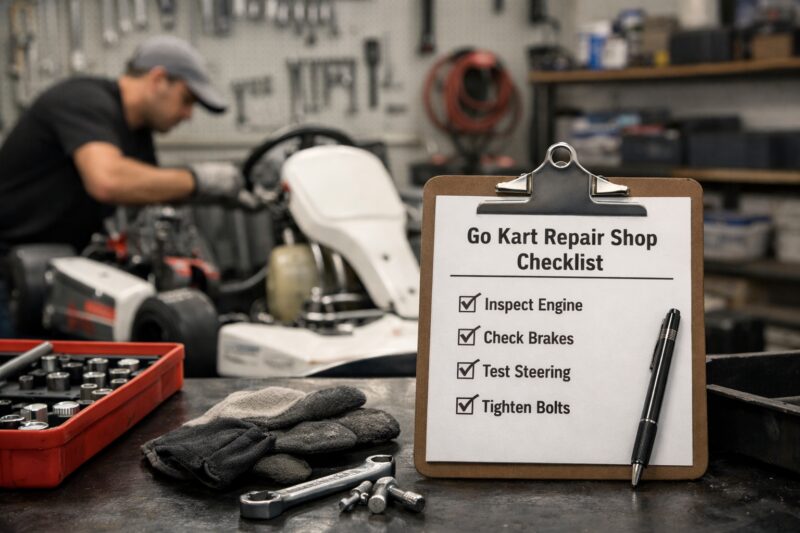
Deeper-than-obvious intake protocol: insist they treat intermittent failures as a first-class case. For symptoms that appear after heat soak or vibration, they should plan repeatable testing conditions (warm restart, short ride cycles, vibration checks for loosened fasteners, and fuel contamination screening). Also ask whether they inspect brakes/steering bearings and frame fasteners as part of the quote—if not, you should decide whether to include it, because safety and reliability are linked.
Common mistake: customers describe the kart as “slow” or “not running right” without specifying cold/warm behavior. That vagueness forces the shop into trial-and-error. A simple improvement is to supply a short timeline: when the symptom started, what changed right before it, and whether it’s consistent across sessions.
If you need ongoing reliability planning after repairs, you can align intake expectations with a Checklist for reliable rides framework at https://nrtoffroadperformance.com/go-kart-maintenance-service/.
Diagnostic decision path: how does a Go Kart Repair Shop go from symptoms to root cause?
A reliable Go Kart Repair Shop follows a diagnostic decision path with a test order, acceptance criteria, and documentation—so they can prove what they checked and why they chose the next step. Without that process, repairs become random part swapping.
Why it matters: karts often fail due to interacting variables. A lean mixture (air leak, fuel quality, restricted filter) can mimic ignition issues; clutch engagement problems can look like “engine loss of power.” A decision path prevents these cross-system misreads by using a logical test sequence and evidence-based thresholds, not intuition alone.
How the test order should work: start with basic checks (air filter condition, fuel level/venting, kill switch operation, throttle return, visible leaks, and battery/ground integrity if electric components exist). Then move to fuel/spark/air verification—spark test quality, fuel flow and delivery consistency, intake/exhaust leaks where relevant, and carb/air restriction checks. Only after those results point in a specific direction should the shop perform compression/leakdown (or equivalent measurements for the engine type) and then drivetrain checks such as chain alignment, clutch engagement, sprocket wear, and endplay.
Practical application: ask what “acceptance criteria” they use. For example, they should state what spark test outcome passes, what compression range is expected for your engine type, and how they evaluate chain alignment and endplay rather than guessing. They should also explain their isolation method—one change at a time testing—and how they document outcomes to reduce comeback risk.
Parts verification must be included. Before replacing components like carb jets, ignition modules, clutches, or sprockets, a quality checklist should confirm compatibility and condition of existing parts (including whether replacements match your kart’s specific spec). This avoids the common “wrong part, wrong cause” loop that wastes both money and time.
Deeper-than-obvious: require false-positive handling. A checklist should explicitly distinguish user-caused variables (wrong fuel/oil ratio, incorrect oil for 2-stroke, blocked air filter, improper choke usage, contaminated fuel) from true mechanical failure. For example, a kart that stumbles after refueling may be reacting to fuel contamination or improper mix ratio—diagnosis should test fuel quality and delivery consistency before assuming carb failure.
Limitation: intermittents can’t always be proven in one session. A strong shop addresses this with a plan for warm restart and load reproduction so the diagnostic evidence matches the symptom conditions.
To connect this to broader performance maintenance, consider adding Reliable performance engine checks via https://nrtoffroadperformance.com/go-kart-engine-service/ to your own shop expectations, especially if the shop is diagnosing engine-adjacent complaints.
Service plan & quoting: what should you require from a Go Kart Repair Shop to avoid guesswork?
A Go Kart Repair Shop should provide a written estimate and a service plan tied directly to the diagnostic findings, including itemized labor/parts and clear authorization rules. The goal is to eliminate surprise costs by defining “replace now vs inspect first” before work expands.
Why it matters: commercial repair pricing can balloon when repairs are not bounded by evidence. A checklist-driven shop prevents scope creep by using decision trees—wear items may be replaced when measurements confirm them, while other areas are inspected first when data suggests the problem is elsewhere. For customers, this means you’ll understand what you’re paying for and why the shop is confident.
How a good service plan is structured: deliverables should include written estimate(s), diagnosis notes summary, and an itemized plan for labor, parts, and any consumables. The shop should outline what can be completed same-day versus what requires parts procurement or bench testing. They should also specify communication cadence: when they will update you, what “call-before-work” thresholds trigger an authorization request, and what happens if additional damage is found during teardown.
Practical application: ask the shop to map your situation to a decision tree. For example, if overheating was reported, they should explain whether the plan is “verify cooling/mixture first, inspect clutch afterward, and only then recommend carb work,” or whether there’s evidence that directly points to a carb rebuild. This is where the checklist pays off: the shop anticipates downstream effects and prevents doing unrelated work.
Deeper-than-obvious: scope creep scenarios are predictable. If an overheating event is confirmed, a thorough shop will often inspect clutch engagement, chain wear, and fastener condition because heat can accelerate deterioration. However, the checklist should still protect your budget by requiring evidence-based confirmations and call-before-work approvals for optional repairs beyond the original diagnostic scope.
Real-world scenario: a kart bogs on acceleration. A sloppy shop might immediately replace a carb. A checklist-driven shop might first confirm air restriction and fuel delivery, verify spark stability, then only propose carb jet and float adjustments if measurements support it. If they discover additional drivetrain wear, they should discuss it with you and provide justification tied to measured results.
For customers who need time-sensitive service, the shop’s approach to Fast fixes before race can be a deciding factor—ask whether they can prioritize bench testing, staged parts orders, and verification runs to meet your event schedule. You can review a related workflow at https://nrtoffroadperformance.com/go-kart-repair/.
Parts & workmanship checklist: what should be verified so repairs don’t fail again?
A dependable Go Kart Repair Shop checklist should verify parts sourcing, installation quality, and test-before-delivery outcomes. This is what turns a “repaired” kart into a reliable one that survives the next session.
Start with parts sourcing standards. The shop should use OEM/spec where possible and confirm compatibility for carb/ignition/clutch components, including jetting specifics and mounting configurations. If substitutions are necessary (availability, budget, or spec differences), the shop should document what they used and why it fits your kart’s class and engine configuration. This reduces the likelihood of performance changes and future troubleshooting confusion.
Next is installation quality. The checklist should include torque verification where applicable, correct chain tension and alignment, brake adjustment verification, and safety wiring or fastener checks according to local best practices. Even small installation errors can create big symptoms: incorrect chain tension can cause binding or noise; brake misadjustment can cause dragging that leads to heat and apparent engine “power loss.” Installation checks should also confirm chain guard integrity and ensure wiring/hoses aren’t routed in a way that risks abrasion.
Consumables and wear items should be addressed systematically. A quality shop will recommend what’s necessary (filters, gaskets, spark plugs, throttle cables, brake pads/shoes) and clearly label what is optional. The decision should be tied to measurements and wear indicators, not a blanket upsell. If a shop can’t explain why a consumable is needed, you should ask for the evidence.
Test-before-delivery labor is a must. Ask what tests they run: cold start verification, warm stability checks, drive engagement tests, and controlled speed/acceleration testing. For example, a kart that stalls only when warm should be verified with warm restart and a short controlled run under load (not just idle). If intermittent issues exist, ask whether they’ll repeat the test cycle to ensure the fault is resolved.
Deeper-than-obvious: include a run-in and retorque policy where appropriate. Chain stretch, clutch settling, and fastener re-seat can cause early-life failures if retorque isn’t handled. A checklist-driven shop should account for this and recommend follow-up checks based on your usage.
Common mistake: customers authorize parts replacement without insisting on installation verification and post-repair test runs. That omission creates the perfect conditions for repeat problems and undermines warranty value.
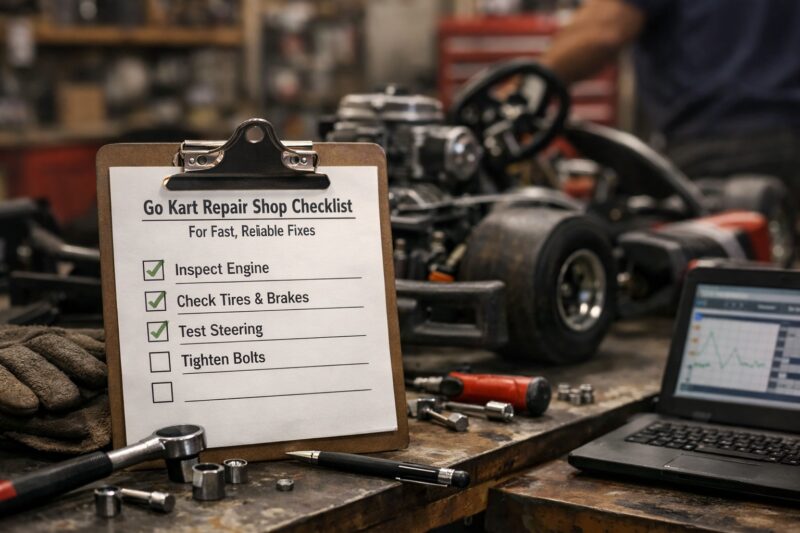
To maintain continuity after the repair, you can align this checklist with Checklist for reliable rides expectations at https://nrtoffroadperformance.com/go-kart-maintenance-service/ so your next maintenance window prevents the “same failure again” cycle.
Warranty, receipts, and verification: what does “reliable fix” mean after pickup?
A “reliable fix” after pickup should come with proof of work, documented test results, and a warranty you understand. A Go Kart Repair Shop checklist ensures the shop can show what was done, what was measured, and what you should no longer observe.
Why it matters: without clear receipts and verification notes, a recurrence becomes a blame game. The shop may claim “it’s different now,” while you may suspect the same root cause. In commercial settings, the checklist reduces disputes by linking diagnostic evidence to the repair plan and then to post-repair outcomes.
Receipts and documentation: require invoices that include replaced parts and measurable information where appropriate (examples include compression results, adjustment values, and inspection findings). The shop should provide diagnostic notes that justify what was done. Even when certain tests can’t be completed due to intermittent behavior, the notes should explain what conditions were tested and what limitations remained.
Warranty expectations need to be explicit. Ask what is covered—parts plus labor—and the warranty duration. Also request exclusions: misuse, incorrect fuel/oil ratios, racing-only modifications that exceed intended spec, or negligence after pickup (such as skipping follow-up retorque). A good shop will describe warranty handling for recurrence quickly so you can restore performance without paying for a full re-diagnosis every time.
Verification at checkout should be described. The checklist should include what was tested (cold start, warm stability, engagement, controlled run), what values were observed (for example, spark test pass outcome or measured adjustments), and what symptoms should no longer occur. If your kart previously failed after 5 minutes, the shop should define what they did to mimic that scenario.
Maintenance handoff: the shop should recommend maintenance intervals relevant to preventing repeat failures—filter checks, spark plug inspection cadence, clutch/brake inspections, and seasonal storage guidance. The handoff should connect to the repair that was performed, not a generic maintenance flyer.
Deeper-than-obvious recurrence handling: define a priority re-diagnosis window. If the failure matches the original symptoms, the shop should troubleshoot without charging full diagnostic labor again when the recurrence is within warranty terms and caused by the same unresolved issue.
If your repair needs to be scheduled around events, ask whether their verification process supports Fast fixes before race at https://nrtoffroadperformance.com/go-kart-repair/—a strong verification checklist is what helps you trust a kart right before a critical date.
Common mistakes customers make when choosing a Go Kart Repair Shop (and how to avoid them)
Customers often choose the wrong Go Kart Repair Shop by focusing on price or vague estimates instead of diagnostic rigor, documentation, and verification. Avoid these mistakes to prevent repeat failures and extended downtime.
First mistake: choosing based on the cheapest quote without diagnostic depth. A low quote might reflect minimal inspection and part swapping, not evidence-based troubleshooting. Instead of asking “How much,” ask “What diagnostic steps will you run before replacing parts,” “How will you document findings,” and “What are your acceptance criteria.” This shifts the conversation from cost to quality.
Second mistake: accepting vague estimates like “we’ll see what’s wrong.” In a commercial setting, a checklist-based shop should provide a decision path and define call-before-work thresholds. If the shop can’t describe when they’ll contact you for additional authorization, you risk paying for expanded teardown without understanding why.
Third mistake: skipping intake documentation and not describing symptom timing. If you don’t provide cold vs warm detail, or you don’t send photos/video, the shop can misdiagnose. For example, an intermittent stalling issue may appear “random” to a technician if they only test cold starts. A checklist should explicitly capture the conditions so the test plan matches reality.
Fourth mistake: authorizing parts replacements without confirming the cause. This is the fastest path to “we fixed it” followed by “it’s back again.” A quality checklist forces the shop to validate root cause using measurements and controlled testing rather than assuming replacement equals resolution.
Deeper-than-obvious: overlook system-level causes. For example, a kart that overheats may have cooling issues or an incorrect mixture problem that also affects ignition and clutch/drivetrain behavior. Many guides focus on the obvious symptom (“fix the overheating”) without connecting it logically to secondary effects. A checklist-driven shop should connect symptoms across systems so your repair isn’t incomplete.
Practical prevention: prepare a symptom timeline and supply modifications history. Then insist on written findings and a checkout verification report. You can also align your prep with Quick checklist before repair at https://nrtoffroadperformance.com/go-kart-mechanic/ so the shop receives the right inputs for accurate diagnostics.
Alternatives & options: categories of service for your situation
The best service category depends on how complex your failure is, how time-sensitive your schedule is, and whether you need maximum diagnostic depth. You can choose between full-service repair shops, specialists, mobile diagnostics, and hybrids—while still demanding a checklist standard for documentation and verification.
Option 1 is a full-service repair shop that handles diagnosis + parts sourcing + bench/controlled testing. This is typically the best choice when the symptoms are safety-critical (brakes/steering), the kart has multiple recent changes, or the failure is complex and likely cross-system. The tradeoff is turnaround time, especially if parts need procurement.
Option 2 is an engine-focused specialist or drivetrain-focused tech. This can be faster when symptoms clearly point to one subsystem—such as a known carb tuning problem or a drivetrain engagement issue—because the specialist may have tighter bench workflows. The limitation is that they must still cross-check related systems (air leaks affecting mixture, overheating affecting clutch, or drivetrain issues changing perceived engine performance) or you risk an incomplete fix.
Option 3 is mobile/at-track diagnostics for time-sensitive racing events. The benefit is speed: you can get an evidence-based direction while the kart is still at the venue. The downside is limited parts inventory and reduced verification depth, especially for intermittent problems that require controlled bench testing.
Option 4 is DIY + shop support, where you handle teardown or basic tasks and the shop focuses on diagnostics, parts install, or verification. This can reduce cost, but only if scopes are explicit. The checklist standard should still require written findings, test verification, and warranty terms comparable to a Go Kart Repair Shop baseline—otherwise you may lose accountability.
Deeper-than-obvious: use a hybrid checklist for any option. Whether you go mobile, specialist, or partially DIY, require the same core deliverables: intake notes, diagnostic decision path, call-before-work rules, test results, and a clear warranty. The goal is consistency and proof, not simply who touches the kart first.
Optional comparison (use it to quickly align expectations):
| Service type | Diagnostic depth | Turnaround speed | Warranty clarity | Best-fit scenarios |
|---|---|---|---|---|
| Full-service repair shop | High (bench + structured decision path) | Medium (parts may be ordered) | Usually strongest (written findings) | Complex failures, safety-critical issues, intermittent faults needing reproduction |
| Engine or drivetrain specialist | Medium to high (focused measurements) | Fast (if the subsystem is clear) | Good (if cross-checks are required) | Clear engine symptoms, clear drivetrain symptoms, known recent part swaps |
| Mobile/at-track diagnostics | Medium (limited verification depth) | Fast (same day direction) | Often limited to observed findings | Race-week troubleshooting, venue-time constraints, quick “what to try next” |
| DIY + shop support | Varies (depends on your scope) | Fast to medium (if parts are ready) | Varies; ensure written scope | Cost control, you can safely teardown, need verification + parts install |
If you want a baseline workflow to discuss with any shop category, reference Reliable performance engine checks via https://nrtoffroadperformance.com/go-kart-engine-service/ and adapt it to your kart class and symptom scenario.
Advanced considerations most guides miss: edge cases, safety, and repeat-failure prevention
The advanced level of a Go Kart Repair Shop checklist addresses edge cases—especially intermittent, heat-related, and cross-system failures—while explicitly protecting safety-critical components. This is where many “good enough” repairs fail, and where experienced shops differentiate themselves.

Intermittent and heat-related failures require reproduction, not one lucky run. A proper checklist should define how the shop reproduces the conditions: warm restart after a set heat soak, short ride cycles to simulate track load, vibration checks for loosened fasteners, and fuel contamination screening. If a kart bogs only after 10 minutes, the shop should document that it tested after 10 minutes, not only at minute one. This is a major reason customers should demand an intermittent failure protocol rather than accepting “it seems fine now.”
Safety-critical inspection boundaries should be explicit in the checklist. Even if your complaint is “engine power,” the shop should inspect brakes, steering play, wheel/bearing condition, chain guard integrity, and frame fastener verification as part of a reliable fix. Safety issues can also affect performance: dragging brakes increase heat, worn bearings can change alignment under load, and loose mounts can alter engine timing and drivetrain behavior.
Cross-system interactions are another gap in many guides. For example, exhaust leaks can change scavenging and mixture behavior, affecting how a clutch engages and how the kart accelerates. A checklist-driven shop should connect these dots logically without unnecessary work. That means holistic checks that are evidence-based: they don’t rebuild everything, but they verify related systems when measurements show it’s necessary.
Electric systems and sensors (where applicable) must be treated as potential “random” causes. The checklist should include grounding and wiring inspection, connector integrity, and routing that prevents chafing. “Random misfires” are often wiring/ground issues that only appear when the kart warms up or vibrates.
Deeper-than-obvious repeat-failure prevention metrics: insist on a “no new problems introduced” plan. Ask whether they recheck fasteners, alignment measurements, and post-test observations after the repair steps. A strong shop also documents early-life considerations like retorque and chain stretch so the next session doesn’t undo the repair.
For customers focused on reliability for frequent use, pair this with Checklist for reliable rides at https://nrtoffroadperformance.com/go-kart-maintenance-service/ to ensure you’re not fighting the same root cause through maintenance gaps.
Go Kart Repair Shop checklist for local decision-making: what changes in your area and how to compare shops?
Local availability affects parts lead times, technician scheduling, and turnaround certainty, so your Go Kart Repair Shop checklist should include how the shop communicates verified ETAs and what happens if parts are delayed. That’s how you decide with confidence even when inventory varies.
Even without naming a specific city, you can apply a 2026 practical rule: ask the shop to provide a verified ETA window for parts procurement and explain how they handle shortages. Some shops may have local inventory variability, so you should ask whether they source OEM/spec or compatible alternatives and whether substitutions are documented. Also ask how they schedule bench testing or controlled verification when parts arrive—timelines should be tied to real steps, not promises.
Location-independent questions are still powerful. Ask whether they work with your kart class/spec, whether they offer pickup/drop-off or shipping, and whether they can handle weekend or event schedules. If you race, ask whether they prioritize “evidence-first” diagnostics to support Fast fixes before race expectations, and whether they can stagger tasks (tear-down and diagnostic on day one, parts order day two, controlled testing day three).
A “distance vs confidence” rule helps when comparing nearby options. If a local shop offers minimal scope or unclear documentation, traveling to a more checklist-driven shop can be cheaper than paying for multiple comebacks. Conversely, if your failure is simple and you can validate results quickly, local service may be adequate and faster.
Deeper-than-obvious: evaluate shops that serve multiple regions by consistency. Ask whether their technician practices are standardized through checklists and whether warranty terms are transferable. If the shop runs standardized diagnostics and issues similar written findings regardless of location, you’re more likely to get predictable outcomes.
For decision support, you can align your local selection conversation with a Quick checklist before repair plan at https://nrtoffroadperformance.com/go-kart-mechanic/ to ensure your intake information is complete enough for fast triage.
Frequently Asked Questions About Go Kart Repair Shop services in 2026
What should I ask a Go Kart Repair Shop before booking a diagnostic?
Ask what diagnostic steps they’ll run in a defined order and how they’ll document results (photos/video, symptom timeline, and any measured values). Request their test sequence approach (basic checks first, then fuel/spark/air, then compression/drivetrain where appropriate) and the call-before-work threshold for additional repairs. Also ask what paperwork you’ll receive after diagnosis and what warranty or confidence level they attach to the findings.
How long does a typical Go Kart Repair Shop diagnosis take?
Timing depends on complexity, parts availability, and whether the failure is intermittent. A consistent non-intermittent fault might be diagnosed the same or next day, while heat-related or vibration-dependent symptoms may require warm restart and repeated test cycles. The shop should tell you what “diagnosis includes” for their checklist and give a communication cadence for updates.
Will a Go Kart Repair Shop replace parts without confirming the cause?
A checklist-driven Go Kart Repair Shop should use a decision path and justify replacements with measurements, test results, or acceptance criteria. If a shop proposes parts without confirming likely root cause, ask what evidence supports the replacement and whether there is an “inspect first” option. If the shop can’t explain the diagnostic reasoning, treat that as a warning sign.
Do repair shops test the kart before returning it to me?
They should perform cold and warm start verification when relevant, check drive engagement, and run controlled tests that match the symptom conditions (idle vs acceleration vs under load). For intermittent issues, they should repeat testing after heat soak or vibration exposure. Ask what results they observed and what symptoms should no longer occur when you pick up the kart.
What does a warranty from a Go Kart Repair Shop usually cover?
Warranty coverage commonly includes parts and labor related to the work performed, but duration and exclusions vary by shop. Exclusions may include incorrect fuel/oil ratios, misuse, racing beyond intended setup, or damage caused after pickup. A reliable shop will explain how recurrence is handled—often through a priority re-diagnosis window if the symptoms match the original failure.
Can a Go Kart Repair Shop fix intermittent starting issues reliably?
Intermittent starting issues are fixable when the shop uses an intermittent failure protocol, including warm restart testing and repeatable reproduction conditions. They should document what they observed and how they isolated user-caused variables like fuel contamination or incorrect oil mix (for 2-strokes). Reliability improves when the shop retests under the same conditions that previously triggered the symptom.
It’s worth it when symptoms are ambiguous, intermittent, or could involve cross-system causes (for example, mixture and ignition interactions or overheating effects on clutch behavior). If the issue is clearly linked to a specific wear item and there’s evidence, parts may be more straightforward. The key is setting a budget-protecting scope: diagnostic first unless a measurement indicates a direct replacement is warranted.
What safety checks should be included after any Go Kart Repair Shop service?
After service, the shop should verify brakes and steering function, inspect wheel/bearing condition, and confirm frame fastener security where applicable. They should also check chain guard integrity and ensure fasteners are correctly tightened and secured. Finally, they should perform a post-repair verification run (within safe operating limits) to confirm the kart behaves correctly.
How do I prepare my kart and information for a faster Go Kart Repair Shop turnaround?
Provide a symptom timeline (when it started, cold vs warm behavior, and whether it fails under load), and include any modifications history like carb or ignition changes. Share photos or short videos of the engine bay, fuel lines, and air filter setup, plus prior repair receipts if available. Also report the exact fuel/oil information (especially for 2-strokes) and any recent refueling events.
Can I request a quote with a clear decision tree for my Go Kart Repair Shop visit?
Yes—ask for an itemized estimate that includes an “inspect vs replace first” plan, aligned to the diagnostic findings. Request call-before-work authorization rules for scope expansions discovered during teardown. A clear decision tree helps you approve only the steps that match evidence, reducing budget blowouts.
What’s the difference between engine-only and full-service repairs at a Go Kart Repair Shop?
Engine-only repairs typically focus on the engine subsystem (fuel/air/ignition/compression), while full-service repairs may include drivetrain and safety-critical checks like clutch engagement behavior and brake verification. Full-service often catches cross-system interactions—such as overheating affecting clutch behavior—at the cost of potentially more diagnostic time. Before committing, ask what cross-checks the engine-only shop includes and request written verification results.
Conclusion: how to use this checklist to get fast, reliable repairs in 2026
To get fast and reliable results from a Go Kart Repair Shop in 2026, focus on three themes: intake documentation, a diagnostic decision path, and verification plus warranty/receipts at checkout. When these elements are present, the shop can reduce repeat failures and shorten your total downtime because decisions are evidence-based, not guess-driven.
Your next action is straightforward: ask the shop for a checklist-based diagnostic plan with the intake steps, acceptance criteria, and a call-before-work policy. Then insist on a written service scope and a measurable checkout verification process so you know the kart is actually fixed under the conditions that caused the symptom.
Finally, compare shops by evidence, not just price. Look for warranty clarity, documentation standards, and transparent timelines tied to real diagnostic and parts steps. If you want a structured way to prepare and coordinate, you can revisit Quick checklist before repair at https://nrtoffroadperformance.com/go-kart-mechanic/ and then book a consult/diagnostic where you can request the written service plan before authorization.
Updated May 2026