If you need an auto repair shop in North Plains, Oregon, the right choice comes down to evidence-based diagnosis, written estimates, clear approval steps, and a warranty you can actually verify. This guide for local drivers covers how to select reliable service in 2026, what to expect during diagnosis, and how to avoid costly mistakes when you search for Auto Repair North Plains Oregon.
When you’re comparing shops, the goal isn’t to find the cheapest ad—it’s to find a shop that can explain what’s wrong, how they tested it, and what work is truly necessary before you authorize anything. By the end, you’ll know what to ask, which documents to request, and how to compare options fairly across North Plains.
This article stays focused on choosing and authorizing auto repairs (not towing, detailing, or unrelated Services). It’s designed to help you plan for diagnosis and estimates, confirm quality signals, and reduce the risk of “parts swapping” or surprise costs.
Top 10 questions to ask before choosing auto repair in North Plains, Oregon
Before you book anyone, ask the questions that reveal whether the shop can diagnose correctly, communicate clearly, and protect your wallet. For Auto Repair North Plains Oregon, these are the fastest ways to separate “we’ll try a part” from a professional, test-driven repair process.
Start with how the shop handles intake and diagnosis: what information they collect, how they verify the complaint, and what evidence they document. Then ask about the estimate workflow, including how they price labor, how parts are sourced, and how they request approval if new findings appear during the job.
Finally, confirm quality and accountability: what warranty terms apply, how long you’ll wait for updates, and what happens if the fault can’t be reproduced. A competent shop can answer directly, without vague promises, and will provide written line items you can review before work starts.
Edge case to watch: intermittent problems (like a no-start that only happens after heat soak) require more than generic scan reading. You should expect questions about when it fails, what conditions trigger it, and how they plan to test under those conditions. If a shop dismisses this and jumps straight to replacing expensive modules, treat that as a red flag.
If you want a structured way to compare local service options, use an auto service center checklist as a baseline for your call and pre-authorization questions.
What “good” auto repair looks like in North Plains, Oregon (and how to spot it fast)
Good auto repair in North Plains looks like a transparent intake process, written estimates with assumptions, documented test results, and communication that doesn’t leave you guessing. If a shop can’t explain the findings clearly before you authorize work, you’re taking on unnecessary risk.
First, watch for trust signals at intake: they should ask about symptoms, recent maintenance, warning lights, fuel quality (when relevant), and driving conditions. Then they should explain what they tested and what that means in plain language—without forcing you to interpret jargon or relying on “it probably needs…” statements.
Next, evaluate the diagnostic approach. A professional shop verifies symptoms through stepwise checks (for example, verifying charging output before replacing a battery, or confirming brake hydraulic issues before swapping calipers). This avoids parts swapping, which can waste money when multiple components are capable of triggering similar symptoms.
Communication is not optional. “Good communication” should include a timeline for diagnosis, how you’ll be contacted, how approvals are handled for supplemental work, and how updates will be provided while parts are ordered or testing continues. For intermittent faults or warning-light-only issues, quality shops document what they observed, what codes are present (including “pending” codes), and what tests did or did not reproduce the issue.
Measurable outcomes you can look for include a written estimate breakdown (parts + labor line items), explicit warranty terms, and a record of test results. You should also receive documentation showing why a repair is necessary, not just what will be replaced.
If you’re comparing shops and want a broader context beyond North Plains, you can also review how other nearby markets evaluate service communication, such as Gresham Oregon auto repair, to spot patterns in how shops structure intake and estimates.
How to choose the right auto repair shop for your specific job in North Plains
The right shop depends on your symptom type and complexity: start with the problem, match the shop’s diagnostic strengths, and then compare written estimates and warranty terms. For most drivers in North Plains, the “best fit” is the shop that ties your complaint to test results and explains the repair plan before ordering parts.
Use a decision path that mirrors how technicians work: symptom → gather info → request diagnosis → compare written estimates → confirm warranty and approval workflow. When you call, be ready to describe what you felt (vibration, hesitation, pulling, hard starts), when it happens (cold vs. hot), and any warning lights (and whether the light is steady or intermittent).
Discuss the repair category explicitly. Ask whether they will focus on mechanical diagnosis (like engine misfire causes), electrical and starting issues (battery/alternator/ground integrity), brake or steering concerns (hydraulic integrity, alignment-related wear patterns), or maintenance vs. repair decisions. This matters because the diagnostic strategy and cost drivers differ significantly between these categories.
Specialists vs. generalists can be a real factor. Complex electrical draw, transmission concerns, or hybrid/EV powertrain issues may require deeper tooling and experience, while common mechanical repairs can often be handled by a well-equipped general shop. Tradeoffs exist: dealership-style service may reduce uncertainty for certain systems, while independent shops may offer flexible parts sourcing and shorter scheduling—provided they still document their testing.
Nuance about labor quoting: some shops use flat-rate labor, others estimate labor time based on the work required. Either can be fair, but the key is what assumptions are written down. Ask: “If you find additional faults during disassembly, how do you document them and request supplemental approval?” That question helps prevent under-quoting disguised as certainty.
If you’re deciding between different service styles, it can help to compare expectations in Forest Grove Oregon repair when you’re considering turnaround time versus diagnostic depth across similar shop types.
A solid estimate is detailed enough that you can understand what they plan to do, how they diagnosed the issue, and how they’ll handle changes if new findings appear. Before you authorize work, use an estimate checklist to confirm that the shop is documenting the “why,” not just the “what.”
Start by confirming the estimate includes a problem summary and the diagnosis performed. It should list what they found (codes, measurements, test results), what tests supported the conclusion, and which parts they plan to replace. Look for a clear parts list and labor line items that match the repair steps—so you can evaluate whether the quote is complete.
Require transparency about the basis of the diagnosis. Instead of only “we think the part is bad,” ask what scan data they used, which measurements they took, and what components passed or failed. If they can’t show evidence, you may be paying for trial-and-error.
Next, clarify the approval workflow. A professional shop should explain whether they need your sign-off for supplemental repairs discovered mid-job, how they communicate that, and how you’ll be contacted. Also ask how warranty applies if the repair involves labor, parts, or both, and what exclusions could limit coverage.
Deeper nuance: cost “reconciliation” is normal sometimes, but it should be documented. Ask what variance is expected between estimate and final invoice (for example, when additional diagnosis is needed), and how they’ll itemize differences. A shop that handles variance by documenting what changed—and why—is typically more reliable than one that treats estimate differences as an afterthought.
If you want wording that helps you compare proposals across shops, use this frame: request a fair quote car mechanic breakdown that shows diagnosis evidence, parts sourcing, labor steps, and warranty coverage.
Top mistakes drivers make when searching for Auto Repair North Plains Oregon
The most expensive mistakes usually come from skipping diagnosis, accepting vague estimates, or authorizing repairs before the shop proves the cause. When you’re searching for Auto Repair North Plains Oregon, avoiding these pitfalls can protect both your car and your budget.
One common mistake is choosing based on price alone. A lower advertised price might be a diagnostic fee special or a partial estimate that doesn’t include evidence-based testing steps. Another mistake is skipping documentation—if you don’t receive test results, measurements, or a written estimate with assumptions, it becomes difficult to dispute final costs or warranty outcomes later.
A misconception that leads to wasted money: “new parts always fix it.” In reality, many failures have underlying causes—like a failing alternator damaging a battery repeatedly, or an oil leak causing low oil pressure and unrelated symptoms. Similarly, “if the light is on it’s one part” ignores how sensors report electrical conditions, not guaranteed component failure. Even “diagnosis is a waste of money” can backfire if it prevents multiple incorrect parts replacements.
Look for failure modes in communication and transparency: delayed updates, hidden fees, incomplete parts sourcing details, or labor descriptions that don’t match the work performed. Edge cases are where poor processes show—intermittent faults, multiple simultaneous warning lights, and safety-related repairs where rushing increases the risk of repeat failures.
Deeper nuance about upselling: sometimes recommendations are framed as necessities without adequate evidence. Neutralize that with evidence-based questions: “What tests confirm this?” “What else did you check that could cause the same symptom?” and “What happens if we choose a less expensive step first?”
If you’re tempted to move fast, compare your approach with how other markets structure customer communication—such as Forest Grove Oregon repair—so you know what “normal, documented updates” should look like.
Repair options and comparison in North Plains: what your choices really mean
Repair options in North Plains typically fall into dealership-style service, independent repair, specialty shops, and technician-led mobile service, depending on the job. The best choice is the one that matches your repair complexity, parts needs, warranty expectations, and timeline.
Authorized dealership service can be a strong fit for systems where factory-level procedures and OEM parts are preferred. Independent shops often balance cost transparency with flexible sourcing and scheduling, making them a practical option for many mechanical and maintenance repairs. Specialty shops can be ideal when the job requires deeper expertise—such as complex drivability issues, specific electrical systems, or advanced diagnostics.
Mobile service can be appropriate for certain diagnostics, battery and starting issues, and minor repairs when the mechanic can safely test on-site. However, mobile setups may be limited for jobs requiring lifts, extensive teardown, or specific lab equipment. Safety-critical repairs (like brakes requiring thorough inspection or suspension work needing alignment follow-up) usually benefit from a full facility.
Within any category, you’ll still choose parts quality. Ask about OEM vs. aftermarket, and whether remanufactured components are being considered. The tradeoff is usually upfront cost versus long-term durability and warranty terms, plus lead-time risks if parts need to be sourced. Warranty coverage can also change depending on parts sourcing, so confirm exactly what’s covered and how long.
To compare estimates fairly across shops, focus on apples-to-apples line items: labor rate, diagnostic fee treatment, parts grade, warranty coverage, and the documented evidence behind the repair recommendation. A lower total price is not always better if it includes fewer testing steps or weaker warranty terms.
If you’re also researching broader service comparisons, you may find useful context when evaluating approaches like “Gresham Oregon auto repair” for patterns in quote structure and warranty clarity.
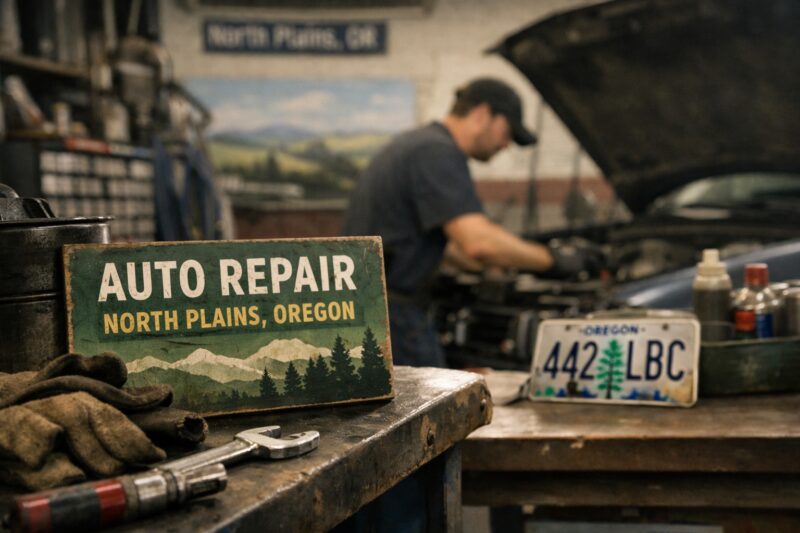
Advanced considerations beyond the basics: diagnostics, safety, and what most guides miss
Advanced auto repair decisions come down to diagnostic depth, safety-critical sequencing, and evidence-based confirmation before major replacements. In North Plains, the difference between a “fixed it” outcome and a repeat failure is often the shop’s diagnostic order.
For high-cost categories, ask how the shop will narrow down root causes. For electrical draw issues, they should outline how they will test for parasitic drain rather than replace parts blindly. For drivability and engine hesitation, they should connect your symptom to data (freeze-frame, live misfire data, fuel trims, ignition patterns) and verify vacuum or fuel delivery concerns. For ABS and traction issues, they should confirm wheel-speed sensor behavior and network conditions rather than assume a single module replacement.
Safety-critical decision points require a clear plan. Brakes and steering/suspension repairs should include measurement and inspection steps, not just replacement. Overheating repairs should identify the root cause (coolant flow, thermostat behavior, fan control, air pockets, hoses) rather than swapping one component and hoping for the best. Tire wear patterns can reveal alignment or suspension issues that, if ignored, lead to repeat tire replacement.
Complaint-to-confirmation mapping is where best shops stand out: they tie your complaint to test results. If a shop finds “no problem,” ask what “no problem” means—what checks they ran, what readings were normal, and whether they gathered video, sensor history, or test-drive data. Edge case: intermittent failures might require capturing conditions (recording voltage, observing under load, rechecking after a heat cycle), and a reputable shop will explain how they handle that uncertainty.
Repair sequencing matters. A smart shop addresses cause versus symptom: for example, verify charging and voltage stability before replacing sensitive modules that may have been damaged indirectly. Sequencing impacts cost and repeat failures because replacing downstream parts without fixing upstream causes can lead to immediate or eventual return visits.
When you want a framework to evaluate whether a shop’s diagnostic plan is thorough, the “auto service center checklist” can help you compare how different shops document safety-critical inspection steps and confirm repairs with evidence.
If you need reliable services around Auto Repair North Plains Oregon, choosing a shop that communicates clearly and stands behind the work can make all the difference. Before repairs begin, many drivers find it helpful to have an auto service center checklist ready so the conversation about symptoms, safety concerns, and parts is straightforward.
When you bring your vehicle in for an inspection, a good team will review what they find and explain the options without rushing you. Using an auto service center checklist can also help you keep track of recommended maintenance steps, answers to your questions, and the details that matter most for your budget and timeline.
As you compare estimates and ask about warranties, you’ll be better prepared for the kinds of questions that often come up next. In the FAQ section, you can expect clear guidance on scheduling, common troubleshooting, and what to ask before approving service.
Frequently Asked Questions About Auto Repair North Plains Oregon
How do I find reliable Auto Repair North Plains Oregon without overpaying?
Look for a shop that provides written evidence for diagnosis—scan data, measurements, and test results—not just opinions. Compare line-item estimates (parts grade, labor steps, diagnostic fee handling) and confirm warranty terms before authorizing work. If one shop’s quote is vague, it’s harder to compare fairly, which can lead to overpaying later.
Ask what diagnosis they performed, what test results support the recommendation, and whether they need your approval for any supplemental work. Confirm expected timelines, how you’ll be updated, and what warranty covers (parts and labor, duration, and exclusions). Also ask what would happen if the issue can’t be reproduced during testing.
Is it worth paying for a diagnostic fee at an auto repair shop?
In many cases, yes—diagnosis can prevent wasted parts and reduce repeat visits, especially for intermittent drivability and electrical issues. If the shop applies the diagnostic fee toward approved repairs, it often makes the diagnostic step more cost-effective. If your symptom is straightforward and the parts failure is obvious, diagnosis may be smaller, but you still want evidence-based confirmation.
Why does my check engine light stay on after a repair?
It can stay on if the root cause was not fully identified, if the repair addressed only the symptom, or if pending codes weren’t resolved. Sometimes the light remains due to incomplete readiness monitors or the need for additional clearing and rechecks after a test drive. Ask the shop for the exact code(s) present and the documentation showing tests passed after the repair.
What should I do if an auto shop’s estimate changes after the work starts?
Ask for updated line items and request approval before the additional work proceeds. Variance should be explained with specific reasons tied to evidence (for example, new test results during teardown). A reliable shop documents why costs changed and communicates it promptly using the agreed contact method.
Do I have to use dealer parts for repairs to keep my warranty valid?
In general, warranty principles typically allow you to use aftermarket or non-dealer parts as long as they are suitable and the repair is performed correctly. However, your warranty could be affected by the specific warranty terms of your vehicle and the repair you’re making. Keep receipts, part numbers, and documentation of the work so you can verify compliance if questions arise.
How long should common auto repairs take in 2026?
Typical timelines vary by parts availability and diagnostic complexity, but many common repairs fall into same-day to a few days once diagnosis is complete. Brake repairs might be quick when parts are in stock, while electrical or drivability issues can take longer because they may require repeated testing under different conditions. If the shop can’t estimate a realistic range, ask how they prioritize diagnosis and what triggers faster or slower turnaround.
What’s the difference between OEM and aftermarket parts for auto repair?
OEM parts are produced to the original manufacturer’s specifications, while aftermarket parts are made by other suppliers with varying quality and fitment standards. Aftermarket can be more cost-effective, but you should confirm compatibility, warranty terms, and the exact part specification the shop is installing. Ask how they verify fitment and whether they document part numbers and sourcing.
Can a mobile mechanic do the same diagnostic work as a full shop?
Mobile mechanics can often perform basic scan readings, battery/charging checks, and certain tests on-site, but limitations may exist for deeper diagnostics. Full shops generally have more equipment for teardown, lift access, and controlled testing. For complex intermittent issues or safety-critical work, a full facility is often necessary to confirm results with documentation.
What are the red flags of a bad auto repair shop in North Plains?
Red flags include vague estimates with no diagnosis evidence, delayed communication, refusal to provide written warranty terms, and pressure to authorize repairs before testing. Another warning sign is “we’ll just replace parts until it works” without explaining supporting test results. If they cannot document what they checked—especially for safety-related repairs—consider switching shops.
Conclusion
By the end of this guide, you should be able to choose an auto repair shop in North Plains with confidence: ask for evidence-based diagnosis, request written estimates with clear assumptions, and authorize only documented work. The transactional outcome you want is simple—compare apples to apples, understand what’s being replaced and why, and know exactly what warranty terms apply.
To avoid costly mistakes, prioritize communication and documentation. Don’t accept vague quotes, don’t rush past diagnosis (especially for intermittent or warning-light-only issues), and don’t base your decision solely on price. When estimates change, insist on updated line items and approval steps tied to specific findings.
Your next best move is practical: contact one or two shops in North Plains, ask the checklist questions, and request written estimates that include diagnosis evidence, parts sourcing details, labor line items, and warranty terms. If you compare those elements fairly, you’ll reduce the risk of repeat repairs and make a better decision the first time—exactly what drivers need when searching for Auto Repair North Plains Oregon.
For additional planning on how to structure shop calls and compare service transparency, you can also use the car-mechanic-near-me framework as a guide for what to ask and what documentation to request.
Updated May 2026